Tag: Thermodynamics

Ducts

Ducts

Ducts

09/28/17

“How can we direct the flow of air?”


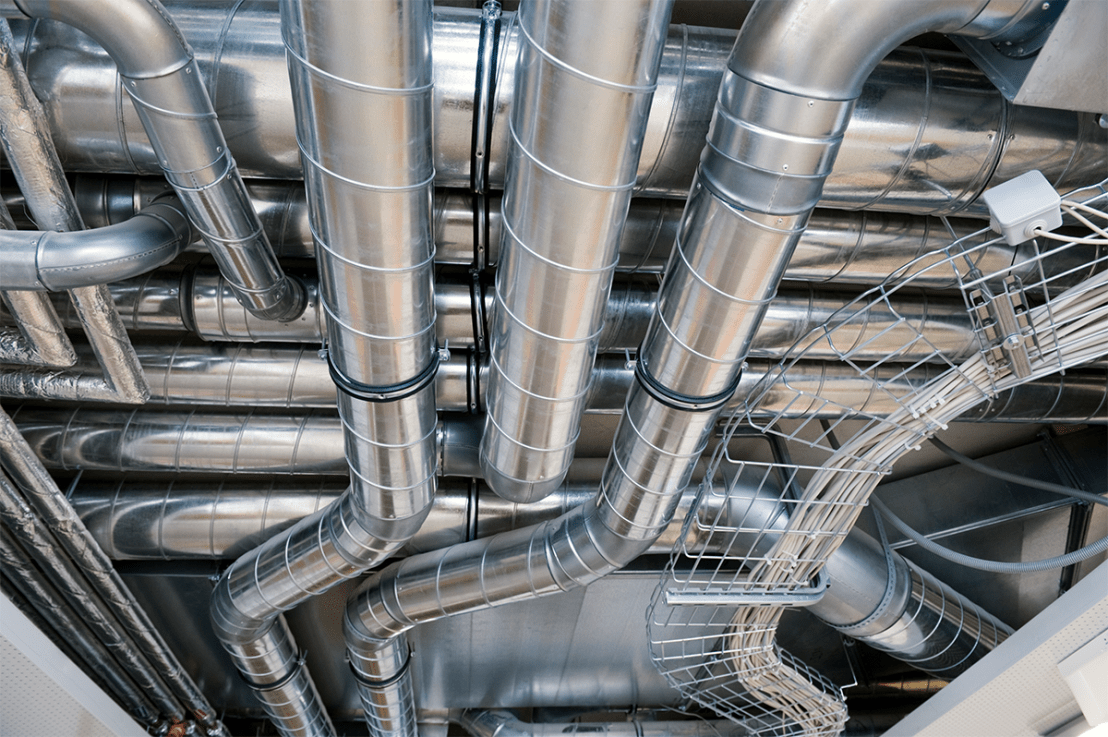
HVAC systems often rely on the flow of air for operation. However, since air is a gas, it can be very difficult to control. So how can we use our engineering mindsets to contain it? Well, let’s think back to some basic principles. We know that that gas is a fluid. And we already know that one method for transporting another type of fluid (liquids) is to use pipes. So what if we were to make a conduit that does this same exact mechanism except for gases? Well, it turns out that this system is actually one of the most widely used HVAC structures on the planet, and has been termed a duct by engineers.


Fan Coil Units

Fan Coil Units

Fan Coil Unit

09/26/17

“What is an affordable alternative to VAV systems?”


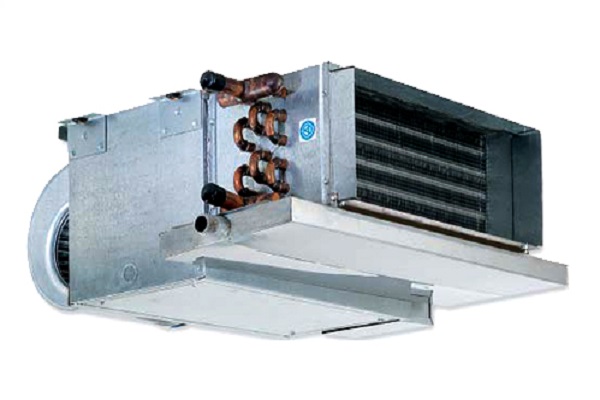
Variable Air Volume (or VAV) systems are great for controlling the weather in an interior space. However, these machines can be quite expensive, so how can we use our engineering mindsets to solve this problem? Well, let’s start with some basic components, a fan to move around air and a heat exchanger (also known as a coil) to control the temperature. With this combination, we can create an HVAC system called a Fan Coil Unit. Fan Coil Units are typically used in smaller buildings where ductwork is not as necessary and are popular in Italy and Eastern Europe.

Centrifugal Fan

Centrifugal Fan

Centrifugal Fan

09/25/17

“How can we use a fan to control gases?”


Most HVAC systems by moving around gases. However, materials at this phase can be quite difficult to control, so how can we use our engineering mindset to create such a mechanism? Well, we know that blades on a turbine react when a fluid passes through it, and through symmetry we can assume that a fluid will react to motor movement. So what if we were to construct something similar (like a motor) that would take in the gas, impart kinetic energy through its centripetal acceleration, and then change its direction by 90 degrees? Well, this is the fundamental idea behind a centrifugal fan and is one of the most fundamental components of modern HVAC systems.

HVAC Grilles

HVAC Grilles

HVAC Grilles

09/24/17

“How can we control the flow of air without spending too much money?”


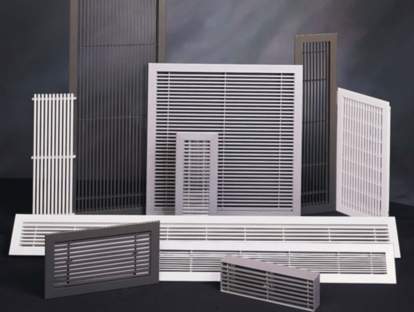
Directing airflow how many HVAC systems such as fans and air conditioners work. However, how can we do this in a safe and affordable manner? Well, let’s use our engineering mindset to solve this problem. Let’s start with basic physics. We know that if air passes through a cross-section of multiple vents, then the air molecules will be forced into a particular direction (while large objects would be blocked). So what if we were to attach such vents in front of an HVAC system? This setup is known as an HVAC grille and can be seen in the face of nearly every heating and cooling system.

The Compressibility Factor

The Compressibility Factor

The Compressibility Factor

09/23/17

“How can we quantify how much a gas deviates from its ideal form?”


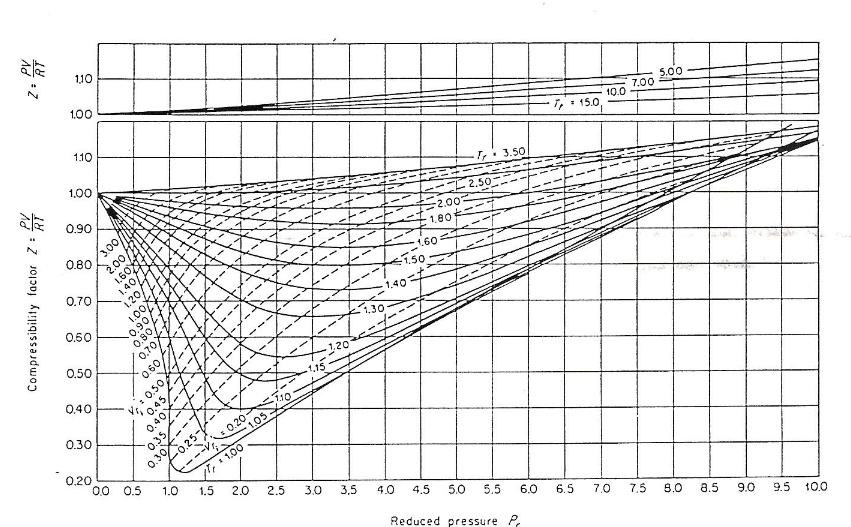
In introductory chemistry and physics classes, all gases are assumed to be completely ideal. However, in the real world gases usually are not so easy to work with. So how can we quantify a gas’ deviation from its ideal form? Well, let’s start from the basics. We know that all of the gas’s properties can be completely related to one another through the ideal gas equation p*v_specific=r*T. It would logically follow that if we were to divide the product of the pressure and the product of the specific volume by the universal gas constant times the temperature, we should end up with a ratio of 1/1.So what if we were to find out a gas’s specific volume, temperature, and volume of a gas in its non-ideal form, take their ration, and use that as a constant in a modified ideal gas equation? This is known as the compressibility factor and is commonly represented as z in the non-ideal gas equation p*v_specific=z*r*t.

Damper Controls

Damper Controls

Damper Controls

09/22/17

“How can we control an HVAC damper?”


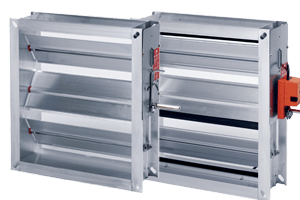
HVAC dampers are instrumental for controlling heating and cooling for buildings. However, since they are located in isolated air ducts, we will need to use some form of remote control to operate them. This is where damper controls come in. Damper controls allow for the angle of the ducts of a damper to be adjusted at will, inducing optimal living conditions.

Underfloor Air Distribution Systems

Underfloor Air Distribution Systems

Underfloor Air Distribution Systems

09/19/2017

“How can we optimize HVAC systems by completely reinventing them?”


Most HVAC systems operate by using ceiling-based air vents. However, the air funneled can suffer from low quality, induce low comfort, and most importantly give a high energy bill! So how can we use our engineering mindset to fix these problems? Well, what if we were to completely reinvent the paradigm, and instead funnel air directly from the ground? It turns out that this is the exact idea behind a technology known as Underfloor Air Distribution Systems. These systems work by filtering air through the open space between the structural concrete slabs on the floor of a building using plenums for direct cooling. Underfloor Air Distribution Systems are commonly implemented in data centers for their high efficiency and low cost.

The Strange Second State of Water

The Strange Second State of Water


The Strange Second State of Water

09/17/17

“Can water have a second liquid state?”


Water is a most peculiar molecular compound. Although this material composes over sixty percent of the human body and the vast majority of the Earth’s surface area, we still know very little about the chemical and physical properties and behaviors of this element. And this idea could not be better exemplified by a most recent discovery lead by a highly intelligent group of scientists.

At Oxford University, A group of physicists led by the postdoctoral research assistant Laura Martinez Maestro had decided to conduct a new experiment on water (Crew, Bec). For this, they took a sample of water at zero degrees Celsius and increased the temperature slowly until it reached one hundred degrees Celsius while measuring the thermal conductivity, refractive index, conductivity, surface tension, and the dielectric constant. Once the water hit, 40 degrees Celsius, its properties started to shift drastically, and once it had hit 60 degrees Celsius all of its properties had changed into something new. Specifically, the temperature of change was 64 degrees Celsius for thermal conductivity, 50 degrees Celsius for refractive index, about 53 degrees Celsius for conductivity, and 57 degrees Celsius for surface tension.

Why does this happen? Although everything seems murky at the moment, this phenomenon might be a consequence of the fact that water molecules only have a very weak bond with one another, and that the bond between oxygen and hydrogen is far greater than the hydrogen-hydrogen bonding. As a result, the molecular structure of  molecules is constantly changing and reforming, leading many to believe that this might be the cause for the strange second stage of matter


References

Crew, Bec. “Physicists Just Discovered a Second State of Liquid Water.” ScienceAlert, ScienceAlert, 14 Nov. 2016, http://www.sciencealert.com/physicists-just-discovered-a-second-state-of-liquid-water.

On water’s expansion with freezing

On water’s expansion with freezing

On water’s expansion with freezing

09/16/17

“Why does water expand upon freezing?”

The variation of volume with thermal energy for most liquids has a very simple characteristic. When heat is applied, the volume increases, and vice versa for cooling. This is because the added (or subtracted) energy will cause the amplitude of the vibrations of the molecules to change, thereby modifying the volume. For example, when a liquid freezes, the molecules will pack into one another, thereby shrinking the volume.

However, water exhibits a very peculiar phenomenon. When water is cooled to its freezing point, its volume will actually expand. Why does this happen? Well, let’s analyze it using our scientific mindset. Unlike most other molecules, water has a very unusual structure. Specifically, a water molecule’s primary form of bonding is based on hydrogen bonding. When temperature decreases, the strength of a hydrogen bond actually increases (since the lower thermal energy means that the hydrogen bonds will have less vibrational energy, therefore lowering the chance to shake out of position and increasing stability).

Once water is cooled into ice, the only bonding will be hydrogen bonding. Specifically, it will be bonded in a hexagonal structure, which is a much more “open” network than most structures. The tandem of hydrogen bonding and a hexagonal structure vastly decreasing the density (Levine, Scott 2013). And because density is described by the equation, with being the density,  being the mass, and being the volume, and as mass is constant, when the density decreases the volume must increase as a result. Consequentially, the volume of water increases upon freezing! This fact has multiple implications. For example, a lower density of ice means that ice will float in water, which allows for complex structures such as ice glaciers to occur naturally.


References

“Why Does Water Expand When It Freezes? .” FAQ: Water Expansion on Freezing, New York University, 3 Dec. 2013, http://www.iapws.org/faq1/freeze.html.