Tag: Physics

Transistor Saturation

Transistor Saturation

Transistor Saturation

03/11/18

“How can we get a transistor to pass current?”


Transistors are some of the most commonly used electronic devices in the world because of their ability to act like an electrically controlled switch. However, what exactly is it called when they act like an open circuit? Well, after many years of studying this, engineers and scientists have termed such an effect Transistor Saturation. Transistor Saturation occurs when the voltage difference between the base and emitter is around 0.7 volts and the collector and emitter is 0.1 volts.

Zener Diodes

Zener Diodes

Zener Diodes

03/03/18

“Is there a diode that can allow for current to flow in both directions?”


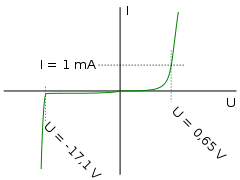
When you hear the word diode, you probably think of circuit elements that limit the current to only one direction. However, is it possible to have bidirectional current flow with a diode? Well, it turns out that there is something called a Zener diode which allows for exactly this! When Zener Diodes reach a certain critical value in the negative direction known as the Zener voltage, then a break will occur which will allow for current to pass through! As seen in the graph, the Zener voltage is much higher in magnitude than its positive equivalent. Zener diodes are commonly used in microelectronic system to regulate voltage.

Bioelectrical Resistance

Bioelectrical Resistance

Bioelectrical Resistance

01/23/18

“Can biological organisms resist electric current?”


Biological organisms have many properties. It turns out they also have some electrical resistance as well! This phenomenon is known as bioelectrical resistance and is usually caused by the exterior epidermis of organisms.


Isobaric processes

Isobaric processes

Isobaric process

12/17/17

“What is a thermodynamic process in which pressure remains constant?”


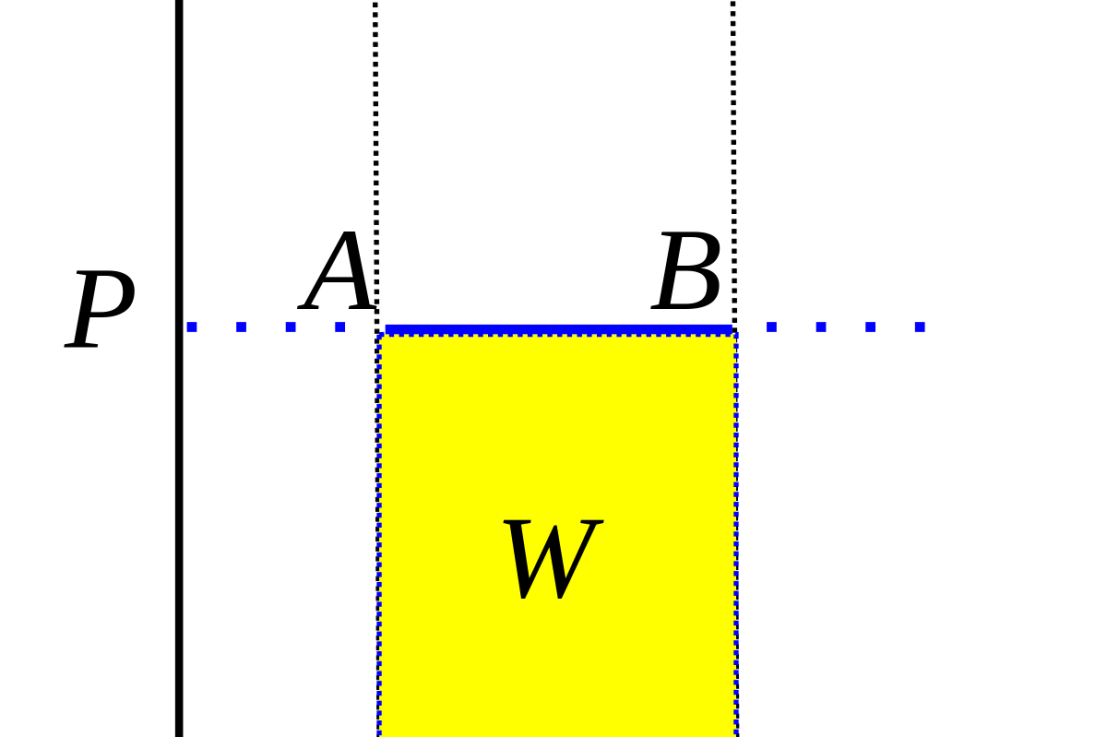
One of the defining features of a thermodynamic process is that the state of the system will change with time. However, in some of these processes, not all of the properties of a state will change. An example is Isobaric Processes, in which the pressure of a system will stay constant throughout the process. The work done under an isobaric process can be very simple to compute, being proportional to the change of volume W = P(v2-v1).

The Physics of a Hanukkah Dreidel

The Physics of a Hanukkah Dreidel

The Physics of a Hanukkah Dreidel

12/12/17

“How does a Hanukkah dreidel spin?”


Hanukkah dreidels are great fun for people of all ages. These little tops are able to spin round and round with a very peculiar pattern. However, why exactly do they spin? Well, let’s use our scientific mindset to find out. All spinning objects with mass have a property called angular momentum. The more moment of inertia it has and the greater spin then the greater angular momentum it will have. Angular momentum tries to be conserved so a dreidel will try to keep on spinning when acting upon!


Happy Hanukkah, and Happy Holidays to everybody!!!

Entropy Changes of an Ideal Gas

Entropy Changes of an Ideal Gas

Entropy Changes of an Ideal Gas

12/05/17

“How does the entropy of an ideal gas change with time?”


When an ideal gas undergoes a nonadiabatic process, it’s entropy is bound to change. However, how can we quantify such a change? Well, let’s use our engineering mindset to figure this out. One way would be to look at a thermodynamic property table, find the specific enthalpies for different temperatures, and then take the difference in values. Another way would be to plug in the equation delta s = C_v*ln(t2/t1) + R*ln(v2/v1) or delta s = C_p*ln(t2/t1) – R*ln(p2/p1).

The Compressibility Factor

The Compressibility Factor

The Compressibility Factor

09/23/17

“How can we quantify how much a gas deviates from its ideal form?”


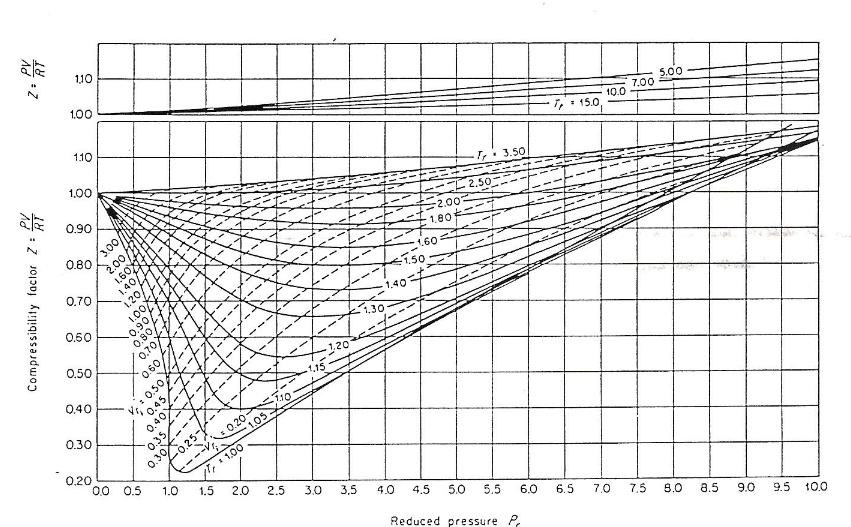
In introductory chemistry and physics classes, all gases are assumed to be completely ideal. However, in the real world gases usually are not so easy to work with. So how can we quantify a gas’ deviation from its ideal form? Well, let’s start from the basics. We know that all of the gas’s properties can be completely related to one another through the ideal gas equation p*v_specific=r*T. It would logically follow that if we were to divide the product of the pressure and the product of the specific volume by the universal gas constant times the temperature, we should end up with a ratio of 1/1.So what if we were to find out a gas’s specific volume, temperature, and volume of a gas in its non-ideal form, take their ration, and use that as a constant in a modified ideal gas equation? This is known as the compressibility factor and is commonly represented as z in the non-ideal gas equation p*v_specific=z*r*t.

Pulse-width Modulation

Pulse-width Modulation

Pulse-width Modulation

09/18/17

“How can we use a digital signal to control power appliances?”

Using sinusoidal analog signals for control applications has drawbacks. Specifically, the constantly changing signal can cause the resistors on a circuit to heat up and induce damage. However, how can we use our engineering mindset to fix this problem? Well, what if we were to replace this analog system with a discrete one operating at a duty cycle? That way we can imitate the perpetually switching signal while avoiding the issues that come along with it. This type of signaling is known as pulse-width modulation and is one of the fundamental ideas of modern control theory


The Strange Second State of Water

The Strange Second State of Water


The Strange Second State of Water

09/17/17

“Can water have a second liquid state?”


Water is a most peculiar molecular compound. Although this material composes over sixty percent of the human body and the vast majority of the Earth’s surface area, we still know very little about the chemical and physical properties and behaviors of this element. And this idea could not be better exemplified by a most recent discovery lead by a highly intelligent group of scientists.

At Oxford University, A group of physicists led by the postdoctoral research assistant Laura Martinez Maestro had decided to conduct a new experiment on water (Crew, Bec). For this, they took a sample of water at zero degrees Celsius and increased the temperature slowly until it reached one hundred degrees Celsius while measuring the thermal conductivity, refractive index, conductivity, surface tension, and the dielectric constant. Once the water hit, 40 degrees Celsius, its properties started to shift drastically, and once it had hit 60 degrees Celsius all of its properties had changed into something new. Specifically, the temperature of change was 64 degrees Celsius for thermal conductivity, 50 degrees Celsius for refractive index, about 53 degrees Celsius for conductivity, and 57 degrees Celsius for surface tension.

Why does this happen? Although everything seems murky at the moment, this phenomenon might be a consequence of the fact that water molecules only have a very weak bond with one another, and that the bond between oxygen and hydrogen is far greater than the hydrogen-hydrogen bonding. As a result, the molecular structure of  molecules is constantly changing and reforming, leading many to believe that this might be the cause for the strange second stage of matter


References

Crew, Bec. “Physicists Just Discovered a Second State of Liquid Water.” ScienceAlert, ScienceAlert, 14 Nov. 2016, http://www.sciencealert.com/physicists-just-discovered-a-second-state-of-liquid-water.