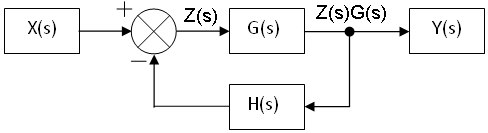
“What causes controls systems to change input to output?” All controls systems have an input (usually some sinusoidal wave) and an output (the wave modified either through addition, multiplication, differentiation, or integration). However, what exactly causes this mathematical change? Well, the key behind this is something known as the transfer function. The transfer function H(s) is defined as the ratio of the output function Y(s) over the input function X(s) (H(s) = Y(s)/X(s)). If we rearrange this formula, then we can see that the input function multiplied by the transfer function is equal to the output function (H(s)*X(s) = Y(s)).
“When does a transfer function go to zero or infinity?”
Transfer functions are usually made up of two polynomials, one in the numerator and one in the denominator. When the polynomial in the denominator (known as the pole) goes to zero, the transfer function will become infinitely large, while when the ones in the numerator go to zero, the function becomes a zero (hence the term zero for such functions). If a transfer function has more poles, then it becomes more unstable, while more zeros will make it more stable. Because of this, controls engineers try to maximize the pole-to-zero ratio.
“How can we predict how a system will react based on how it reacts right now?” When working with control systems, we often have some desired output in our mind. However, frequently the actual performance of our systems diverges greatly from what we want. So how can we use our engineering mindset to correct this problem? Well, let’s think about it. We can tell a computer how we want a certain system to behave. And we can also create a log of its outputs. So what if every time we gave an output, we took its data, compare it to our desired, and try to minimize the difference with the next iteration? Well, this is the fundamental idea behind model predictive control and is used in industries spanning from building controls to renewable energy to intelligent transportation systems!
“What houses the controls for cyber-physical systems?”
Mechatronic systems require controls software in order to function correctly. However, how is this implemented physically into the system? Well, let’s use our engineering mindset to find out. We know that microcontrollers can perform simple controls tasks. So what if we were to hook a number of them together and program them with software to make a controls unit focused on one task? Well, this piece of technology is known as an embedded system and can be found in electro-mechanical operations worldwide. Examples of embedded systems include braking systems in vehicles, thermostats, and the motors on NASA’s Mars Curiosity Rover!
“Can we make a computer from just a single integrated circuit?”
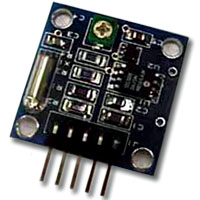
Modern day computers are complex behemoths, employing dozens of integrated circuits to perform computational work. However, is it possible to have much simpler computers that only work with one integrated circuit? Well, it turns out that not only is this possible but that such machines can be seen every day in the form of microcontrollers. Microcontrollers are simple computers that are used for mechatronic control tasks, whether it be in dictating the motion of servo motors for robotic manufacturers or in controlling electric braking systems. Microcontrollers are easily purchasable and have a large number of dedicated hobbyist followers.
“How can engineers control the temperature of machines?”
Machines do a lot of work. Whether it be an assembly robot making a solar panel or a spacecraft launching into space, work is done. However, these machines often need to operate within a certain temperature range. So how can we ensure that our engineering systems can be kept within their safety zone? Well, let’s use our engineering mindset to find out. We know that we can use sensors to monitor the temperature and that we can also use devices to change this temperature. So what if we were to simply implement this? Well, this is known as a thermal control system and can be found in mechatronic systems all over the world.
In the modern world of engineering, devices and processes are no longer operated in a purely mechanical format. Instead, they now have a network of sensors and actuators that allow for programmable movement and operation. However, what exactly causes these systems to move? Well, after many years of incremental development, engineers have designed something known as control systems to manage all operations. Control systems are the programmable logic that allows engineering systems to operate. Engineers that work with control systems are known as control systems engineers.
As it stands, the vast majority of propulsion machines are based upon fuel combustion technologies. However, this approach is costly, wasteful, and dangerous. So how could we make a new propulsion approach that requires no fuel? Well, let’s use our scientific mindset to find out. We know that when an electric current passed through a conductive material immersed in a magnetic field, it will experience a Lorentz force. So what if we were to use this force to cause objects to move? This is the fundamental idea behind electromagnetic propulsion, and can be used to power machines ranging from linear motors to the astronomical electromagnetic propulsion drives!
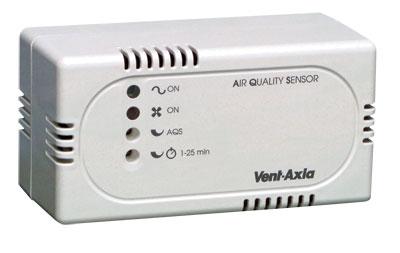
With the advent of industrialization, air pollution has become a significant issue in many parts of the world, inducing grievous health issues and productivity impairments. As such, governments and independent organizations are taking action to reduce this nefarious trend. However, before we can take steps to eliminate pollution, we must first know how much needs to be eliminated. To do this, engineers have developed air pollution sensors which can analyze the atmosphere for certain elements (ozone, particulate matter, carbon monoxide, sulfur dioxide, and nitrous oxide) for human analysis



 Isaac's Science Blog