Tag: Mechanical Engineering

Solar Air Conditioning

Solar Air Conditioning

Solar Air Conditioning

12/23/17

“How can we have solar powered air conditioning?”


Solar PV is set to take the world of residential energy by storm, with its low-cost and emission-free technological prowess. However, it currently faces one serious bottleneck, HVAC systems. HVAC systems consume tremendous amounts of energy, and an affordable solar system powerful enough to run it could prove expensive.


Or at least it used to be.


With the advent of higher efficiency AC systems and cheap PV, Solar Air Conditioning is more science fact than science fiction. Solar AC not only has the potential to save on a voluminous emission load but also energy bills. With this milestone reached, expect even higher adoption rates of residential PV!

Pyrheliometers

Pyrheliometers

Pyrheliometers

12/22/17

“How can we measure direct sunlight irradiance?”


One of the most important things for an area’s solar energy potential is the amount of direct solar irradiance. However, how can we measure this? Well, let’s use our engineering mindset to solve this. First, let’s make a portable apparatus. Then, let’s put a window in this device such that sunlight can be collected. Let’s then focus this slight onto a thermopile, and convert the heat generated into an electrical signal which can describe the power incident on the panel. This machine is known as a pyrheliometer and is vital for measuring solar energy.

Thermal Power Stations

Thermal Power Stations

Thermal Power Stations

12/21/17

“What type of facility can convert thermal energy to electrical?”


Energy can be generated in a wide multitude of methods. However, (and perhaps unfortunately) the most popular method is to heat an energy dense material to boil water into steam to drive a turbine. This facility known as a Thermal Power Station. Thermal Power Stations usually operate under a Rankine Cycle and can run on multiple types of input such as coal, petroleum, and municipal waste.

Cooling Towers

Cooling Towers

Cooling Towers

12/20/17

“How can we cool a large flow of water?”


Water is often used to cool buildings. However, during the process, it absorbs heat from its surroundings, thereby warming it up and making it less usable for future use. So how can we ensure that this water can be cooled down to usable levels? Well, let us use our engineering mindset to find out. We know that if water comes into contact with surrounding air, it will cool down a bit, and some may even evaporate. So what if we were to take our stream, move it through condensers, causing some to evaporate and the rest to cool down to a workable state? Well, this technology is known as cooling towers and is used in industrial processes all over the world.

Head Loss In Fluids

Head Loss In Fluids

Head Loss In Fluids

12/19/17

“How do fluids lose potential due to viscosity?”


Understanding of fluids has led to some of the most important breakthroughs in engineering. However, when analyzing these systems, it is very important to take into consideration that viscous forces will act upon the fluid in transit. So how can we take this into account? Well, what if we were to just take into account all of the losses from both frictional and inertial changes? This is known as the head loss in fluids and is one of the most important foundations of one’s study of fluid mechanics. Head loss can be visualized by the pressure drop in a manometer like the one shown in the picture.

Isobaric processes

Isobaric processes

Isobaric process

12/17/17

“What is a thermodynamic process in which pressure remains constant?”


One of the defining features of a thermodynamic process is that the state of the system will change with time. However, in some of these processes, not all of the properties of a state will change. An example is Isobaric Processes, in which the pressure of a system will stay constant throughout the process. The work done under an isobaric process can be very simple to compute, being proportional to the change of volume W = P(v2-v1).

California Title 24

California Title 24

California Title 24

12/17/17

“What is the official building energy efficiency standard for California?”


In the U.S, most building efficiency standards are regulated by ASHRAE 90. However, some states go a little bit further with their regulations. In California, a series of codes known as Title 24 is the law of the land. Title 24 contains all of the specifications that a construction firm must consider before going through with a project. These include a requirement for LED lights, motion sensors for buildings, a specified minimum reflectivity for roofs,  electrical service panels for disaggregated measurement, and many other variables. California Title 24 is updated every 3 years such that the next set of rules saves more energy than the last.

Energy Recovery Ventilation

Energy Recovery Ventilation

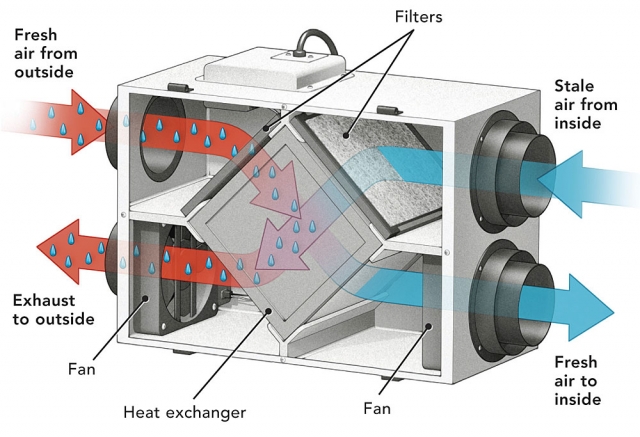
Energy Recovery Ventilation

12/15/17

“How can we use stagnant building air to do something productive?”


When air is trapped inside a building for too long, it can become unhealthy and stagnant. However, could we possibly use our engineering mindsets to do something productive with this? Well, we know that heat exchangers can be used to make use of any fluids. And oftentimes, incoming air into buildings is suboptimal. So what if we were to use a heat exchanger to cycle the external air with the old interior air to keep our building fresh? This system is known as  Energy Recovery Ventilation and holds much promise for the future of the HVAC industry.

Building Integrated Photovoltaics

Building Integrated Photovoltaics

Building Integrated Photovoltaics

12/13/17

“How can we directly integrate photovoltaics into a building?”


Solar photovoltaic panels have revolutionized energy as we know it. And since buildings are some the highest consumers of energy, it would only be logical that panels be applied to them. But PV systems can be big and clunky and take up a lot of room.


Or do they have to?


Novel breakthroughs have resulted in the creation of a technology known as Building Integrated Photovoltaics (BIPs). These systems are directly integrated into the building envelope, allowing for much more flexible use. They can be put directly on rooftops, applied to the sides, or even constructed as transparent windows! However, there are numerous factors to consider when using building integrated photovoltaics. Shading may occur from other edifices, there may be deposition from weather, and a proper tilt angle depending on the geographic location must all be considered. Despite this, BIPs are an excellent foray for humanity into greater sustainability.