Tag: Electromagnetism

Joule heating

Joule heating

Joule heating

07/09/16

What effects does dissipated current have on a wire?

Let’s think about something. When particles move through a conductor, we know that they do not move in a straight line, but instead in a semi-random and chaotic pattern of colliding off the walls of the material. During the collision process, some of the kinetic energy of the electrons is converted into thermal energy inside the conductor. After a while, this process (Which scientists and engineers have termed joule heating) will have a macroscopic effect on the temperature of the material. We can quantify Joule heating by using the formula H = k* I^2 *R * T, where H is the heat, K is a constant I is the current, and R is the resistance of the material. One very pragmatic application of joule heating is in a technology that we all know of, the incandescent light bulb. The increased temperature of the filament in the light bulb causes it to glow, which gives off light to the surrounding area.

Ionic bonding

Ionic bonding

Ionic bonding

07/05/16

“What happens when ions of opposite and equal charge react?”

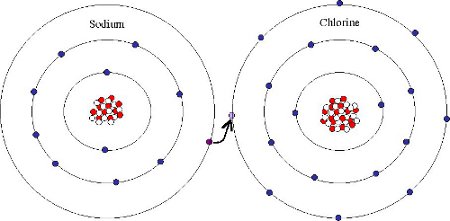
Let’s think about something. We know that ions are atoms with a net electric charge. We also know that when a positive and a negative charge are close to each other, there will be an electric force that pulls them together. So what happens when ions with charges of equal magnitude and opposite sign come within the vicinity each other? Well, if we use our own scientific intuition, then we would know that there will be an attractive force between the objects, causing them to be pulled together. These atoms will form a bond which chemists have decided to term an ionic bond. Ionic bonds are between metals and non-metals, are very hard to break (often melting only at high temperatures), and can be conductive when they are in liquid form.

Electric conductivity

Electric conductivity

Electric conductivity

06/30/16

“What are the properties of materials that conducts electric current and how can we measure it?”

When pondering electrical insulators, many may wonder if there are any anti-thesis to such materials? Specifically, what are some properties of objects that conduct electricity? And how do they do so? First off all, we must think about how electric current works in the first place. Electric current is caused when a voltage potential difference interacts with the free-moving electrons within a lattice. These particles, being weakly bonded to their structure, are carried away in the direction of the potential difference. So logically, all current conducting materials (which will henceforth be referred to as conductors) must have an internal lattice with electromagnetic bonds that are not too powerful, and a path for electron travel.

With this knowledge, we can then delve further in to what geometric factors may affect the conductivity. If the cross-sectional area of the object is larger, then that means that the electrons have a greater area to travel through (remember, electrons do not move in a straight line, they bounce around the internal structure, so when the area gets wider, they have more room to move, which means less traffic and therefore less collision and therefore less resistance). Secondly, if the Length is longer, then there will be more internal resistance, which would lead to a slowdown.

After much research, scientists and engineers have come up with an analytic model of conductivity, with the equation G=(alpha)*A/L, with G being the capacitance, (alpha) being a constant, A being the cross sectional area, and L being the length. What’s even more interesting is that this relationship is directly inverse to the equation for  resistance! This is an amazing technical feat, because this means that human ingenuity was able to find a fundamental relationship between the resistance and conductivity of a material.

Electric insulators

Electric insulators

Electric insulators

06/29/16

“How do we classify materials that do not let charge flow freely?”

For most of our study of electromagnetism, we have been studying materials that allow electrons to flow freely. But out of curiosity, are there materials that do not allow such a free movement of electrons? If these materials do in fact exist, then trying to induce an electric current to flow through them would be futile, as the electrons would not even budge. Believe it or not, these objects do in fact exist, and scientists and engineers  classify these materials as insulators. Insulators have many pragmatic purposes, such as dielectrics and high voltage systems.

Supercapacitors

Supercapacitors

Supercapacitors

06/26/16

“Are there capacitors that can store much more energy than average?”

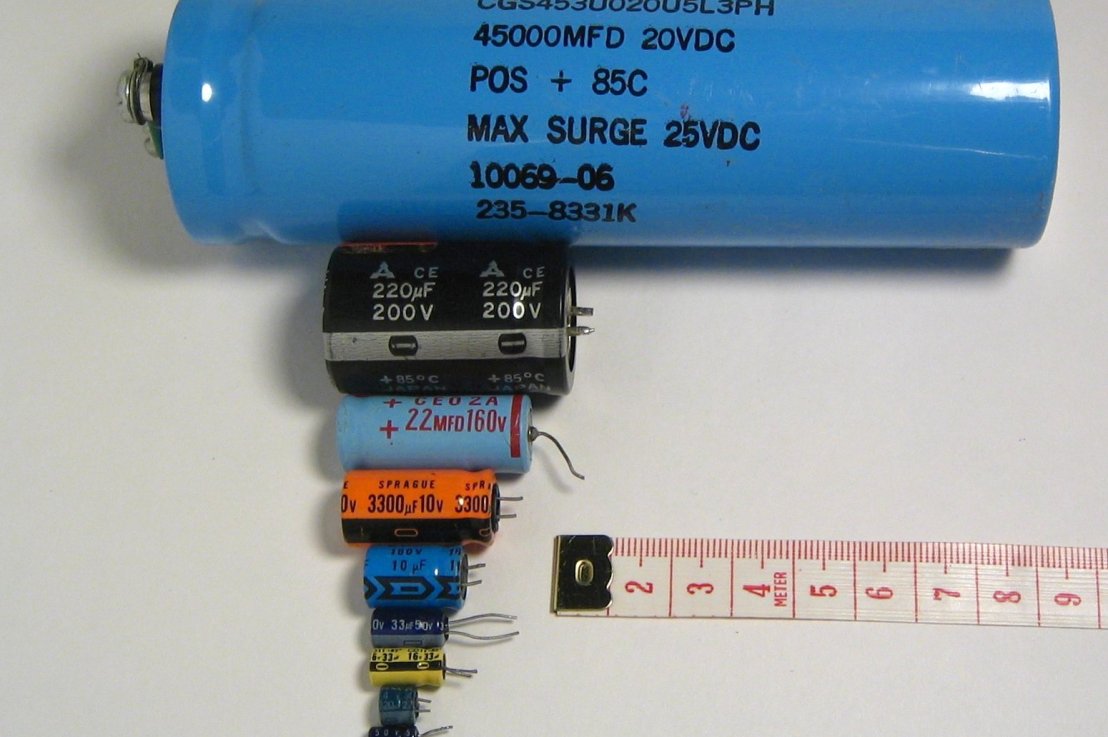
Let’s think about something. With the advancement of technology, new ways to store sufficient energy for machines needs to be introduced. One way we can do that is by identifying an existing concept and modifying it suit our needs. Let’s take capacitors. they’re simple, useful, and have a lot of potential for applications. One of the main bottlenecks with capacitors is that they can only store so much energy. Specifically, most capacitors are rated in Microfarads, (one farad = charge/voltage, or the ratio of charge to voltage). This means that with a certain voltage only a very tiny amount of charge can be stored (specifically, one microfarad means that it would take one million volts to store one coulomb of charge).

Now, how could we modify capacitors to store a higher density of charge? Well, as discussed earlier, the capacitance of a capacitor is proportional to the area of the plates divided by the distance between them, so what if not only we used special materials, but we also used very large plates separated at a very small distance? Scientists and  engineers have termed such an invention supercapacitors. Supercapacitors can have capacitance values usually rated in the farad level, or one million times the ratio of noraml capacitors! This means that such inventions can store much more energy than.Supercapacitors (also known as ultracapacitors) have many applications, ranging from being used as a storage medium for regenerative braking systems to Defibrillators. In fact, supercapacitors are deemed to be so practical that major that major transportation networks such as the Portland MAX are starting to use them 

Practice of Capacitors

Practice of Capacitors

Practice of Capacitors

06/25/16

“How can we apply capacitors to accomplish practical tasks?”

Capacitors have many uses in application. The most common utilization for capacitors is to store energy. Energy can be stored within the electric field of a capacitor, and this energy can continue being stored even if the battery has been disconnected! Capacitors also have a very quick discharge time (often only in the milliseconds) so they can serve as a quick battery. Capacitors can also be used a sensors, accomplishing tasks such as measuring the fuel levels in an airplane. However, one of the most powerful uses of a capacitor is to be a low pass filter. Since the resistance of capacitors in an AC circuit increases inversely proportionally to the frequency of an object, a low frequency current will be hampered by the filter, which means that a minimum threshold of frequency must pass through.

Mechatronics engineering

Mechatronics engineering

Mechatronics engineering

06/21/16

“What is the future of engineering?”

Day by day the nature of engineering is changing. It seems that as time goes on, all of the myriad of different disciplines of engineering seem to be coming closer together, almost like how trees that grow near each other slowly but eventually merge. Processes that used to be solely governed one field are now an intersection of many others. For example, automobile transportation used to be completely under the control of mechanical engineers, but with the advent of computer technology, cars now have a multitude of “smart” systems to account for greater control of the vehicle.To account for such change, an entirely new branch of engineering called Mechatronics Engineering has emerged to analyze and explore such intersections. Specifically, mechatronics focuses on the interactions between mechanical, electrical, computational, and control systems. A mechatronics engineer would take their knowledge about these systems and then apply it to create an entirely new machine. Examples of mechatronics technologies include industrial robots, rotary actuators, linear actuators, servos, and regenerative braking systems. The future of mechatronics is quite exciting, as digital systems become ever more integrated with mechanical equivalents.


Electric motors

Electric motors

Electric motors

06/20/16

“How can we use electric energy to create mechanical motion? ”

Given that energy is a conserved quantity, isn’t logical that energy in one form could be transformed into energy of another form? And since two of the most used forms of energy for human civilization is electrical and mechanical energy, wouldn’t it be useful if we can convert from one to another? This is the basis behind an Electric motor. Principally, an electric motor performs one simple function, it uses electrical energy to create mechanical motion.  Because they perform such a useful function, electric motors are one of the most prolific inventions of the human race. In fact, they are the most used electrical machines on the planet! Motors can be found as components in a wide range of machines, varying from regenerative braking systems to electric fans to rail transportation. Because of this, there are many types of electric motors, ranging in all types of technology.


Regenerative braking

Regenerative braking

Regenerative braking

06/16/16

“Is it possible to convert the energy used by the breaks of the car into something useful?”

Motorized transportation manufacturers have always had to deal with braking systems. One annoying aspect of friction-based technologies is that all of the kinetic energy leaves the system once the motion has to come to a stop. However, wouldn’t be really practical if we transfer this energy somewhere else?  This is the basic idea behind regenerative braking.

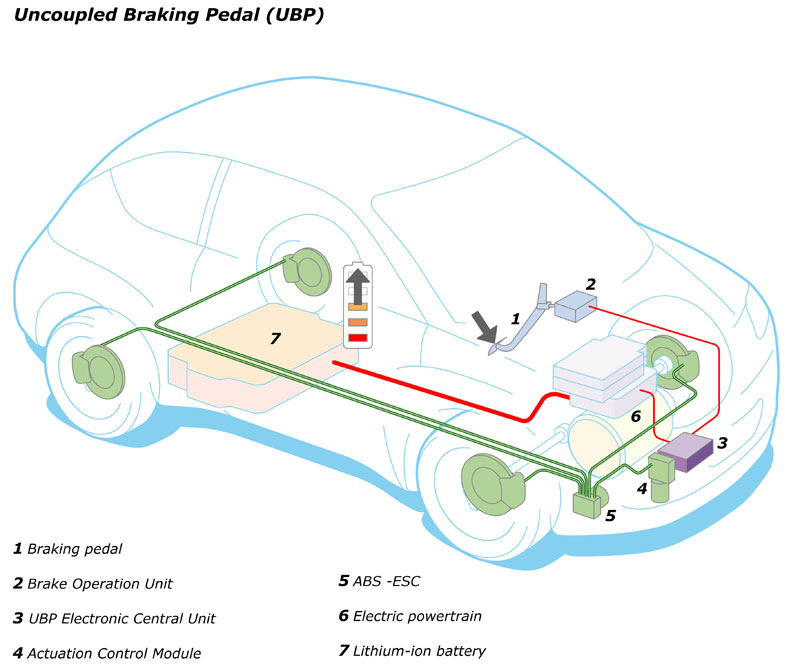
In automobile systems, an AC motor is used to transfer energy from the car’s battery into the motion of the wheels. However, once the brakes are activated, the motion of the car’s wheel will reverse. This effectively transform the systems from a motor into a generator, with the new motion causing the current the flow in the opposite direction, therefore charging the battery! Even with an efficiency of only around 20%, the extra energy can be used to allow hybrid engines to have better mileage or allow electric cars to go farther

Regenerative braking systems are controlled by regenerative braking controllers. The regenerative braking controllers monitor how fast the vehicle is moving and how much torque is able to generate electricity to be fed back into the batteries. This information allows the controller to decide to if the speed is to high for the regenerative braking system to handle (in which case the old-fashioned friction braking system will take over).

In summation, regenerative breaking is an ingenious technology that uses creative ways to recover power. In fact, these machines have been found powerful enough to convince companies and organizations such as Tesla and the New Dehli metro to implement them in their products!