Tag: Electromagnetism

Motor armatures

Motor armatures

Motor armatures

08/21/16

“What component causes an electric motor to spin?”


We know that Electric motors have two main mechanical parts, a stationary stator that encapsulates a rotating rotor. Now, how is this rotation induced? Well, in addition to having the aforementioned two mechanical components, electric motors has two electrical components. The first electrical component is called the field, which is simply the magnetic field component inside the airgap. This field will turn the armature, which is the primary power producing component in the motor. The armature carries current that is oriented perpendicular to the magnetic field, which in turn will induce a force which will cause a torque to take place. The armature usually consist of several conductive windings for this effect to happen. The field and the armature can be on either on the rotor or the stator but one must only occupy one other.

Resistor coloring

Resistor coloring

Resistor coloring

08/20/16

“Why do resistors have different colors?”


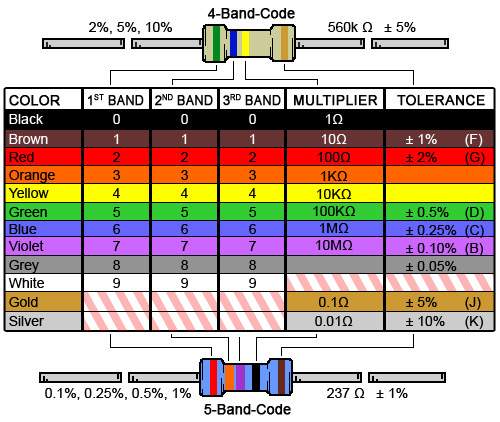
When looking at resistors, you might notice that they seem to have different colors. Four in fact, all in different bands. What do they mean and what do they imply? Well believe it or not, this different resistor coloring corresponds to different resistance values. This means that users such as yourself can easily find the resistor they require just by looking at the band colors.

The first band (called band A) represents the first figure, the second one t(band b) represents the second figure (some more precise resistors may have an extra band to indicated a further figure), the third band the Decimal multiplier (meaning how much this figure  constructed by the earlier bands will be multiplied by), and the final band represents the tolerance percentage (no band means a 20% tolerance level). A chart of the colors and the corresponding values can be found in the picture above

To get a better idea about how this works, let’s do an example. Let’s say that you find a band with the first band colored gray, the second band colored blue, the third green, and the final one red. This resistor will have a value of 86*10^5 ohms, and a tolerance of +-2%. Now go out there, find yourself some resistors, and try to apply these rules to try to estimated the values!

Series and Parallel

Series and Parallel

Series and Parallel

08/18/16

“How can different elements in a circuit be hooked up and what are the effects on current?”


When studying electronics, one might wonder, “What are the different ways that we hook up different resistors in a circuit, and how do they affect the circuit current itself?”. Well, let’s think about it.

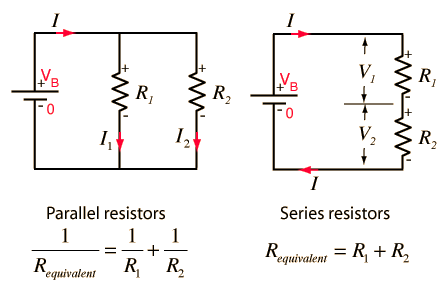
One way we could hook up everything is to directly connect each element in series. This way, the voltage from the power source will pass through each individual part, giving an associated drop at each one. Due to the fact that they are all directly connected, each resistive element will have the same current pass through it. This makes calculating the final current easily, because we can solve symbolically as follows. Let’s say we have a circuit with 3 resistors, all of different values R1, R2, and R3. Each one of them will have the same current I. Because the voltage drop through all of them combined must be equal to the total voltage V, we can construct the algebraic equation I*R1+ I*R2 + I*R3=V. Due to a common factor of I, we can simplify this equation to be I*(R1+R2+R3)=V. We can then divide the voltage by the total resistance to find the current I = V/(R1+R2+R3). This pattern holds for any number of elements in series. Let’s do a numerical example to cement our knowledge. Let’s take R1=1 ohm, R2= 2 ohm, R3 = 3 ohm, and V = 12 volts. If we do our math right, then we should end up with I=12/(1+2+3) → I=12/6 → I = 2 amps.

Another example that we could do is to to elements, hook them up directly to the voltage source, but do not directly connect them, only have them in parallel. Let’s work out the framework for these paradigm. Since each element is directly hooked up the voltage source, not only must it provide a current to go through each element, but the voltage drop must be the same as the voltage source. So how can we find out the current? Well, it’s actually surprisingly simple. First we must notice that each of the elements obtain an individual current, corresponding to the voltage divided by the resistance, or v/r. We must then notice that the total current I will be all of the individual currents added up, I = V/R1+V/R2+V/R3+….Then, since there is a common factor on each of these elements V (as I = V/R), we can divide everything by the Voltage V, to obtain I/V=1/R1+1/R2+1/R3+… , and if we simply notice that I/V is equal to the inverse of the total resistance Req, we can then represent this equation as 1/Req=1/R1+1/R2+1/R3.. We can obtain an equivalent resistance for all of the elements in parallel, and find the total current by setting it equal to the total voltage or I=V/Req, and find our answer! As one can observe, and a parallel setup, the more elements one adds, the higher the current will be, because all of those elements will need to be supplied with the same voltage drop

Electric arcs

Electric arcs

Electric arcs

08/04/16

“What are those electric discharges that I see in highly ionized gasses?”


You might be curious what exactlymakes welding work. Well, it turns out to be very simple. All that is going on is that there is a continuous, high density electric current that passes through a gas or vapor with a relatively low potential difference across the conductors. This allows for the high intensity of heat that is used for engineering applications such as welding

Electrical resistors

Electrical resistors

Electrical resistors

08/14/16

“What causes electrical resistance?”


When working with circuits, you have probably read about how resistance causes a current to slow down. However, what causes this resistance, and how does it work?

Well, these items are simply called resistors. Resistors are simple by construction, being only a ceramic round surrounded by a winding of copper. Resistors are able to causes an impedance to current flow by dissipating power, with the power loss being equal to the square of the current times the resistance, which can be represented analytically as P=I^2*R. Some resistors actually have an adjustable resistance. The surrounding heat can have adverse effects on the resistivity of a resistor, however, some resistors are designed to apply this heat for their daily functioning.

Why do light-bulb filaments go out?

Why do light-bulb filaments go out?

Why do light-bulb filaments go out?

08/13/16

“Why do light-bulb filaments go out?”


We all know what electric light bulbs are and what they do, they are some of the most omnipresent devices in human civilization. However, have you ever wondered why they die out? Well, let’s think about it like an engineer

For a quick review, light-bulbs work by pushing a current  through a tungsten filament. This filament acts as a resistor, absorbing current as heat and giving off light. However, as this filament gets used more and more, this filament will become damaged and brittle from effects such as thermal expansion and joule heating, especially during the initial starting phase (in fact, light-bulbs actually last longer if they are kept on permanently). Eventually, this filament will wear out, and the light bulb will be rendered useless. Light bulbs take up so much power, that up to 24 percent of a home’s electricity bill is used for lighting!

Battery lifetime

Battery lifetime

Battery lifetime

08/11/16

“What factors determine a battery’s lifetime?”


What is one of the most important things to consider when purchasing a battery, besides things such as cost, size and type? Why, it would be the lifetime of course. The lifetime of a battery depends on multiple factors. First of all, the temperature of the storage area matters. If the battery is kept in a room at room temperature, then internal reactions will occur, causing self-discharge, which results in a shortened battery life, typically 8-20% of the original lifetime. In order to prevent this, one should keep batteries inside colder areas, as that would slow down all internal reactions. In addition, for renewables, overcharging a battery can lead to internal damage, which can  cause internal decimation and therefore shorten their lifetime. Also, having the battery over discharge can cause drainage.

Batteries

Batteries

Batteries

08/10/16

“What are batteries?”


We learned about how galvanic cells are able to create a voltage difference through the use of chemistry. But a single galvanic cell can only provide a low voltage, and humanity requires alot of power, so how can we take this concept and expand upon to make it practical for common usage? Well, how about we just simply take  bunch of galvanic cells and hook them up in series? If we do that, then we will create a machine with a title that you are probably very familiar with, a battery. The batteries that we use everyday are simply devices that use chemical differences to create a voltage. Batteries come in two types, disposable and rechargeable. Disposable batteries are batteries that have a limited chemical supply and stop working once depleted, while rechargeables allow a current to flow in the reverse direction when plugged in to regenerate the battery (however, due to the second law of thermodynamics, each recharge will wear down the capacity of the battery)

Rectifiers

Rectifiers

Rectifiers

08/08/16

“How can we turn AC electricity into to DC?”


After studying how inverters can turn DC electricity in to AC, you might be wondering, “Can the inverse happen?, and if so, how do we accomplish it?”.

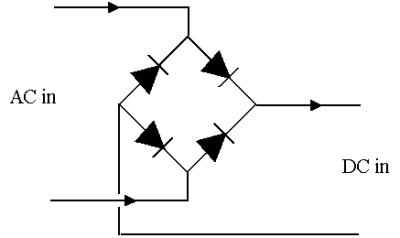
Well, let’s think about it. We know that the primary principle of AC electricity is that it switches the direction of current through a circuit at a certain time interval. However, if we add a diode in to this circuit, then the current will only be able to flow in one direction. Through this we would come much closer to our goal of DC electricity, with the current flowing in only one direction. However, a drawback of this solution is that the voltage and therefore current would be zero for half of the time it operates. A quick fix to this problem would be to use four diodes instead of one. With this setup, no matter which direction the current is in, there will be a voltage across the output. To further improve this device, we can add a capacitor, so when the voltage changes the capacitor absorb some of the moving particles, therefore balancing out this change.