Tag: Electrical Engineering

Smart grid

Smart grid

Smart grid

12/28/16

“How can we advance the grid into the 21st century?”


The grid as we known it is heavily outdated. When the grid was first conceived of a century ago, the users lived in heavily localized areas, and often only had a few electrical needs, often all electrical appliances could be counted on one hand. However, as just as how electrical technology has matured in an exponential fashion, so has the complexity of the systems, resulting in a strained communication with the grid. We now have dozens if not hundreds of vastly more complicated items being used, each carrying different power requirements, with more being added at a superfluous rate. This is causing grave impingements on our grid, which could lead to pure devastation. So how can we apply our engineering mindset to take our aging electrical infrastructure into the 21st century? Well, why not just implement a two way grid communication system, also known as a smart grid? The fundamental idea is that all electrical signals from this new grid will be monitored and regulated by computer technology. To illustrate, a smart grid will be able to analytically distribute the voltage of electricity to units that require more of it, while supplying less to less intensive units. A smart grid will also be able to integrate more efficiently the sinusoidal nature of renewable energy sources like wind and solar through this monitoring technology. Smart grids are a foresightful investment, and will truly be the technology of the future.

The electrical grid

The electrical grid

The electrical grid

12/27/16

“How exactly do we obtain our electricity from power plants?”


It is very well known that humanity generates large amounts of electricity using power plants, and then consumes it for their appliances, whether it be residential or industrial. But how does this raw power get transferred? Well, it turns out that this system is in fact the largest machine our civilization has ever built, the electrical grid. The electrical grid is the summation of all of the power transmissions systems which take in energy from a generation source and transport it to our appliances. The electrical grid primarily uses high voltage transmission lines and step-up transformers to accomplish this task.

Energy density and it’s importance

Energy density and it’s importance

Energy density and it’s importance

12/02/16

“How do scientists and engineers measure the density of energy within a system and why is it important?”

Energy is a quantity that is used omnipresently for calculations in all branches of science and engineering. However, energy is more than a theoretical abstraction, and since it is tied to the material universe, it must be stored somewhere in reality, such as in objects. And since objects of the same size can have different abilities to hold energy , we will need some conceptual way to understand this. As a result, scientists and engineers have developed the concept of energy density to represent the amount of energy stored within in object. Energy density is an important concept because when analyzing energy storage mechanisms such as batteries and capacitors, once must take in to consideration the volume vs power limitations that a project might have. To illustrate, let’s say that you want to build an autonomous boat. Since this boat will have no people on board, it will need a mechanism to power it’s systems. However, the boat can not uphold too much weight, or else it will sync. Therefore, when designing such a contraption, engineers will have to choose an energy storage technology with a high energy density.

Ohm-meter

Ohm-meter

Ohm-meter

11/27/16

“How can we measure the resistance in an electronic component?”


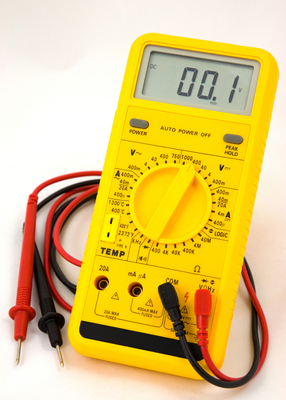
Electronic structures such as resistors play a vital part in the workings of electrical devices through the use of resistance. However, how can we measure such a phenomena empirically? Well, let’s use our engineering mindset to figure it out. Firstly, we should be aware that it is possible to experimentally measure both the voltage and current between two points, and that the resistors of a circuit is equal to the voltage divided by the resistance (R = V/I). Therefore, it would be most rational to combine these two facts, and synthesize a most useful device known as the ohm-meter.

Why do rechargeable batteries wear out?

Why do rechargeable batteries wear out?

Why do rechargeable batteries wear out?

11/23/16

“So why do they?”

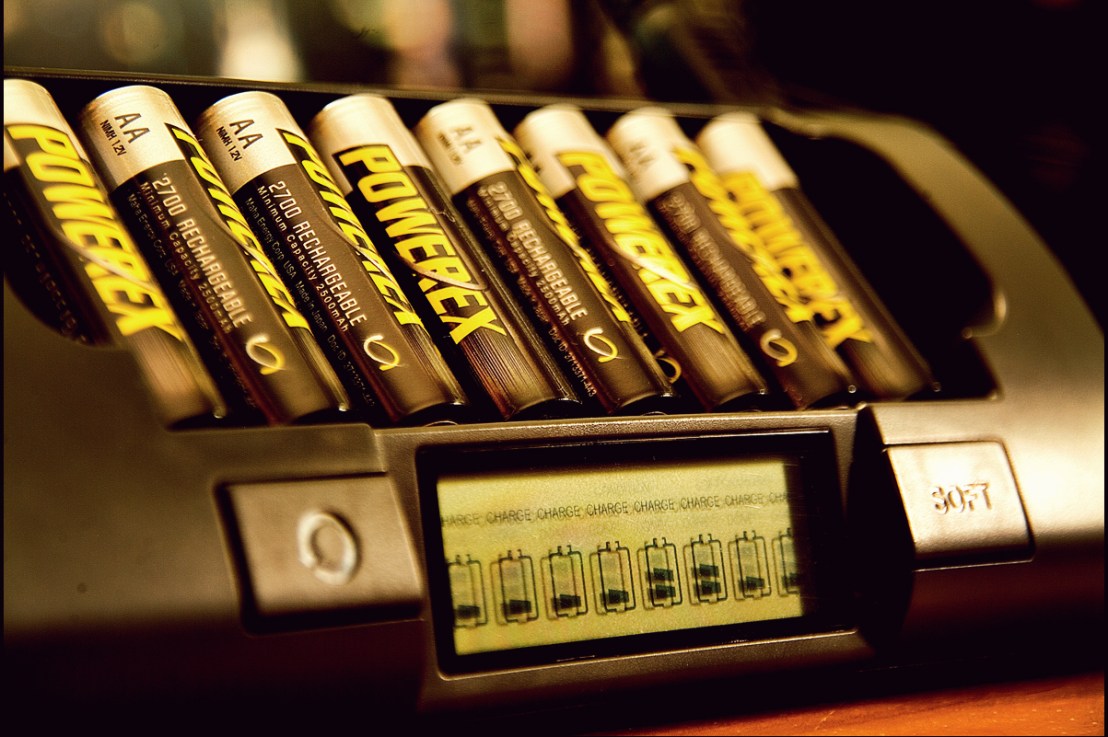
Rechargeable batteries can be a very worthwhile investment. For just a small amount of money, one can save not only save the environment but also much pain irritation from having to unceasingly find new batteries . However, something one very vexatious impinging factor on their worthwhileness is the fact that rechargeable batteries tend to wear out. Specifically, the more one recharges a battery, the less charge the battery will be able to hold. But why does this happen? Well, it all comes down to a the way that it works. Rechargeable batteries charge by using a transfer of ions through an anode and a cathode to convert active energy into potential energy  . However, this process will wear down the anodes and cathodes over time, leading to a degradation of internal materials which in turn leads to increased inefficiency. Therefore, the more time one charges a battery, the less productive it will be.

Why do phone batteries last a short time?

Why do phone batteries last a short time?

Why do phone batteries last a short time?

10/21/16

“Well, why do they?”
Batteries are one of the most indispensable drivers of modern civilization. And smartphones are of the chief applications of this technology. However, how is it that something so pivotal to society’s function wear out it’s sole power source so rapidly? Well, let’s think about it like an Engineer would. We know that batteries are powered by releasing stored chemical energy through reactions. However, batteries have a low energy density, meaning that a large battery will hold a relatively small amount of energy compared to it’s size. And since phones need to be smaller for practical use, the battery has to be small as well, and since the only other way to increase battery capacity is to increase the efficiency (which would increase costs prohibitively), smartphone users are stuck with low battery lifetimes!

Motor armatures

Motor armatures

Motor armatures

08/21/16

“What component causes an electric motor to spin?”


We know that Electric motors have two main mechanical parts, a stationary stator that encapsulates a rotating rotor. Now, how is this rotation induced? Well, in addition to having the aforementioned two mechanical components, electric motors has two electrical components. The first electrical component is called the field, which is simply the magnetic field component inside the airgap. This field will turn the armature, which is the primary power producing component in the motor. The armature carries current that is oriented perpendicular to the magnetic field, which in turn will induce a force which will cause a torque to take place. The armature usually consist of several conductive windings for this effect to happen. The field and the armature can be on either on the rotor or the stator but one must only occupy one other.

Resistor coloring

Resistor coloring

Resistor coloring

08/20/16

“Why do resistors have different colors?”


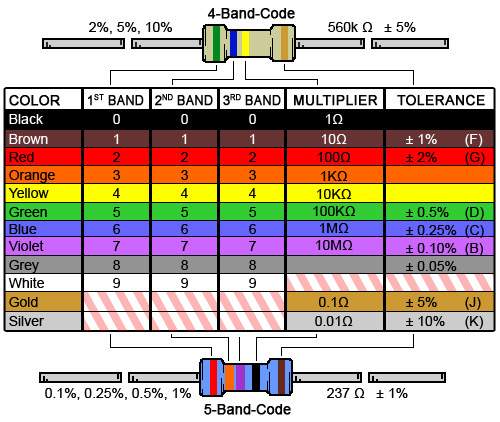
When looking at resistors, you might notice that they seem to have different colors. Four in fact, all in different bands. What do they mean and what do they imply? Well believe it or not, this different resistor coloring corresponds to different resistance values. This means that users such as yourself can easily find the resistor they require just by looking at the band colors.

The first band (called band A) represents the first figure, the second one t(band b) represents the second figure (some more precise resistors may have an extra band to indicated a further figure), the third band the Decimal multiplier (meaning how much this figure  constructed by the earlier bands will be multiplied by), and the final band represents the tolerance percentage (no band means a 20% tolerance level). A chart of the colors and the corresponding values can be found in the picture above

To get a better idea about how this works, let’s do an example. Let’s say that you find a band with the first band colored gray, the second band colored blue, the third green, and the final one red. This resistor will have a value of 86*10^5 ohms, and a tolerance of +-2%. Now go out there, find yourself some resistors, and try to apply these rules to try to estimated the values!

Series and Parallel

Series and Parallel

Series and Parallel

08/18/16

“How can different elements in a circuit be hooked up and what are the effects on current?”


When studying electronics, one might wonder, “What are the different ways that we hook up different resistors in a circuit, and how do they affect the circuit current itself?”. Well, let’s think about it.

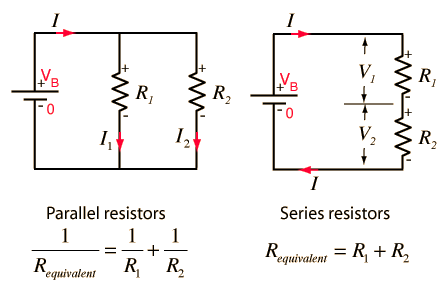
One way we could hook up everything is to directly connect each element in series. This way, the voltage from the power source will pass through each individual part, giving an associated drop at each one. Due to the fact that they are all directly connected, each resistive element will have the same current pass through it. This makes calculating the final current easily, because we can solve symbolically as follows. Let’s say we have a circuit with 3 resistors, all of different values R1, R2, and R3. Each one of them will have the same current I. Because the voltage drop through all of them combined must be equal to the total voltage V, we can construct the algebraic equation I*R1+ I*R2 + I*R3=V. Due to a common factor of I, we can simplify this equation to be I*(R1+R2+R3)=V. We can then divide the voltage by the total resistance to find the current I = V/(R1+R2+R3). This pattern holds for any number of elements in series. Let’s do a numerical example to cement our knowledge. Let’s take R1=1 ohm, R2= 2 ohm, R3 = 3 ohm, and V = 12 volts. If we do our math right, then we should end up with I=12/(1+2+3) → I=12/6 → I = 2 amps.

Another example that we could do is to to elements, hook them up directly to the voltage source, but do not directly connect them, only have them in parallel. Let’s work out the framework for these paradigm. Since each element is directly hooked up the voltage source, not only must it provide a current to go through each element, but the voltage drop must be the same as the voltage source. So how can we find out the current? Well, it’s actually surprisingly simple. First we must notice that each of the elements obtain an individual current, corresponding to the voltage divided by the resistance, or v/r. We must then notice that the total current I will be all of the individual currents added up, I = V/R1+V/R2+V/R3+….Then, since there is a common factor on each of these elements V (as I = V/R), we can divide everything by the Voltage V, to obtain I/V=1/R1+1/R2+1/R3+… , and if we simply notice that I/V is equal to the inverse of the total resistance Req, we can then represent this equation as 1/Req=1/R1+1/R2+1/R3.. We can obtain an equivalent resistance for all of the elements in parallel, and find the total current by setting it equal to the total voltage or I=V/Req, and find our answer! As one can observe, and a parallel setup, the more elements one adds, the higher the current will be, because all of those elements will need to be supplied with the same voltage drop