Tag: Civil Engineering

Suspension bridges

Suspension bridges

Suspension bridges

12/16/16

“How can we create a bridge using the phenomena of tension and compression?”


As the scope of humanity’s ambitions and technology grow, so must it’s fundamental infrastructure such as bridges. So if we would like to create bridges that can cross wide spans without faltering, how can we use our own ingenuity to do so? Well, let’s think about it. We know that we can use tension to keep solid objects up. Furthermore, if we experiment, then we can find out that if we attach a beam-like object with tensile supports on both ends to two heavy vertical beams, it would be kept stable. Now let’s apply this system to build ourselves a bridge. First, let’s take a basic, horizontal beam and put in on two end supports. Then, to balance things out, let’s put in two vertical beams, attach them to the horizontal beam, each not too far away from the supports. Now let’s fashion onto these vertical members a long cable that not only connects each support to each other but also contains supporting cables coming out vertically that will hold up the bridge deck, keeping it level in tension, while transmitting the rest force into the members. This is framework is termed a suspension bridge and is one of the most effective bridge designs ever fabricated. Perhaps the most example of a suspension bridge is the monumental Golden Gate Bridge, a 746-meter long piece of metal whose salient engineering has led it to become the most iconic emblem of the San Francisco Bay Area

Factor of safety

Factor of safety

Factor of safety

11/19/16

“How do engineers deal with loads near the failure point?”


When doing engineering, one has to deal with the maximum load that a system can handle. However, in the real world, it would be quite unwise to have loads even near this limit. The rationale behind this is that such a system could experience an unexpected impingement. To illustrate, let’s suppose that enough people stand in an elevator to have it at maximum capacity, if even a rat were to climb into this elevator, then this capacity would be overloaded and the elevator would experience failure. Luckily, engineers tend to be foresightful people, so when developing structures, instead of designing them just to sustain the expected loads, they are created in respect to a factor of safety. A factor of safety an extra “margin” that a structure can support (in terms of a multiple of the expected load), and can be calculated using the formula FoS =Ultimate stress/actual stress . An example of the factor of safety in use is the famous Eiffel tower, which is designed to sustain 4.5 times as much stress than it typically does. In summation, the factor of safety is an intrinsically necessary tool in modern engineering, and has saved countless of lives all over the world.  

What are frames?

What are frames?

11/01/16

“What are frames, why are they so commonly used, and how can we analyze them?”


Frames are some of the most utilized structures in engineering. In Fact, they are so commonly used that they are used in the name Framework. But what exactly are they, why are they so utilized, and how can we analyze them? Well, like I always say, let’s think about it. Frames are fundamentally structures that hold structures together. This allows them to hold multiple disjointed parts together to become continuous, therefore allowing for more complex structures to be built, therefore allowing for complicated urban systems to be developed! Frames can be analyzed by the fact that they provide static resistance to all parts connected to their system, allowing for loads and other members to balance each other out.

Method of sections

Method of sections

Method of sections

10/18/16

“Is there a simpler way to solve truss problems?”


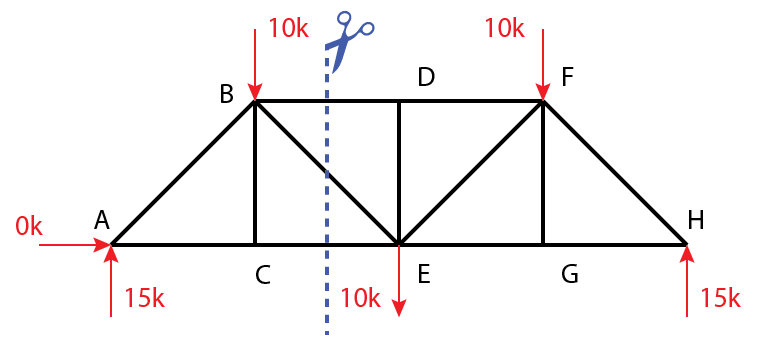
Trusses are one of the most fundamental elements in modern structural engineering. However, performing truss calculations is not only time consuming but can also be quite tiring, especially if we only desire to obtain the values for a few members. So is there a way in which we can simplify truss calculations if we are only focusing on a few parts? Well, let’s think about it. We know that when we work with external forces on trusses, we can solve for them without worrying about the internal forces, thereby allowing us to work with much less equations required. So what if we were to take the forces in the members we need and somehow turn them into external forces? This is the fundamental idea behind a technique known as the method of sections. To implement the methodm all we need to do is to find the members we desire, and then cut the truss through those members so that the internal forces will seem like net forces, and then solve for those members. This drastically reduces the time necessary to solve the problem, and prevents us from making too many absent minded mistakes

Normal stress

Normal stress

Normal stress

10/08/16

“What happens when stress acts upon an area parallel to the axis of an object?”
The concept of stress is one of the premier foundations of all of engineering science. So, what happens when a stress is applied to an area that is parallel to the axis of the object? Well, this type of action is very simple. Since all of the stress acts through the axis of an object, the only deformations will be parallel to the axis as well. This type of stress would cause tensile or compressive deformations (depending on the direction and strength of materials). Scientists and Engineers have termed this phenomena normal stress. You can find the magnitude of normal stress very simply, as the stress is just the force distributed over the area that it is acting upon (we can represent this symbolically with the equation (sigma)=F/A, with being (sigma) the stress, F being the force, and A being the geometric area)

Eccentric loads

Eccentric loads

Eccentric loads

10/07/16

“What happens when a non-axial load occurs on a column?”


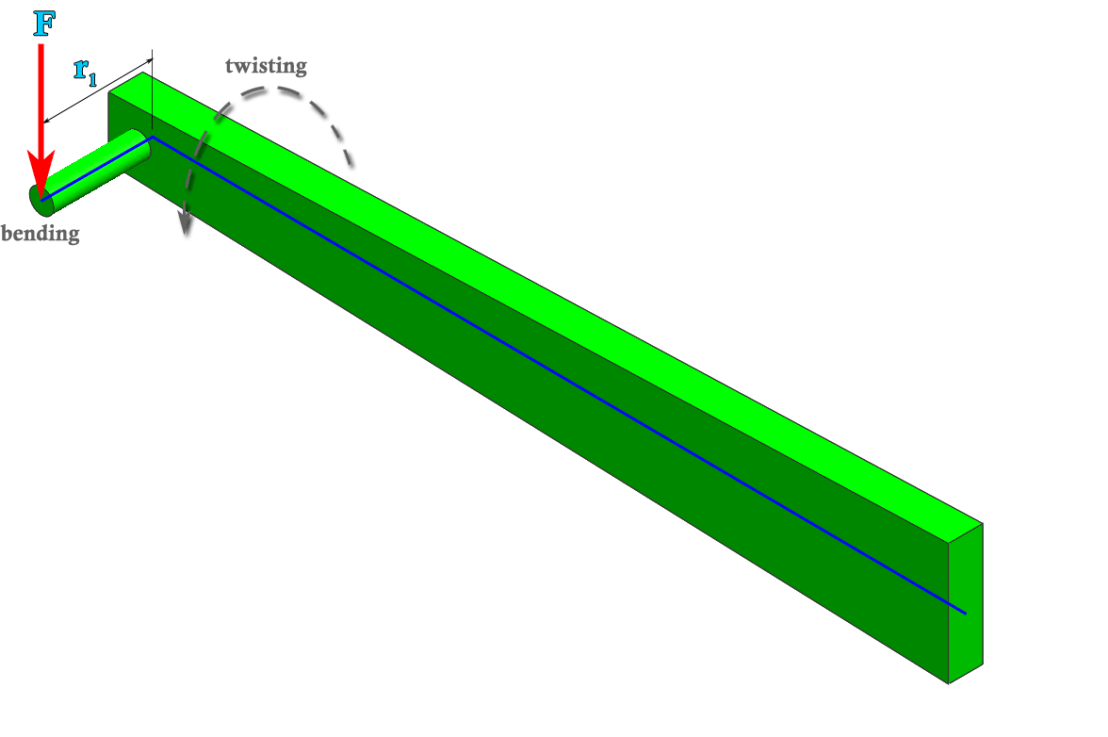
When working with  columns, we often have to analyze loads that impinge on the structure. However, what happens when a load acts in a direction not parallel to the axis? Well, what will happen is that the strength of the material will not be completely able to resist the force, thereby resulting in bending. Engineers have termed this type of load an eccentric load.

Equivalent forces

Equivalent forces

Equivalent forces

09/13/16

“How can we simplify force diagrams?”


When working in physics or engineering, we all have to work with forces. Sometimes, we will have a multitude of forces, all going in different direction. However, how could we simplify all of these different elements of a problem to get the big picture and streamline our solution process? Well, let’s think about it. First we should think of our objective, and that is to see what happens when all of these forces are combined. So how about we take the components of each of the separate forces and moments, add them together, and find the equivalent force for all of these values? For example, let’s suppose that we had a bar of length 6 meters, with one force of 20 acting on the far left from the top and another one of 20 newtons acting at the far right coming in from the bottom. When we do all of the calculations, the equivalent force in the x direction will be 0 Newtons (Since none of the forces have an x component), The net force in the y direction will be 0 Newtons (since both forces are going in opposite directions, they will subtract each other) and the net moment will be 135 N-m (Since they are both in the same moment direction, 3m*20N+3m*25N=135N-m). With the use of equivalent forces, we can analyze an unlimited amount of problems, ranging from structural engineering to electrodynamics

Shear strength

Shear strength

Shear strength

08/30/16

“How can we classify the ability of a material to resist forces that are parallel to the surface?”


Have you ever been mystified by how an object can be broken apart by taking two different sides and sliding one upwards and the other downwards? And have you ever thought about how we could quantify this phenomena? Well, believe it or not, this comes down to a very simple factor called shear strength. Shear strength is the maximum ability of an object to resist yielding against shear strains, or deformations in objects that are induced by internal sliding. Adhesives are often used to solidify the shear strength. The study of shear strength is critically important for structural engineering, as doing so could prevent catastrophic failures. For example, we  can apply the shear strength of materials to study how a boat being tethered to a dock could cause a rupture on the dock.

Yield

Yield

Yield

08/29/16

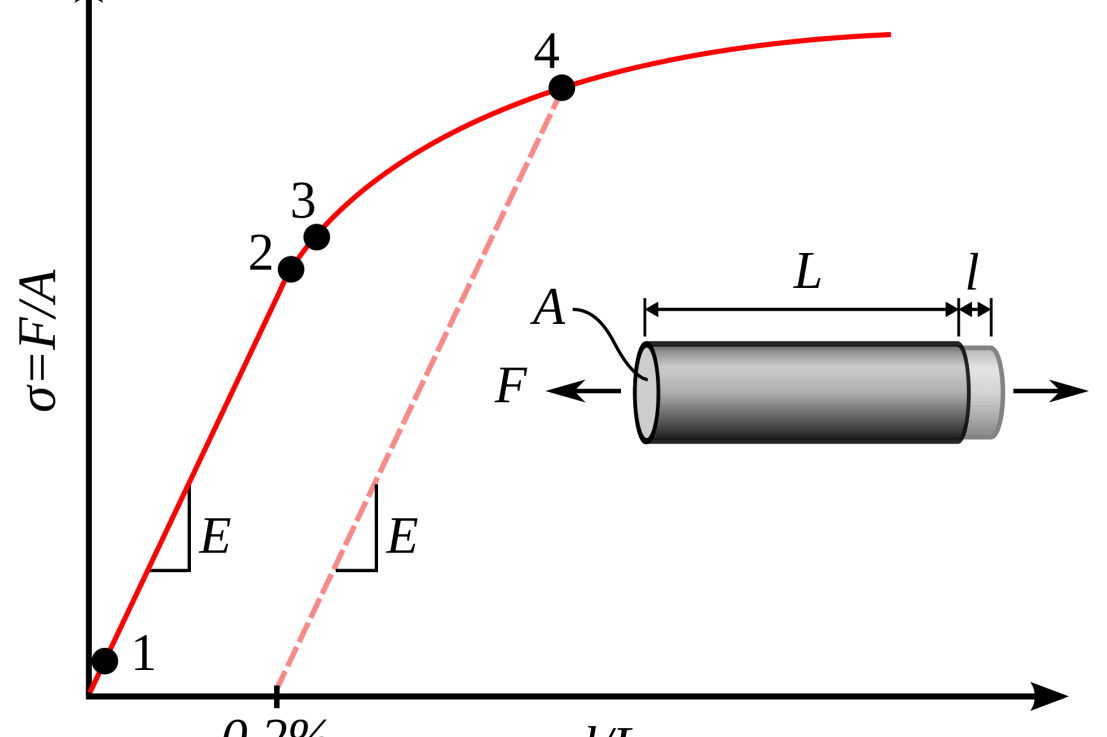
“How can we measure when a deformation will be permanent on a material?”


When you were young, you probably noticed that if you apply enough stress onto an object, there will be a point in which in the material will be permanently deformed. However, did you ever consider that we might be able to classify this point in some form? Well, after many years of research, structural engineers have termed this “point of no return” as the yield. In technical terms, the yield point or yield strength is a material property that measures the point at which the level of stress applied becomes so high that the material will no longer deform elastically (meaning returning to it’s original shape) and instead deform plastically (meaning that there is some permanent deformation). The yield strength of an object is very important for estimating the applied strength it can take, since it could be used for pre-emptive failure analysis.