Trusses
08/28/16
“What is the fundamental framework behind many modern structures?”
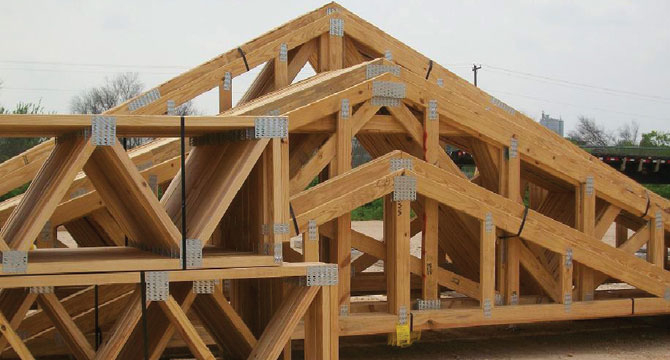
Have you ever wondered what exactly makes moderns structures such as bridges and houses supportable? Well, believe it or not, all of these complex structures have their foundations in a straightforward yet ingenious engineering piece, the beam. And not just beams by themselves, but beams arranged in a very particular way. When making edifices, one must take into account that beams have very little lateral strength. In other words, beams do not have much strength to support perpendicular forces. However, beams are very sturdy when it comes to compressive and tensile forces. So in order to build complex structures, beams must be construed in a way that all of the forces are applied at the joints so that all of the forces are either compressive or tensile forces. We can accomplish this by having the beams must be connected only by their joints. This way, all of the loads will be distributed on the ends of the beam, so we can have highly stable structures without having to worry about collapse. This type of framework is called a truss, and is used in all forms of engineering.

 Isaac's Science Blog