Tag: Civil Engineering

Head Loss In Fluids

Head Loss In Fluids

Head Loss In Fluids

12/19/17

“How do fluids lose potential due to viscosity?”


Understanding of fluids has led to some of the most important breakthroughs in engineering. However, when analyzing these systems, it is very important to take into consideration that viscous forces will act upon the fluid in transit. So how can we take this into account? Well, what if we were to just take into account all of the losses from both frictional and inertial changes? This is known as the head loss in fluids and is one of the most important foundations of one’s study of fluid mechanics. Head loss can be visualized by the pressure drop in a manometer like the one shown in the picture.

California Title 24

California Title 24

California Title 24

12/17/17

“What is the official building energy efficiency standard for California?”


In the U.S, most building efficiency standards are regulated by ASHRAE 90. However, some states go a little bit further with their regulations. In California, a series of codes known as Title 24 is the law of the land. Title 24 contains all of the specifications that a construction firm must consider before going through with a project. These include a requirement for LED lights, motion sensors for buildings, a specified minimum reflectivity for roofs,  electrical service panels for disaggregated measurement, and many other variables. California Title 24 is updated every 3 years such that the next set of rules saves more energy than the last.

Electric Sub-Panels

Electric Sub-Panels

Electric Sub-Panels

12/15/17

“How can we distribute electricity in a larger building?”


Electrical service panels are ubiquitous in integrating an edifice to the grid. However, sometimes a building unit can become too large for just one subpanel. However, what if instead we were to just hook up a smaller panel to the larger one? Think of it like attaching a multi-plug to an outlet. These Electric Sub-Panels can now be found in built environments all over the world.

Electrical Service Panels

Electrical Service Panels

Electrical Service Panels

12/14/17

“What connects a house to the grid?”


Electricity from the grid has made modern living much better, whether it be in the lights that allow us to stay up late into the night, the HVAC systems that keep our place cool, or the energy that powers our computers. However, what exactly connects these services to our built environment? Well, let’s use our engineering mindset to think of it.


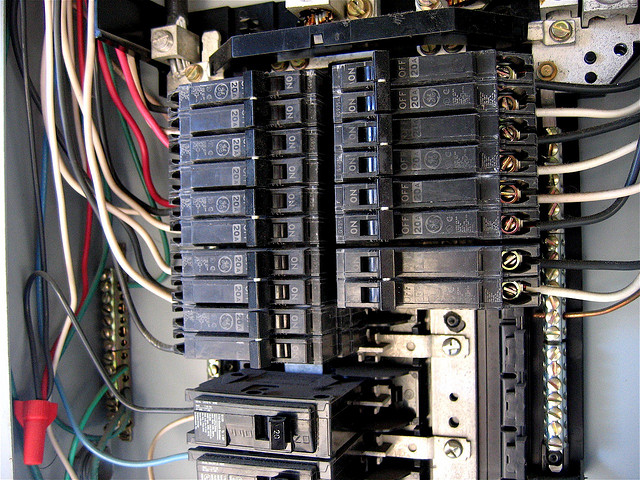
First, we will need a central location to keep all of the connecting circuits. This will allow us to centrally deliver power throughout a unit. We must also keep in mind that a circuit overload may occur, in which case circuit breakers will be attached. Now let’s place all of these in a central frame, making a device called an Electrical Service Panel. Electric Service Panels are one of the foundations of modern home energy systems and can be found in nearly every grid-connected building.

Building Integrated Photovoltaics

Building Integrated Photovoltaics

Building Integrated Photovoltaics

12/13/17

“How can we directly integrate photovoltaics into a building?”


Solar photovoltaic panels have revolutionized energy as we know it. And since buildings are some the highest consumers of energy, it would only be logical that panels be applied to them. But PV systems can be big and clunky and take up a lot of room.


Or do they have to?


Novel breakthroughs have resulted in the creation of a technology known as Building Integrated Photovoltaics (BIPs). These systems are directly integrated into the building envelope, allowing for much more flexible use. They can be put directly on rooftops, applied to the sides, or even constructed as transparent windows! However, there are numerous factors to consider when using building integrated photovoltaics. Shading may occur from other edifices, there may be deposition from weather, and a proper tilt angle depending on the geographic location must all be considered. Despite this, BIPs are an excellent foray for humanity into greater sustainability.

ASHRAE Standard 90.1

ASHRAE Standard 90.1

ASHRAE Standard 90.1

12/10/17

“What is the basis for building energy efficiency in the U.S and much of the world?”


With the onset of global warming, energy efficiency has become a great necessity. As such, buildings in the U.S must now follow a certain standard so that after construction they will meet the sustainability requirements dictated by ASHRAE Standard 90.1. ASHRAE Standard 90.1 is a compilation of all of the codes for building energy efficiency (with the exception of low rise residential units) and is updated every three years to ensure that the next set of codes will be 15 percent more efficient than the previous.

Cradle to Gate Life-Cycle Assessments

Cradle to Gate Life-Cycle Assessments

Cradle to Gate Life-Cycle Assessments

11/13/17

“How can we analyze the portion of the lifecycle of a product?”


Life-cycle assessments are done on projects to determine their total impact upon the environment. However, sometimes we may only want to know the impact of a portion of their life, specifically from resource extraction up until it leaves the factory. One way to accomplish this is to use something known as a cradle to gate life-cycle assessment. This process is very useful for manufacturers to determine what their contribution to climate change is.

Industrial Applications of Humidifiers

Industrial Applications of Humidifiers

Industrial Applications of Humidifiers

11/11/17

“How can we design humidifiers for industrial needs?”


Humidifiers are widely used to make personal spaces much more habitable. However, can this technology be utilized for industrial applications as well? Well, it turns out that many processes actually need to be undertaken in less dry conditions because static air friction becomes more prevalent. To illustrate, the this buildup of dry air in data centers and manufacturing facilities could cause static electricity to discharge. Art museums also need to keep paintings at a certain humidity to protect works of art. As you can see, there are in fact many many industrial applications of humidifiers!

Post-Occupancy Evaluation

Post-Occupancy Evaluation

Post-Occupancy Evaluation

11/05/17

“How do we evaluate buildings after they have been built and used?”


Modern Buildings are designed to function in a certain way. However, after they have been built, unforeseen factors can disrupt things and cause inefficiencies. So how can we evaluate buildings in an effective and rigorous manner after they have been constructed? Well, after many years of research, building professionals in both the U.S and Scotland have developed something called a Post-Occupancy Evaluation, which involves authorized individuals to arrive onsite an perform audits. Once an evaluation has been done, further action can be commenced to bring the unit to full operation