Tag: Chemical Engineering

Ethanol fuel

Ethanol fuel

Ethanol fuel

06/27/17

“Can we use plants to make fuel?”


Plants can be found everywhere on this planet, from the sandiest deserts to the densest rainforests. And like animals, all of these plants have one thing in common, stored energy! So logically speaking, couldn’t we convert some of this plant matter into a fuel for our own use? Well, let’s use our scientific mindset to find out.
First, let’s gather up some plants with starches and sugars such as corn grain and place it in a production facility. Then, let’s break it down into its component sugars and convert into a chemical called ethanol. Ethanol is a flammable liquid that can be used to power internal combustion engines. Because of its wide availability in agricultural areas, ethanol fuel is a popular choice in the nation of Brazil and the Great Plains of the United States.

Fractional distillation

Fractional distillation

Fractional distillation

05/28/17

“How can we have distillation for materials with more than two substances?”


Distillation is the process of separating two substances using the science of evaporation and condensation in regard to different boiling points. However, how can we make this process happen for materials such as crude oil which are composed of many different substances? Well, let’s use our engineering mindset to find out. Let’s start out with a simple test tube. In this test tube, let’s also have another smaller tube at the midsection leading to a stationary beaker. Now let have the bottom portion of the main tube be immersed in a hot fluid. When we dispose a material into the tube, the hot fluid will heat the material until one of the substances evaporates. The gas from the evaporated substance will rise and move through the tube, eventually reaching the midsection tube, cooling and condensing into a liquid form in the beaker. Once all of this substance has been removed, we can swap out the old stationary beaker for a new one, replace the hot liquid with a bunsen burner, and repeat the process. This procedure is known as fractional distillation and is commonly employed for separating substances with numerous hydrocarbons.

Cross-linking

Cross-linking

Cross-linking

05/20/17

“What happens when polymer chains link together?”
Polymers are famous for their absolutely long chains. However what happens when these chains link together? Well, let’s use our scientific mindsets to find out. If we look carefully, then we will observe that the density of the materials will go down (since now all of its composing elements will no longer be able to be squeezed together so easily) but the strength will increase since the there are now three-dimensional impediments to dislocations.

Elastomers

Elastomers

Elastomers

05/19/17

“How can we have flexible polymers?”
Polymers are widely utilized in a swath of industries for their malleable properties. But is it possible to make such things flexible? Well, let’s use our scientific mindset to find out. Polymer molecules are often arranged in a disordered manner due to the second law of thermodynamics. However, when pulled upon, some of these materials can actually become more ordered and will revert to their original shape once the force is removed, giving them an elastic property. These materials are known as elastomers,and are commonly used for flexible materials such as rubber. Elastomers are usually thermosets, have a low young’s modulus, and a higher failure strain.

Vulcanization

Vulcanization

Vulcanization

05/17/17

“How can we improve the properties of rubber using engineering?”


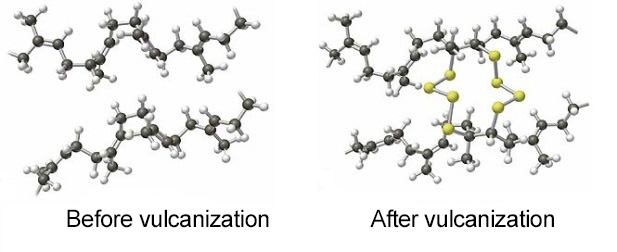
Rubber is a very useful material. It can be found in almost every facet of life, from the cars for our commute to the gloves that we wear to the soles of shoes. However, how can we make this material even stronger? Well, let’s use our engineering mindset to find out. Rubber is naturally composed of strands of singular polymer chains. However, if we were to introduce some sulfur into this medium, then some of the C-H bonds will be broken and replaced with C-S bonds, resulting in a cross-linked material. This makes the structure much stronger and more rigid while maintaining its elasticity. This process is known as vulcanization and is used in the manufacturing procedure of a wide range of items, such as hockey pucks and bouncing balls.

Thermosetting polymers

Thermosetting polymers

Thermosetting polymers

05/16/17

“Can certain plastics become harder with heat?”
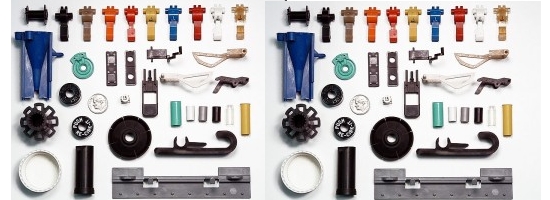
Thermoplastic materials are widely used for their behavioral effects to induced heat. However, is it possible that some materials might become harder with temperature in an irreversible process? Well, let’s use our scientific mindset to find out. We know that when polymers become cross-linked, they become harder and tougher. So it would follow that when heated, they would be stronger when compared to a non-cross-linked material. What more, because these polymer chains are bonded to each other, they will not change shape after reheating! Thermosetting polymers have applications to be found everywhere, from latex gloves to erasers to bicycle tires.

Landfill Gas to Energy

Landfill Gas to Energy

Landfill Gas to Energy

05/08/17

“How can we convert landfill gas into energy?”


Landfill gas is often left to rot and waste the environment. However, would it be possible if we could actually do something with this corrosive material? Well, let’s use our engineering mindsets to think about this. We know that gasses are transported through piping systems to provide energy. So what is we were to replace these glasses with the methane gasses released by landfills? This system is known as landfill gas to energy and is often used for generating electricity, replacing non-renewable resources, cogeneration, and pipeline gas

Desalination plants

Desalination plants

Desalination plants

04/21/17

“How can we make saltwater drinkable for humans?”


Humanity is running into a problem. With each year our water supplies are getting lower and lower. Soon enough, we may not be able to provide ourselves with one of the most basic components of life.


But does it have to be this way?
If we apply our engineering mindsets, then we can devise a method for water purification to sustain our livelihoods. To begin, let’s start out with some simple chemistry. 96% of the water on this planet is stored in oceans as salinated water. And because of its salty nature, by default, it is unsafe for human consumption. However, we must take one more fact into consideration, that the evaporation point of liquid water is lower than that of salt. So what if we used some simple logic and create a device that would heat salt water up until the point of evaporation, move it over into another container, and then condense it into drinkable water? Well, this is the fundamental idea behind a system which engineers have termed desalination plants, and are used to treat saltwater around the world. One downside of traditional desalination plants is the vast amount of energy required to heat up the water, taking around 5 kWh for a cubic meter of just fresh water!

Pipeline transport

Pipeline transport

Pipeline transport

04/14/17

“How can we move fuel over long distances?”


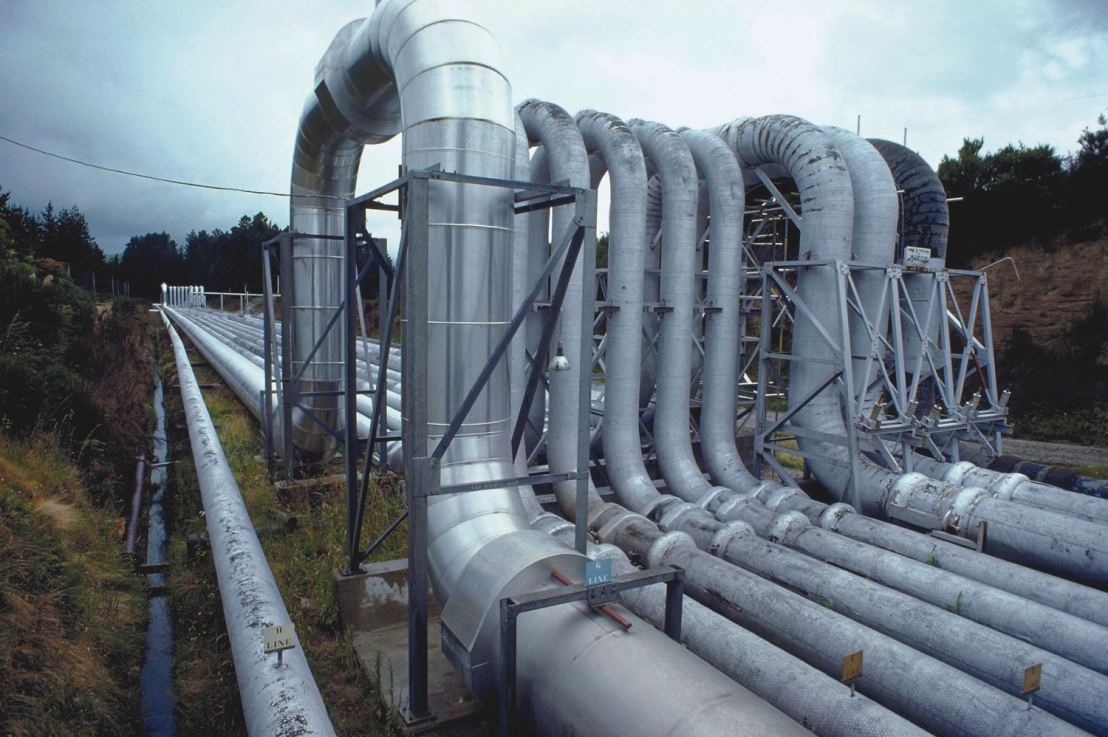
Human infrastructure has a logistics problem. The resources needed for the operation of our civilization (such as water and petroleum) are produced in locations far, far away from where they are consumed. So how can we devise a mechanism to transport these materials over long distances? Well, let’s use our engineering mindset to solve this problem. We know that these resources are often extracted in fluid form. And we know that one way to transport fluids is to use piping systems. So what if we were to use giant pipelines strewn throughout the landscape for the transportation of this material? Well, it turns out that pipeline transport of resources is more than a theoretical idea but a practical reality, and is used by almost every country in the world.