Elad Orian, Co-founder of Comet-ME
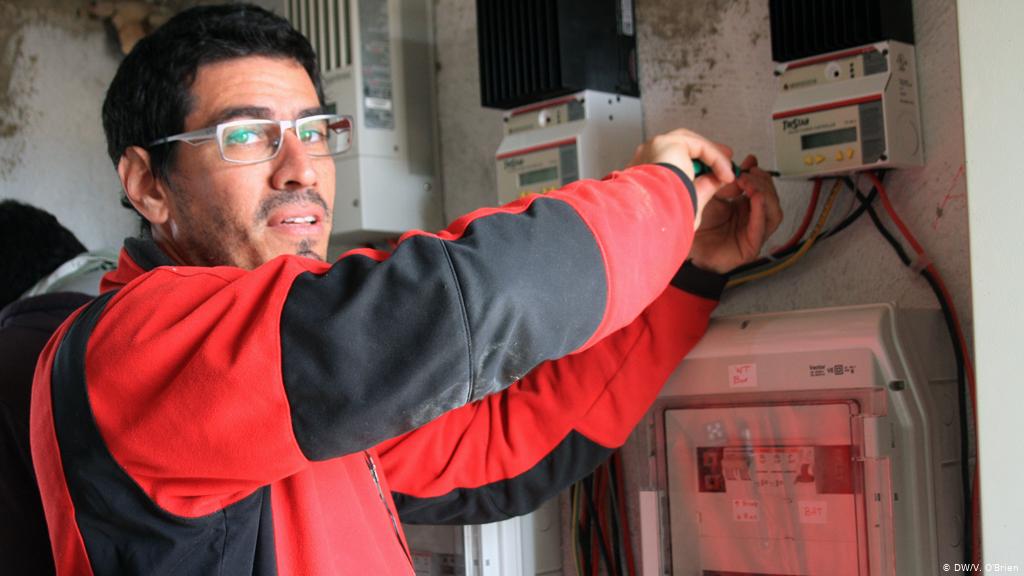
We here at Isaac’s Science Blog are pleased to be hosting our sixth professional interview, this time with Elad Orian! Elad is the co-founder of Comet-ME, an Israeli-Palestinian organization providing renewable energy and clean water services to off-grid communities in some of the most marginalized parts of the Palestinian Territories using environmentally and socially sustainable methods.
1. Tell us about yourself and your educational/professional background.
I studied physics and later environmental science/policy. I’ve been doing my current work for 10 years now.
2. What inspired you to work in energy?
I’m a political activist along with my partner (Noam Dotan). We started thinking about something more proactive and using our abilities and know-how and energy was a very natural conclusion
3. Why did you help found Comet-ME
We actually started doing this type of work before we officially established Comet. It just so happened that these activities were relatively successful and grew really fast to the point that we needed an organization/framework that can handle this. As a result, Comet-ME was born.
4. Tell us about some of the challenges that of the Palestinian residents that you worked with.
We work with Palestinian communities in Area C of the West Bank. In the Oslo accords the West Bank was divided into three areas (A under control of the Palestinian Authority, B under Palestinian civil control and joint Israeli-Palestinian security control, and C, which happens to be the majority of West Bank under control of the Israeli government). We work in an area where the Palestinian Authority cannot provide electricity/water to communities. There are communities in A/B that have no electricity but we made a strategic decision to not replace the position Palestinian Authority.
5. What does the life-cycle of an average project look like?
One of the first things we do is to build trust with the community. We know what we do and why we do it, but the people we work with need proof. It is important that we go into a community when we know that we have the funding. We are lucky to have so many long-term donors trust us so when we start a project/budget cycle we don’t know where we are going to work because we need to do a survey of the community, conditions of each place, and then we do a detailed design of system and then we will purchase all the equipment that is required. There are some long-lead items so we do work in houses of the villagers and then once we have everything we install it. Once the installation is finished the hard work is started when service is provided. Because Comet is about providing service and we make sure service is running for a long period of time. In this way, we are like a utility. Every system brings service.
6. What technology does Comet-ME use to help communities establish energy independence?
We always use solar systems. Sometimes wind/diesel hybrids. Our systems can be designed to work from 1 family up to 40/50 families.
7. Tell us about your water program
After a few years of working exclusively with electricity, we decided that we had the organizational capacity to do something else. This is a very different program since many of them already have water, just not enough. Our system is a pump attached to a filter to obtain clean water, it’s a simple single-family system that collects rainwater and pumps it. We developed a system that pumps and filters rainwater using electricity when the batteries are full. There is also a stewardship component where water quality is sampled from all the users on a regular sample schedule to make sure systems are doing what they are meant to do.
8. Is Comet-ME looking at the Water-Energy Nexus and if so how is it?
Very much. Our water systems are dependent on our electricity systems for operation.
9. Have you received any interest from universities on the work that you do?
We have some collaborations with some universities. We also have a few students that have written master’s degrees with us. We don’t do much advertisement so we’re not really a household name.
10. Is Comet-ME looking at how to deal with climate change resilience?
Although we don’t title it, our work is directly tied with climate resilience due to providing an independent source of energy
11. How do you see your organization fit into a long-term Israeli-Palestinian peace partnership?
If there is a peace agreement signed and the West Bank becomes a Palestinian state then we would gladly hand over systems to a Palestinian organization to handle it. I don’t think it would be a problem.
12. Do you think that the Comet-ME model has any application outside of the Palestinian territories?
There are many components that certainly are and some that are idiosyncratic to conditions/politics of the West Bank.
13. What can someone do to help out with your organization?
One can always donate money, also if you’re technically inclined and interested in such issues we do have volunteers from time to time. Feel free to reach out and join us!
Conclusion
So there you have it! Elad, we are very grateful for giving us your time to talk about this very important work. Your organization’s work is a textbook example of how people can apply their scientific knowledge to make the world a better place.
If you would like to connect with Elad and Come-ME, you can find their website here and their facebook page here.
Image credit DW.com




 Isaac's Science Blog