Electrons 02/03/16
Electrons are some of the most flummoxing part of the universe. Electrons are subatomic particles with a negative charge. Contrary to popular notion, electrons do not orbit the nucleus of the atom, but as a consequence of the laws of Quantum Mechanics, they form a probability shell around the nucleus of an atom, with the probability density being weaker the further away from the distance is to the center. When a molecule loses or gains an electron, it becomes an ion, which means that it now has a net charge.
Category: Physics
Perpetual motion machines
Perpetual motion machines 02/01/16
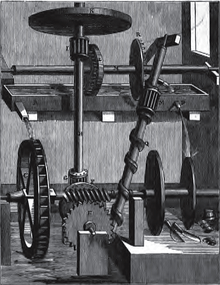
One of the most common statements of crankery among pseudoscientists is that of Perpetual motion machines. A perpetual motion machine is a machine which can operate indefinitely with 100 percent energy efficiency, meaning that all of the energy that enters the system will leave the system in the same way. Perpetual motion machines are a glimpse at mankind’s quest for ultimate symmetry and utility in the universe. Perpetual motion machines are in complete violation of the second law of thermodynamics, as energy can only be debased through use and can never be fully preserved. Therefore, anytime you see something claim that they have made free energy, they haven’t.
Second law of thermodynamics
Second law of thermodynamics 01/31/16
One of the most enigmatic yet intriguing facets of fundamental physics is the second law of thermodynamics. The second law dictates a seemingly simple yet consequential rule, that the entropy in all systems can only increase. Entropy is the measure of disorder in a thermodynamic system, think of it like if there was one room half filled with people wearing red shirts and half blue shirts, with one room they are split evenly half and another they are strewn around in a desultory manner. The second law states that all systems start out like the former and end up like the latter. The dire implications of this quandary is that a perpetual motion machine is completely impossible any any attempt will only based off of erroneous reasoning.
Phases of matter
Phases of matter 01/30/16
Complex matter is invariably found in a physical state. A state of matter can be defined as the macroscopic order that the components are in. There are four (main) type of macroscopic states of matter, Solids, liquids, gases, and Plasmas. Every complex object can be found in one of those states and can transfer between one of those states through a change in temperature and pressure.
The most intuitive phase of solid is the solid. Objects in a solid state have their molecules packed closely together, with the forces so strong that the neighboring molecules are only able to vibrate. Consequently, solids have a definite shape and volume (unless deformation by an outside force impinges upon it, but that’s a topic for a later lecture).
Given the precise conditions, an object can also be extant in a liquid state. If a solid object is heated above the melting point, then the molecules begin to break free of their rigidity but the intermolecular forces are still strong enough to hold them together. As a result, liquids do not have a dependant shape (their geometry is contingent upon the space of the container that they are suffused in). A most intriguing and peculiar facet of nature is that of the triple point, in which the state transitions for a certain object are all bordering one another.
If one is to change the pressure or temperature conditions to the point where the molecules are able to break completely free of neighboring van der wal force impingements, then a gas is formed. Gases have no definite shape or volume, so they are free to move around with little constraint. If enough heat is applied to a gas, then it will undergo a process known as ionization in which all of the electrons will break free of the molecules and a plasma will be formed. Plasmas have much of the same physical properties as a gas except for the fact that they are completely electrically conductive (not to say that gases can not be electrically conductive, just not on the same level as Plasmas)
The conservation of energy
The conservation of energy 01/29/16
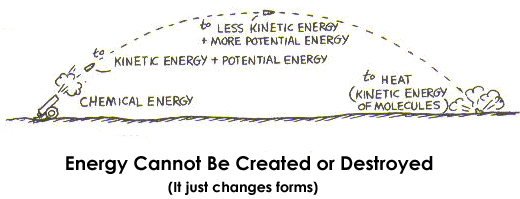
One of the most fundamental laws of physics is the conservation of energy. To put it simply, energy is the capacity of an object to do work. All of the energy in the universe can neither be created nor destroyed. Energy may be transferred from one object to another, and due to the second law of thermodynamics energy becomes more useless as time goes on, but it is never completely destroyed. This means that all of the energy that human civilization is using currently, weather it be electricity or or simple machines, has existed since the primordial ages of the universe.
Newton’s laws
Newton’s laws 01/28/16
For any student of Physics, Newton’s three laws are some of the most paramount and sumptuous facets of the course of study. These laws are the axioms on which the framework of Newtonian mechanics are contingent upon.
We shall embark our journey with the explanation of Newton’s first law, the law of inertia. Newton’s first law dictates that an object at rest stays at rest and an object in motion stays in motion unless there is a net external force. To illustrate, if one were to throw an object suffused in the vacuum of space, then the object will continue in its trajectory unless it is impinged by an external force, such as gravity or if it encounters air resistance. Likewise, an object at rest will remain at rest unless a force is acted upon it.
Newton’s second law states is the law of forces, which states that a force is equal to an object’s change in momentum, pretty much Force is the derivative of momentum, or F=ma (Force is equal to mass * acceleration). This gives us a mathematical description of force, which allows us to further develop any concepts.
Newton’s third and final law states that For every force, there is an equal and opposite force acting upon contact. To give a concrete example, remember anytime you struck your pillow, you felt a force knock back at you? That was Newton’s third law in action, you exerted a force on the pillow and the pillow exerted a force on you.
Quantum superpositioning
Quantum superposition 01/27/16
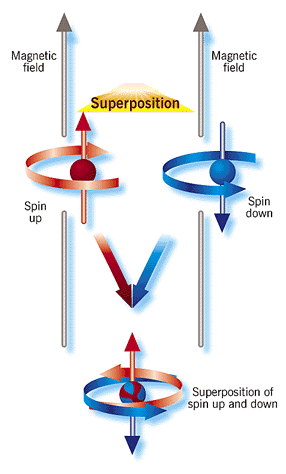
One of the most riveting facets of Quantum mechanics is the phenomena of Quantum superpositioning. Objects on the Quantum mechanical scale become contiguous with one another upon collision, analogous to waves superposition. Consequently, Matter on the quantum scale has no definite location, instead being in probabilities of locations, such as being 30 percent in one part of space and 70 percent in another. This phenomenon has a sumptuous application to the world of Computer Science in the form of quantum computation. In a classical computer, informations can only exist in true forms, true or false. However, with a quantum infrastructure, information can be a superposition of forms, therefore, it is possible to have data stored as 2/3rds true ⅓ false. This has praxis with regards to higher complexity algorithms. To visualize an example, imagine an algorithm’s whose purpose is to find the quickest way out of a maze. A conventional program would willow through each path individually, while a Quantum computer would be able to solve all possible routes simultaneously! The NSA and google are already investing in such machines to do the jarring task of spying on people.
Waves
Waves 01/25/16
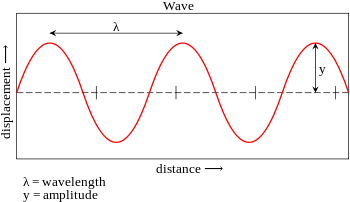
Waves are a most peculiar phenomena in the physical universe. To put it concisely, waves are a transfer of energy through oscillations and vibrations from one point to another. Waves are one of the most commonly occurring facets of natural natural world, being present in everything from water perturbations to earthquakes.
Waves a multitude of intriguing properties. Unlike particles, when two waves come into contact, instead of colliding, they combine to form an temporary superposition, and then proceed on the path they were on. This phenomena is known as interference. During this ephemeral interference state, their directions of oscillations are combined, so if two (or more) were oscillating in the same direction he combined amplitude would be greater and vice versa if tf there directions were incongruous. Waves can also be reflected of reflective media, such as glass. Since waves are commonly are thought of of disturbances through media, their phase velocity is contingent upon such, and if their surrounding media change, then so do their phase velocity. Think of it like a falling ball being dropped into a pool of water, at first the ball only has to face the fluid resistance of the surrounding velocity of the atmosphere, but after coming into contact with the water it will slow down due to the denser material makeup of water. In fact, this is the reason why light changes angles when it strike water!
Wave motion comes in two forms, transversal and longitudinal. Transversal waves consist of energy oscillating perpendicular to the direction of movement, while longitudinal waves is the inverse (oscillations occur in the direction of displacement). Since transversal waves can oscillate in any direction perpendicular to the phase velocity, such waves can have multiple directions of oscillation. Consequently, there is an effect known as polarization, in which the waves have all but a select set of directions filtered out. In addition, there are two (known) types of wave in the universe, mechanical and electromagnetic. Mechanical waves consist of oscillations of material matter, so their entire exantness is contingent upon the medium that they are suffused in. The latter phenomena is the paramount divergence between mechanical and Electromagnetic waves, as the latter can transfer energy even in complete vacuity. Consequently, since light is an electromagnetic wave, light can move through the vacuum of space unimpinged.
Sound
Sound 01/24/16
“What is sound?”
It might come as a surprise to many that all of the opulent varieties of sounds that we listen to are nothing more than simple vibrations of air! Everytime we move our vocal cords, the surrounding medium is perturbed. Consequently, this perturbation stimulates a mechanical wave that propagates throughout the enveloping space. Since waves are contingent on the medium that they travel through, sounds greatly affected by the density, pressure, motion, and viscosity of the aforementioned medium, with the speed of sound being dependent on the density. (Furthermore, if no medium is present, then sound can not exist! The reasoning is simple, if sound is nothing more than a disturbance in a medium and no medium is present, then no sound can be created. It’s like trying to send send an electrical signal with no wiring! So that’s why in space, no one can hear you scream).
When such medium disturbances reach the human ear,sound waves collected by the ear lobe are passed through the ear canal which stimulates a vibration in the ear drum. The vibrations in turn are amplified by small bones in the inner ear, and the cochlea (inner ear) turns these mechanical vibrations into electrical signals which are guided by the auditory lobe in to be processed by the ever so scrupulous brain. Furthermore, the brain is able to synthesize information about the sound by determining it’s pitch (frequency), time duration, loudness (amplitude), Timbre (quality), sonic texture, and spatial location.
Isn’t it flummoxing how over the years curious Scientists have corroborated the seemingly insoluble problem of sound? To think that all of our auditory sensations are nothing more than mechanical disturbances in the surrounding medium is absolutely bewildering. And most dazzling is when one considers the fact that all of these sensations are just electrical signals in the brain.