Category: Physics

Surface tension

Surface tension

      Surface tension          03/20/16
Do you ever wonder why a liquid is able to maintain it’s volume and incompressibility? This facet is due to a phenomena known as surface tension. Because molecules of the same element are under the influence of the same intermolecular forces, they tend to coalesce together. This means that there is a net inward force on the molecules due to the fact that there is no molecules on the outside of the surface area to interact with. In fact, when liquids are in an environment with little to no external forces, they end up becoming spherical shaped as a result surface tension.


Solar irradiance

Solar irradiance

Solar irradiance   03/19/16
Our Sun is the largest producer of energy in our solar system. This energy is often produced in the form of solar radiation. Because of this, scientists pay special attention to the study of solar irradiation. The unit used for measuring such radiation is wm2(WattsMeter2) because we often measure the energy striking the surface area of the earth. Part of the energy that reaches an object in the range of the sun’s energy is absorbed and part is reflected, depending on the level of it’s albedo (reflectivity). The amount of energy that a receives from a blast of sunlight is also contingent upon the Cosine of the angle between the surface and the light, imagine it like water striking object at an angle, if the angle is closer to zero, then a higher percentage of the medium will come into contact with the surface. The study of Solar irradiance has a very pragmatic purpose in the form of solar energy, since the energy that strikes the earth can be transferred into useful processes.

Transformers

Transformers

Transformers     03/12/16
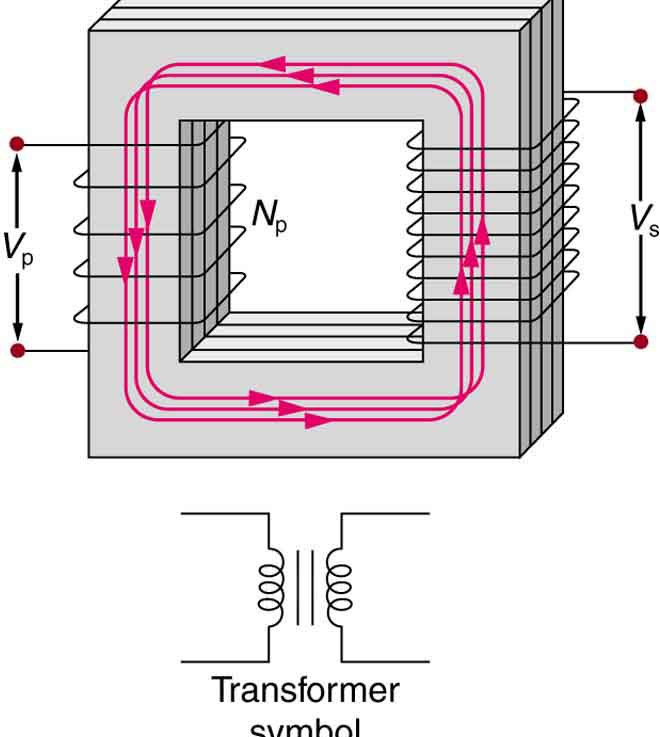
One of the most pertinent devices in the field of electrical engineering are transformers. The function of a transformer is very simple, it changes the potential difference from one value of wiring to another. The mechanism works a follows; The will be two wirings of coil, one on each each side of the transformer. The wire on the left will be hooked up to an alternating current which in turn will cause a magnetic field to be produced. As a by-product of Maxwell’s equations, there will be an voltage difference induced on the second coil. The voltage potential depends on the number of loops that the wire makes. If the wire has more loops then more voltage will be produced and it will be called a step up transformer. If there is less wiring there will be less voltage and it will be called a step down transformer. The equation for a transformer is VsVp=NsNp, with Vsbeing the secondary voltage Vpbeing the primary NsBeing the number of loops in the secondary and Np being the number of loops in the primary. As one can observe, The voltage ratio is directly proportional to the Loop ratio. Power also is assumed to be conserved for Mathematical purposes, so we can derive that V1I1=V1I1by using the fact that P1=P2and that P=IV.

Modelling a pendulum using differential equations

Modelling a pendulum using differential equations

   Modelling a pendulum using differential equations     03/10/16


A most interesting intellectual exercises for anyone with a mathematical mind is to model the swing of a pendulum using differential equations. We know that the two forces that act upon a pendulum are the damping force Fdamping=-cx’and the restoring force Frestoring=-kx. When we combine this with Newton’s second law, we get mx”=-cx’-kxwhich can be rearranged to make the following second order differential equation mx”+cx’+kx=0. We can then use any solution method to solve for this differential equation

Inductor

Inductor

         Inductor       03/07/16


Inductors are some of the most fundamental components of the modern day circuit. An inductor usually consists of conducting wire wrapped into a coil, and since a current will run through this wire, a magnetic field will be produced. As a result of Maxwell’s equations, the energy stored in the magnetic field will try to oppose any change in current and a voltage will be created in the inductor. The strength of an inductor is measured by it’s inductance. Inductance is defined as L=i, with Lbeing the inductance , being magnetic flux and ibeing the current. The voltage across an inductor can be symbolically derived by faraday’s law of inductance v=ddtwhich by using substitution leads to v(t) =L*didt. Inductors are widely used to tune out certain frequencies


Kirchoff’s laws

Kirchoff’s laws

Kirchoff’s laws 03/06/16
One of the most pertinent, practical, and sublime tools for understanding circuit theory in electronics is Kirchoff’s laws. Kirchoff’s first law states that the quantity of current going through a junction is conserved going out a junction, or I=0. For a more mechanical analogy, visualize water going through a pipe. In an ideal case all of the water going through one of the pipes will either be distributed to the other two or it will collide with another one to go down the third. Kirchoff’s laws work the same way. Kirchoff’s second law states that the change in voltage across a loop always amounts to zero. One can derive this analytically using the fact that the voltage drop is the same across two parallel lines in a circuit, so consequently their voltage must equal each other and their voltage drop must equal to zero.

Magnetic fields

Magnetic fields

     Magnetic fields  03/05/16
The study of magnetic fields are one of the most pertinent applications to the study of physics. Magnetic fields emanate out of the “North pole” of a magnet and emanate towards the south pole of a magnet (so technically the naming of the poles of the Earth are switched around). As a consequence of Maxwell’s equations, moving charges emit electric fields, so there is always magnetism around currents. The magnetic field only has an effect on moving charged particles that are not parallel in direction to it, since the equation for magnetic force is  F=qv x B, With q being the charge v being the charge velocity and B being the magnetic field.

Gauss’ law

Gauss’ law

Gauss’ law 03/03/16


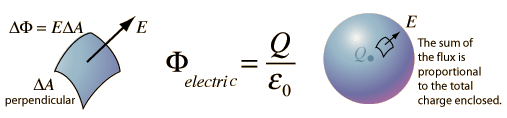
A very interesting way to find the number of charges in an electromagnetic system is to use a technique known as Gauss’ law. Gauss’ law states that if you were to create a geometric surface surrounding the charge distribution and if you were to summate the normal of the total number of electric field lives going through the surface, you would obtain the charge divided by the vacuum permittivity. To put this symbolically, Eda=q0, We can use this concept to find the electric fields in a much simpler fashion that using coulomb’s law.

Birefringence

Birefringence

Birefringence  03/02/16


One of the most perplexing phenomena in the field of optics is that of birefringence. Birefringence is an optical property that depends on the polarization and direction of light. As a result of a peculiar chemical lattice structures, when light strikes birefringent materials, the light splits into two angle of incidences, causing two beams of light to shine. This effect can be induced in a number of ways, one of which is mechanical stress being applied. This effect was stdied by Sir Isaac Newton when he decided to investigate a material known then as the Iceland Spar.