Category: Physics

Earth’s magnetic field

Earth’s magnetic field

Earth’s magnetic field        04/08/16


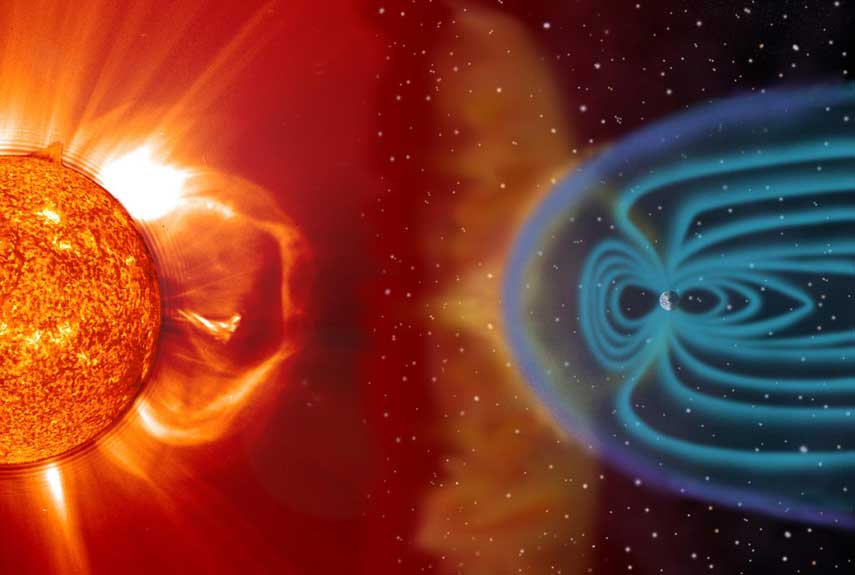
One of the main reasons why the Earth is capable of sustaining life is because of the ever present Magnetic field that it encases. The Earth’s magnetic field usually has an intensity of around 0.65 Gauss, which is enough to deflect charged particles from solar wind aimed at the planet. Also, the magnetic south pole is actually located near the Hudson bay in Canada (the poles are switched around in respect to our conceptual geographic location), so most compases do not point directly north. Every so often the Earth goes through a magnetic field reversal, in which the poles switch from one point to another. The magnetic field is thought to originate from moving iron magma in the outer core of the Earth. Some animals are thought to be able to detect the magnetic field of the earth through the use of biomagnetism, in which a piece of magnetite in the brain of the animal is able to respond to the magnetic field, acting as a sixth sense.
Spontaneous combustion

Spontaneous combustion

  Spontaneous combustion    04/06/16


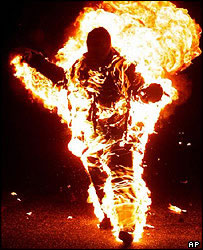
Spontaneous combustion is when an object catches fire through the effect of self-heating. First, objects with low ignition temperatures begin to release heat. If such heat is unable to escape, then the heat re-enters the system. The combustion temperature will rise, and eventually if ignition point is reached and an oxidizer is present, then spontaneous combustion will occur. Hay is an example of an object that reaches combustion quickly.   

Sunspots

Sunspots

Sunspots           04/04/16


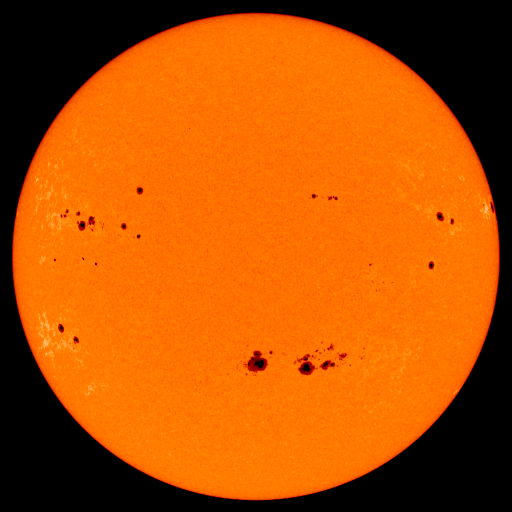
Sunspots are a most peculiar phenomena occurring in the solar system. Sunspots are regions of the sun that are darker and (relatively) cooler than the surrounding photosphere. Sunspots are a temporary phenomenon, usually with a lifespan lasting from several hours to several months. Sunspots can be carried around by the internal rotation of a stellar object. Consequently, the amount of sunspots on a sun have a sinusoidal variability (meaning that the amount of sunspots on the spot goes up and down with time) and this causes the sun to be slightly cooler during times of high sunspot activity. Sunspots also have a high magnetic activity, which in turn can be correlated with events such as coronal mass ejections.

Convection zone

Convection zone

Convection zone         04/02/16


The Convection zone is a layer of a stellar object that is unstable to convection. In this area of a star, all of the energy of this layer is driven completely by convection. This layer is “cool” enough to have heavier ions such as Calcium, nitrogen, carbon, and nitrogen. The convection zone is an important part for any star.

Coronal mass ejection

Coronal mass ejection

       Coronal mass ejection                   04/01/16


Coronal mass ejections are a very intriguing part of solar physics.During filament eruptions, a large amount of hot plasma encapsulated in a magnetic field may be released. Coronal mass ejections will then drift throughout space and if it comes into contact with the Earth, then a Geomagnetic storm may ensue. If the revolution of the magnetic field lines of the CME is in parallel with the magnetic field lines of the Earth, then there will be a large amount of magnetic interference and power grids will be completely shut off.


The photosphere

The photosphere

The photosphere    03/31/16


The photosphere of the sun is so important that if it were to not exist there would be no human life! The photosphere is the spherical surface encapsulating the sun that is thought to emit light. It is situated just above the convection zone of the sun. photosphere blocks certain wavelengths of light. The photosphere is often used to describe a star’s visible surface as it is the part that emits light.

Solar prominence

Solar prominence

Solar prominence         03/30/16


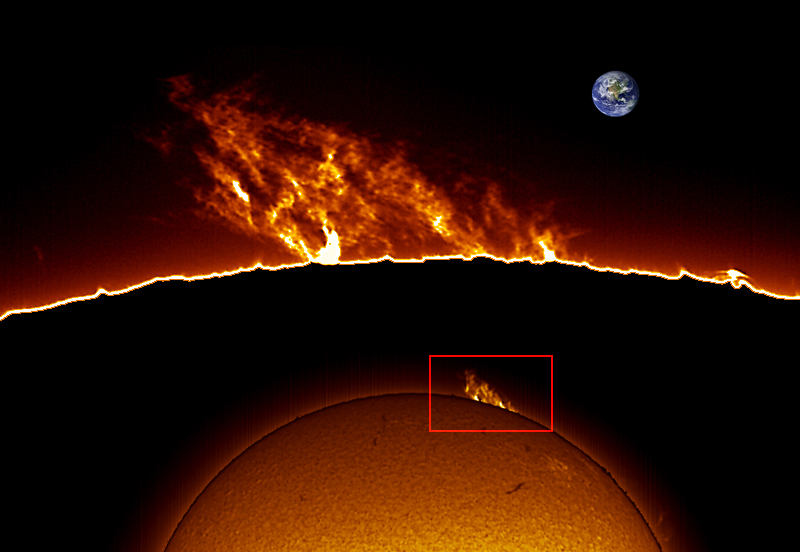
Solar prominences are one of the most important subjects in modern day astronomy. Solar prominences are Bright, gaseous features that extend out from the surface of the sun. Prominences are anchored to the photosphere of the sun in a loop-like geometry. A prominence can form in as little time as a day, and can last for months on end! Solar prominecnes can break apart and give rise to Coronoal mass ejections

Black holes

Black holes

Black holes         03/26/16


One of the most bewildering and fascinating phenomena of reality is that of black holes. Throughout the Universe there are sections of space that have such a high density that the geometry of the space-time becomes so warped that not even light can escape the gravitational pull of such objects. Black holes are usually created with the collapse of a insurmountably large star. The star has such a great contraction that the equivalent density would be if all of the Earth was shrunk down to a marble. Black holes can be of various sizes. A super massive black hole is thought to exist within  the center of the milky way. On February 11th, confirmation was received of gravitational waves originating from a black hole merger.  

Solar power

Solar power

Solar power          03/21/16

Let one consider this. The earth receives around 3.86*1026joules of energy hits the Earth every second. The Earth directly receives1.74*1017of those joules. This number is over 35,000 times the amount  of energy that all of human civilization consumes every second. If we are able to receive this much energy from the sun, wouldn’t it be logical to create a system to harness this energy? This is where Solar Power comes in. Solar power uses Solar panels which in take the energy of the sun and uses the photoelectric effect to transform this into usable energy. Most commercial solar panels have an efficiency rating of 15-20 percent, so research in to higher efficiency solar power is paramount.