Category: Physics

Electric current

Electric current

Electric current 02/26/16


Have you ever wondered how electricity flows? This phenomena has been labelled by Scientists and Engineers as electric current. When there is a voltage difference within a conductive wire, a flow of electrons occur between this voltage difference. The formula for current is given by the equation I=dqdt, where qis the amount of charge flowing and tis the time. There are two types of current found in Engineering, DC (direct current) and AC (alternating current). In direct current, the flow of electrons is a constant, perpetual unidirectional motion, while in Alternating current it oscillates back and forth.  

Hooke’s law

Hooke’s law

   Hooke’s law  02/25/16


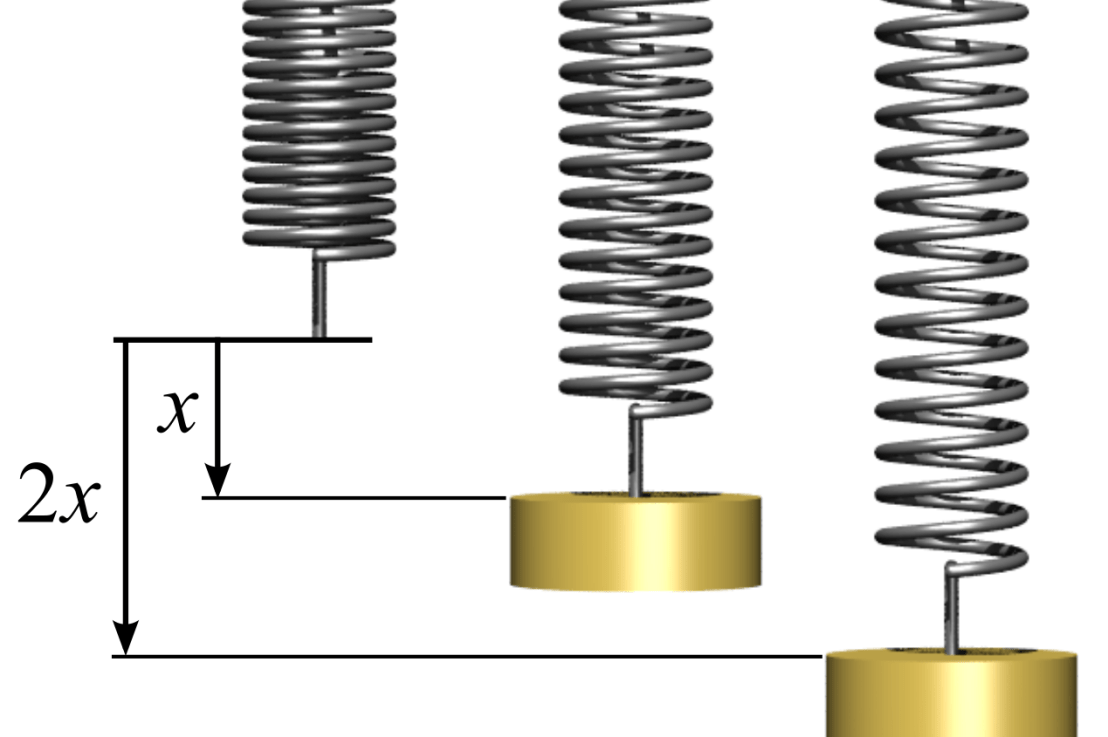
Have you ever wondered why the force of a spring appears to grow stronger as you pull it out? This physical phenomena can be explained with the simple use of Hooke’s law. Hooke’s law states that the force of a string can be measured with the equation Fspring=k*x, with k being the spring constant and xbeing the change in distance from the resting point. The Spring constant can be found empirically by measuring the force’s change over a distance and finding the slope. we can integrate this equation in respect to x to find the potential energy of the object to obtain Uspring=12*k*x2. As one can infer, the more we stretch it out, the more potential energy is in the system, and consequently the more kinetic energy it will have when it reaches the starting point, allowing it to reach a further displacement once again.

Young’s modulus

Young’s modulus

Young’s modulus        02/24/16
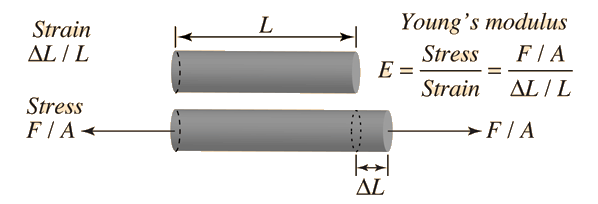
Have you ever wondered why a solid body deforms when stress is applied to it? This is a consequence of Young’s modulus. To get the big picture, Young’s modulus is a property of mechanical bodies that defines how much the body deforms under stress. Before we begin, we must define the terms stress and strain. Stress is the internal forces that neighboring molecules of an continuous material apply to each other (equation is ()=FA0, Force over original area), while strain is the measure of deformation of a material (=LL0, change in length over original length). Young’s modulus is the measure of the proportion of these factors E=()which results in F*L0A0*L. The higher a bodie’s young modulus is the more resistant it is.

Angular momentum

Angular momentum

  Angular momentum   02/21/16
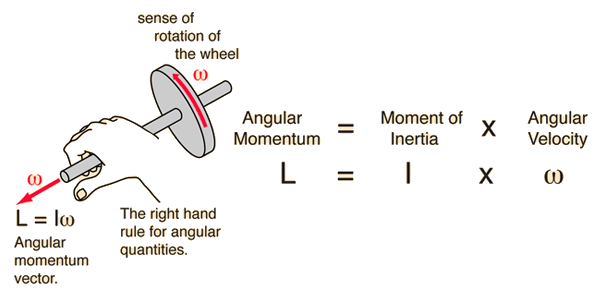
During one’s course of study of physics, one may encounter a concept known as angular momentum. Since momentum is defined as the product of the mass and movement of an object, wouldn’t it follow that there would be a special type of momentum for rotational systems, even if there was no translational movement? This quantity is known as Angular momentum. The mathematical formulation for angular momentum is given as L=I, where Iis the moment of inertia of the system and is the rotational velocity. Angular momentum can also be reformulated as L=r x p, where is the radius, pis the linear momentum and the angular momentum is the cross product between them. Like linear momentum, Angular momentum is always conserved.

Energy Efficiency

Energy Efficiency

Energy Efficiency 02/21/16

As a result of the second law of thermodynamics, the phenomena of a one hundred percent energy efficient system exists in human imagination only. Consequently, the energy efficiency of systems can be measured. If you take the percentage difference between the input power of a system and the amount of work it does, then you have just measured the energy efficiency. This has a pertinent application to the field of Engineering, where maximum efficiency is paramount. For example, the energy efficiency of most commercial solar cells is between 15-20%, so 15-20 percent of the energy taken in from the sun is transferred into usable work.

Electric force

Electric force

Electric force 02/20/16

A most usefull riveting concept found in the study of electromagnetism is the electric force. The electric force is defined as the at-a-distance interaction between two charge particles, described by the equation Felec=q1*q24**0*r2 . As one can discern, the Force is proportional to the strength of the two charges, a constant,  and the square of the distance between them. This equation is kindred in nature to the Universal Gravitation equation, substituting mass for electric charge and changing around the constants, a most intriguing symmetry found in physics. However, there is one glaring incongruity in the fact that the electrically charged particles can be either positive or negative, while mass can only exist in a positive value.

The Electric force

The Electric force

The Electric force         02/14/16
A most useful riveting concept found in the study of electromagnetism is the electric force. The electric force is defined as the at-a-distance interaction between two charge particles, described by the equation Felec=q1*q24**0*r2 . As one can discern, the Force is proportional to the strength of the two charges, a constant,  and the square of the distance between them. This equation is kindred in nature to the Universal Gravitation equation, substituting mass for electric charge and changing around the constants, a most intriguing symmetry found in physics. However, there is one glaring incongruity in the fact that the electrically charged particles can be either positive or negative, while mass can only exist in a positive value.

Air resistance

Air resistance

             Air resistance                  02/12/16
An interesting conundrums appears for students of physics when considering Newton’s first law. If objects are supposed to go on forever in the vacuity of a net force, then why do objects on Earth slow down in the horizontal direction? The answer lies in the fact that when objects move through Earth’s atmosphere, they experience a phenomena called air resistance. Because air is a fluid, solid objects can be suffused in it as a surrounding medium. Analogous to objects moving in water, when one moves through the atmosphere, it comes into contact with air particles, causing minor but emergent impinging effects on an object’s motion. When all of these collisions amalgamate, a phenomena known as a drag force appears. This drag force is what causes all of the impinging effects. Because drag force is based off collisions with air particles which in turn are based off Newton’s third law, the drag force is contingent on an object’s velocity, so the faster one moves, the more resistance one experiences. An application of this is terminal velocity in free fall, a peculiar phenomena that all objects in free fall experience. When an object is in free fall, it accelerates which in turn causes it’s velocity to rise, However, as it’s velocity rises, so does it’s drag force, and consequently the velocity of the object will reach an apex, with the drag force balancing out the gravitational force, therefore causing constant velocity as a result of Newton’s first law.

Nuclear force

Nuclear force

Nuclear force             02/11/16
One comes in to an interesting quandary while studying the atom under Newtonian physics, if the protons and electrons are of opposite charges, then why don’t they attract each other and collide? The answer lies in the fact that there is a force present in the universe called the Nuclear force. The nuclear force is an enigmatic phenomena, being one of the most powerful forces in the universe but only present between particles at distances up to 1 ferometer (1*10^-15 m!). When active, this force is what keeps the electrons floating around in the orbit of the nucleus.