Category: Physics

Electric conductivity

Electric conductivity

Electric conductivity

06/30/16

“What are the properties of materials that conducts electric current and how can we measure it?”

When pondering electrical insulators, many may wonder if there are any anti-thesis to such materials? Specifically, what are some properties of objects that conduct electricity? And how do they do so? First off all, we must think about how electric current works in the first place. Electric current is caused when a voltage potential difference interacts with the free-moving electrons within a lattice. These particles, being weakly bonded to their structure, are carried away in the direction of the potential difference. So logically, all current conducting materials (which will henceforth be referred to as conductors) must have an internal lattice with electromagnetic bonds that are not too powerful, and a path for electron travel.

With this knowledge, we can then delve further in to what geometric factors may affect the conductivity. If the cross-sectional area of the object is larger, then that means that the electrons have a greater area to travel through (remember, electrons do not move in a straight line, they bounce around the internal structure, so when the area gets wider, they have more room to move, which means less traffic and therefore less collision and therefore less resistance). Secondly, if the Length is longer, then there will be more internal resistance, which would lead to a slowdown.

After much research, scientists and engineers have come up with an analytic model of conductivity, with the equation G=(alpha)*A/L, with G being the capacitance, (alpha) being a constant, A being the cross sectional area, and L being the length. What’s even more interesting is that this relationship is directly inverse to the equation for  resistance! This is an amazing technical feat, because this means that human ingenuity was able to find a fundamental relationship between the resistance and conductivity of a material.

Electric insulators

Electric insulators

Electric insulators

06/29/16

“How do we classify materials that do not let charge flow freely?”

For most of our study of electromagnetism, we have been studying materials that allow electrons to flow freely. But out of curiosity, are there materials that do not allow such a free movement of electrons? If these materials do in fact exist, then trying to induce an electric current to flow through them would be futile, as the electrons would not even budge. Believe it or not, these objects do in fact exist, and scientists and engineers  classify these materials as insulators. Insulators have many pragmatic purposes, such as dielectrics and high voltage systems.

Electric polarization

Electric polarization

Electric polarization

06/28/16

“Do insulators respond to electric fields?”

What happens when an insulator, which by nature holds it’s charges in stasis, is placed within an electric field, specifically one with a very large strength? Well, as an object within the universe. the insulating material is made up of subatomic particles. Some of these subatomic particles have a charge.The charges will react to this electric field, and consequently, particles of one charge will be attracted to one side of the object, and particles of another charge will be attracted to another. As a result, the object will have an induced polarization, or some parts of the object’s geometry will have a net charge as a result of the electric force.

Dielectrics

Dielectrics

Dielectrics

06/27/16

“Is there a way to increase the capacitance of a capacitor without actually modifying the capacitor itself?

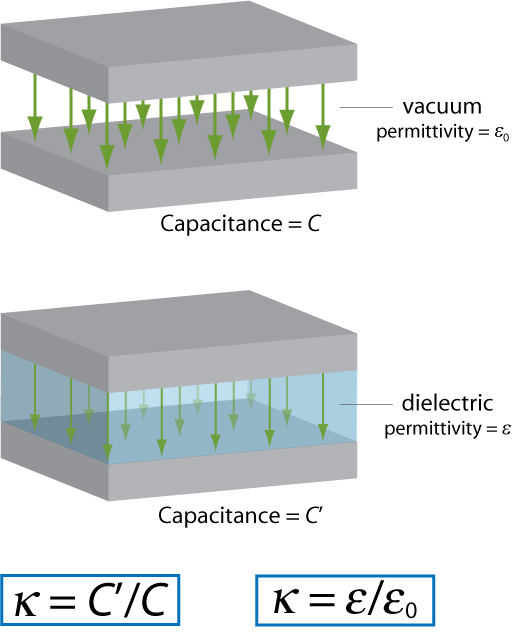
Scientists and Engineers are very practically minded people,so when working with electronics, they would like to make the components as efficient as possible. So when applying this mentality ro capacitors, one way to accomplish this is by increasing the capacitance of the capacitors themselves. So let’s think about how a capacitor works in the first place. If you remember, what makes such components function is that two conducting plates are placed parallel in between a non-conducting material. Let’s call this material a dielectric. When placed in between the two charged plates, this dielectric will react to the net charge on each plate and become polarized. As a consequence, some of the negative charge of the dielectric will be oriented towards the positive plated and vice versa for the negative plate. This causes some of the charge to cancel out, which reduces the effective voltage, which increases the space for extra charge which allows the capacitor to store more charge! We can symbolically relate the old and new capacitance with the equation C=kc, where the capital C represents the new capacitance, k representing the dielectric constant (basically the quantity of the material to store energy in an electric field) and c representing the old capacitance. As one can see, dielectrics are very practical devices that can have many potential uses

Practice of Capacitors

Practice of Capacitors

Practice of Capacitors

06/25/16

“How can we apply capacitors to accomplish practical tasks?”

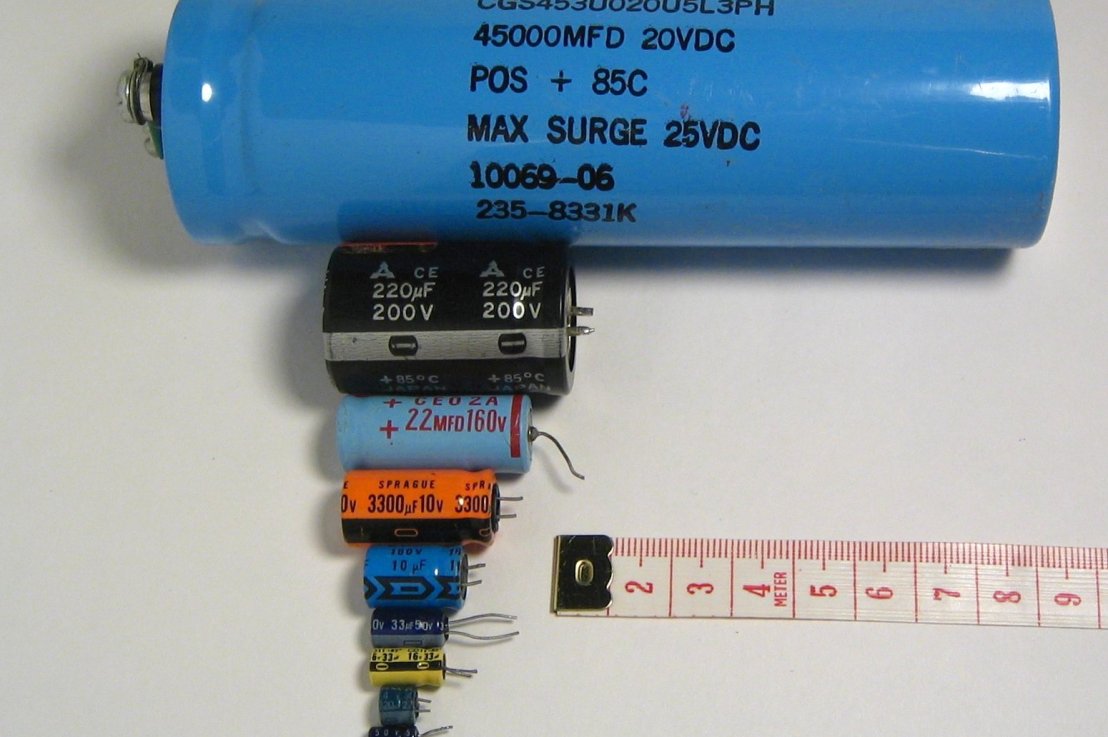
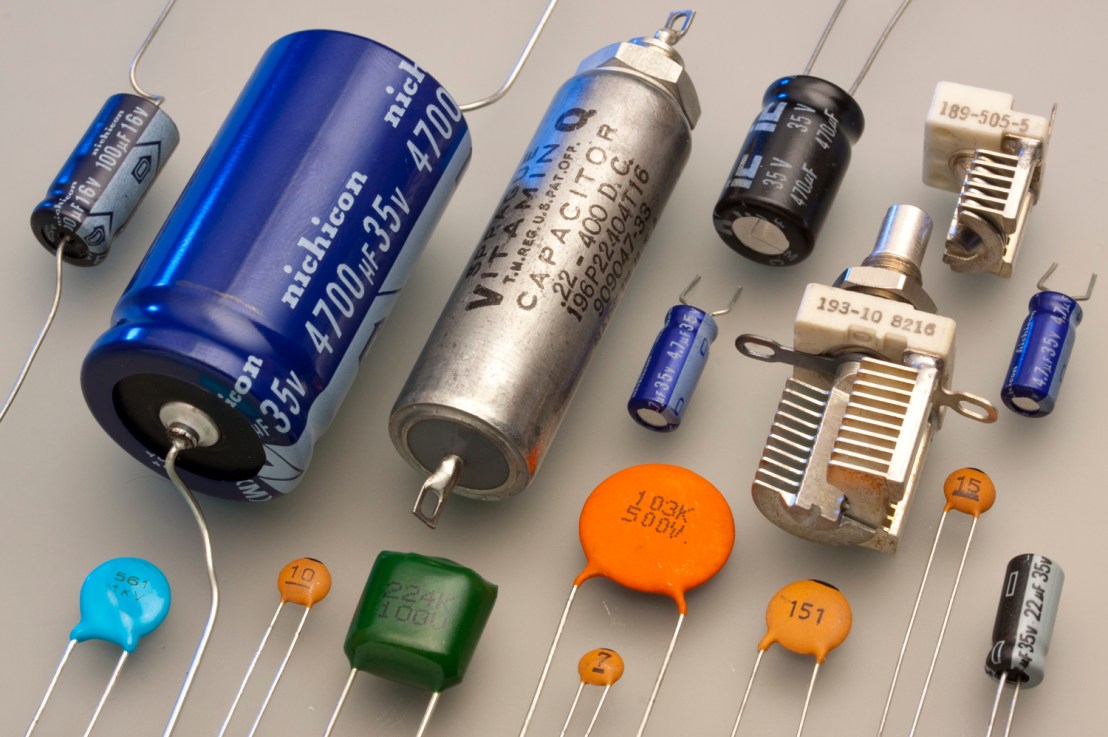
Capacitors have many uses in application. The most common utilization for capacitors is to store energy. Energy can be stored within the electric field of a capacitor, and this energy can continue being stored even if the battery has been disconnected! Capacitors also have a very quick discharge time (often only in the milliseconds) so they can serve as a quick battery. Capacitors can also be used a sensors, accomplishing tasks such as measuring the fuel levels in an airplane. However, one of the most powerful uses of a capacitor is to be a low pass filter. Since the resistance of capacitors in an AC circuit increases inversely proportionally to the frequency of an object, a low frequency current will be hampered by the filter, which means that a minimum threshold of frequency must pass through.

Theory of Capacitors

Theory of Capacitors

Theory of Capacitors

06/24/16

“Is it possible to store electricity in an electric field?”

Let us consider the following. Two conductive plates are placed on the positive and negative terminals of a circuit with a battery, both in parallel with one another and separated by an insulating material. When the battery turns on, electrons will rush from the “positive” terminal plate, causing a net positive charge on the aforementioned plate. This net charge will then induce electrons to flow from the negative side of the battery to the other plate The balance of these two charges will create an electric field, which in turn will store voltage. This device is called a Capacitor

 We can symbolically analyze capacitors using the equation C=qv, with C being the capacitance, q being the charge, and V being the voltage. Now let’s think about this equation from a real world perspective. We know that Capacitance is caused by a charged particles emiting voltages, so the higher the ratio of maximum charged particles to voltage, the more that this capacitor can store. An equivalent  way to put this equations is C=e*A/D, where e is the electric permittivity constant, A is the area, and d is the distance between the plates. Again, let’s put this in a real world perspective. This seems to be a ratio of the area of the plates to the distance between them, so the more area, the more charge we can store, and the greater distance the smaller the electric potential will be between the charges In addition, we can analyze the energy of the capacitors using the equation E=½ * C* V2, so the more capacitance and voltage, the more energy can be stored in in the object. In summation, capacitors are an intriuing way to store energy

Kinetic energy

Kinetic energy

Kinetic energy

06/22/16

“What quantity can we give to a moving object?”

As discussed earlier, energy exists in all kinds of forms, but we want to to be specific, how exactly do we define the energy of a moving object? We call this quantity Kinetic energy. Kinetic energy is a measurement of energy of a

A young physicist might have two questions on their mind. First of all, how what quantity can we give to a moving object, and how can we apply the idea of energy to a moving system? Well, more seasoned veterans of science have already debated and answered the question, with the end result being kinetic energy. Kinetic energy is the quantity of energy associated with a moving object. The unit for Kinetic energy (here on will be abbreviated as K.E) is the Joule, and the formula is K.E = 1/2 * m *v2, with m being the mass of the object and v being the velocity. From this relationship, we can notice an interesting relationship, when the velocity of an object increases, the kinetic energy will increase to the square of the difference! For example, if an object goes twice as fast than another object of the same mass, then it will have four times as much kinetic energy.

Furthermore, the Kinetic energy of an object is directed related to the work that was done on to the object. We can put this numerically as F*d=1/2 * m*v2, Where F is force and d is distance. This means that by knowing the work done to an object, we can find the change in kinetic energy, and if we know the mass, the we can use this to find the change in velocity! On top of this, due to the conservation of energy, K.E can be transferred into all sorts of other forms of energy, such as potential energy.

AC electricity

AC electricity

AC electricity     06/14/16

“What is AC electricity?”

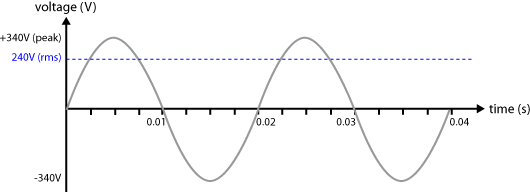
When one first starts to learn about the basic concepts of electricity and circuitry, they are first introduced to the conceptually easier and more primitive DC electricity.However, the most commonly used form of electricity for power transmissions in the modern age is known as AC electricity.

A generator for AC electricity works as follows. A shaft that contains magnetic materials is encass in series of windings. When the generator turns, the electromagnetic interactions between all of the materials will induce a voltage that alternates with time (hence the name Alternating current).

However, what makes AC power vital for long distance transportation is the transformer. Before AC, there was a problem, households require a lower voltage for safety  purposes, but transferring low voltage over a long distance is inefficient due to the IR power loss, or the fact that the higher the current, the more energy will be dissipated over a long distance. But with the introduction of a transformer, this dilemma can be solved. Since AC currents are constantly changing, they produce magnetic fields around their paths. If one is to place a ring of loops near this magnetic field connected to a different circuit, then another current can be induced. What is particularly fascinating about transformers is that both circuits can have different voltages! The way that this works is that the value for magnetic flux will be different depending on the number of loops, so if the “receiving” side has more loops, the transformer will be a step up transformer and the other side will have a higher voltage, while the reverse is true for one with less wires (“step down” transformers). Therefore, the voltage for power transmission can be extremely high and can “step down” once it becomes close to a user’s home.

Pressure volume diagrams

Pressure volume diagrams

Pressure volume diagrams              06/13/16

“How can we empirically model the change in pressure and volume of a gas?”

In order to model the change in pressure and volume of a gas, Scientists and Engineers have created a framework known as Pressure volume diagrams. P-V diagrams are very simple, the Pressure and volume of an object will be represented by a cartesian coordinate system with the Pressure on the vertical axis and the Volume on the horizontal. When work is added to the system, the change in volume and pressure is recorded along an arc length. The volume under this curve represents the change in work in the system. The return process does not have to be symmetric, so often a P-V diagram could possibly have a different return curve.
Let us illustrate with the following example. Imagine gas with a piston in a machine.The state of the gas gas starts at point 1 on the graph. Heat is then added, which the increase the pressure. The normalization process then starts, which decreases the pressure and increases the volume, causing the state to go to poin 2. Heat is then extracted, which causes the state to go to point 4, and the reverse normalization process starts, which causes everything to go back to the begining at point 1.