Category: Physics

Thermal expansion

Thermal expansion

Thermal expansion

08/12/16

“What happens to the volume of objects upon a temperature change?”


Let’s think about something. All objects are composed of vibrating atoms. And when an object is heated, those vibrations become more powerful, and the lengths of their vibration increase. So, what does this imply on the macroscopic scale? Well, if an object’s volume is determined by the volume of space that this volume of atoms takes up, and this volume increases, then the volume object should increase as well, therefore, heating causes (most but not all) objects to expand. Scientists and Engineers have named this phenomena thermal expansion. Thermal expansion is a very omnipresent physical phenomena, and can have dire implications for works of engineering if not taken care of.

What went wrong with Fukushima?

What went wrong with Fukushima?

What went wrong with Fukushima?

08/04/16

“What exactly took place with the fukushima reactor?”


Many people still remember the events of March 11th, 2011. On that day, an earthquake and a tsunami both with an insurmountable amount of force hit Japan, causing truly catastrophic damage. What was particularly hit were the Nuclear reactors in Fukushima, causing a great dispersal of radiation into the surrounding region

Let’s start with the basics. The reactors in Fukushima use both plutonium and uranium as fuel. These atoms are so large that they can easily become unstable. If a neutron hits them then they are likely to collapse. When fission occurs, these atoms release at least two neutrons, which  cause a butterfly effect know as a chain reaction if those neutrons hit more atoms, causing much energy to be created which ends up as heat. Fukushima use water as a coolant to form steam, which passes through a moisture separator to power a large turbine to create electrical energy.

Usually, reactors have a shutdown safety feature, in which a control rod slams into the fission reactor, stopping the fission process. However, since the isotopes are still in the process of decaying, so the “decay heat” needs to be removed so a meltdown does not ensue. Usually, this is accomplished by a cooling pump. However, this cooling pump often requires energy, so it usually takes it from the grid or two backup diesel generators.

Since radiation is still being generated, a three-layer security system is often put into place. This protection system includes fuel cadding (which uses a thin layer of a zirconium alloy to surround the fuel rod), the reactor vessel (a thick steel vessel that contains the fuel rods and a high-pressure coolant) and the containment structure (a thick shell of reinforced concrete). And since pressure from the water reactor often rises with the water temperature level, the vessel has safety valves that are designed to vent pressure (usually in the form of steam or radioactive water).

What happened in Fukushima went as follows; The earthquake caused massive tremors, which caused the fail-safety features to activate. However, the connection to the grid was knocked out by the earthquakes, and the tidal waves destroyed the diesel engines. This in turn caused a heat buildup, which in turn lead to a complete meltdown for three of the reactors.

Whatever has happened, the people lost in Fukushima will always be in our hearts, and we must strive constantly to make sure that such a calamity does not happen again. After reading, this, try to find a way to help the victims of Fukushima

Magnetic field polarity

Magnetic field polarity

Magnetic field polarity

08/03/16

“Why do scientists describe magnets as having a north and south pole?”


Magnets are very interesting pieces of the physical universe. They seem to be able to attract and repel objects with a completely invisible field. However, why is it that one side of a magnetic field can attract objects and the other side repel, and how can we describe the direction of this physical field?

When studying magnetism, scientists and engineers have decided to describe the flow of magnetic field in terms of polarity. All magnets have  are fundamentally dipolar, which means that one side is like the “positive” charge on an electron, while another is like a “negative” charge. Similar to electrons, opposite polarities attract and like ones repel. However, instead of being called positive and negative, these sides of a magnet are called the north and south poles respectively, almost like how the earth has a north and south pole (speaking of which, the earth’s magnetic poles are actually opposite of the geographic poles, but that is a topic for another time). For specifying the direction, Physicists have constructed the system so that the magnetic field will point from the north pole to the south.

Lenz’s law

Lenz’s law

Lenz’s law

07/15/16

“What is the relationship between a changing magnetic field and induced voltage?”

Because of Maxwell’s equations, we know that there are fundamental relationships between electricity and magnetism. If we think more in depth about this, wouldn’t it not be too far fetched if there be some some of affect that a changing magnetic field could have on electricity? Well, if the little physicist in you wants to ponder more, then it turns out that this relationship is true. One of the most fundamental physical laws is known as Lenz’s law, which states that a changing magnetic flux causes an induced voltage. For those of you who know calculus, we can state this quantitatively that the time derivative of magnetic flux is equal to the induced EMF

Eddy Currents

Eddy Currents

Eddy Currents

07/13/16

“What happens when a conductor moves through a magnetic field?”
Let’s consider a situation. Say we have a conducting material, such as copper or iron. And let’s also say that we are going to pass this material through a magnetic field. Since conductors contain electrons, and when electrons move at a speed relative to a magnetic field, a force will be generated. And since conductors allow electrons to move within the internal structure of the material, these electrons will swirl around in a way so that they generate a magnetic field that opposes the original magnetic field. Because such movement of electrons are circular in nature, scientists and engineers have termed this phenomena eddy currents.

Atomic clocks

Atomic clocks

Atomic clocks

07/10/16

“Is it possible to have clocks accurate to a billionth of a second?”

We use clocks to keep time everyday. Whether it be for scheduling flights or processing the internet, civilization depends on clock technology to keep everything in balance. Clocks work by measuring the oscillations of a pattern, such as measuring how long a pendulum takes to swing back and forth or the earth to move around the sun. However, such machines are not always perfect. Since clocks (of all types) are physical objects, they are subject to the physical laws of the universe. Consequentially, these contraptions are prone to perturbation, which in effect makes them liable to becoming out of sync with other clocks. These inconsistencies add up over time (pun defiantly intended), and if they go on for too long, then drastic consequences can happen. For example, high speed finance trading could go asunder, which would have devastating effects on the global economy.

So how can we make a clock so accurate that we would never have to worry about civilization collapsing?

Well, luckily for people anxious about such an event, scientists and engineers have constructed marvelous devices known as atomic clocks. Atomic clocks work by measuring the internal oscillation of a cesium atom. Cesium atoms vibrate over 9 billion times in one second, and atomic clocks base their own measurements off such vibrations. Atomic clocks that are so accurate that commercial units are accurate to one second in 3 million years! Because of this genius design, scientists and engineers now base the unit of the second is based upon how  atomic clocks can measure the osculation of a cesium atom.

Joule heating

Joule heating

Joule heating

07/09/16

What effects does dissipated current have on a wire?

Let’s think about something. When particles move through a conductor, we know that they do not move in a straight line, but instead in a semi-random and chaotic pattern of colliding off the walls of the material. During the collision process, some of the kinetic energy of the electrons is converted into thermal energy inside the conductor. After a while, this process (Which scientists and engineers have termed joule heating) will have a macroscopic effect on the temperature of the material. We can quantify Joule heating by using the formula H = k* I^2 *R * T, where H is the heat, K is a constant I is the current, and R is the resistance of the material. One very pragmatic application of joule heating is in a technology that we all know of, the incandescent light bulb. The increased temperature of the filament in the light bulb causes it to glow, which gives off light to the surrounding area.

Partial pressure

Partial pressure

Partial pressure

07/07/16

“How can we quantify the different pressures contributed by different gases in a container?”

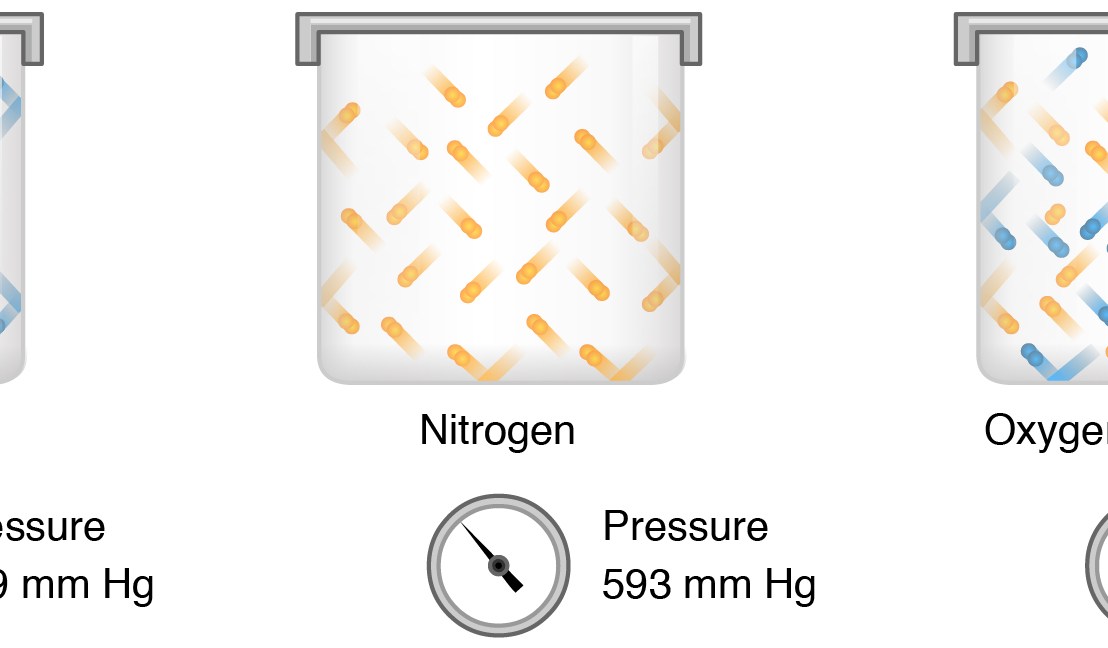
Let’s think about something. We know that a mixture is a combination of different gases held within a given volume. We also know that different gases are made up of different molecules. And we also know that different molecules come in different sizes and forms, giving them different quantitative properties. And one of these different quantitative properties happens to be pressure. So therefore, gases of different chemical makeup will have different pressures. So how can we mathematically determine the pressure that each gas contributes to the mixture? Well, this is actually one of the easiest things to solve for in chemistry. All one has to is find the total percentage contribution to the mixture that one of the gases contribute, then multiply that concentration by the total pressure, and one can get the amount of pressure that the individual gas contributes. Scientists and Engineers have termed this the partial pressure of the gas.

Calorimetry equation

Calorimetry equation

Calorimetry equation

07/06/16

“How can we measure the change in energy of an object when it changes temperature?”

Let’s consider something. We know that temperature is a measure of the average internal kinetic energy of an object. So logically, if there is a change in temperature, there is a change in the energy of an object. But how is it possible to measure this change? Well, luckily for us, Scientists and Engineers have come up with a special relationship relationship known as the calorimetry equation. This equation can be represented numerically as q=m*c*t, with q being the change in energy, m being the mass of the object, c being the specific heat capacity (a constant based on the material), and t being the change in temperature.