Category: Physics

London dispersion

London dispersion

London dispersion

11/11/16

“What is the weakest of the intermolecular forces and how does it form?”


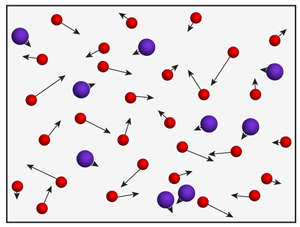
As a result of the nature of quantum mechanics, we know that in atomic structure, electrons do not orbit around the nucleus in a newtonian fashion, but instead are located in probability densities surrounding the core. Since electrons will move around in such a manner, the charge distribution of an atom is bound to become slightly asymmetric with time. Consequently, these asymmetric atoms will interact with other asymmetric atoms to form very subtle electric dipoles, resulting in a very weak intermolecular force. Scientists and Engineers have termed this phenomena to be London dispersion, and it is found to be the weakest of all the intermolecular forces. Despite this, as a result of it’s universal nature, all molecules are found to exhibit london dispersion

  

How quantum mechanics poses problems with reality

How quantum mechanics poses problems with reality

How quantum mechanics poses problems with reality

11/09/16

“What are some of the most counter-intuitive aspects of quantum mechanics?”


At the turn of the 20th century, physicists began discovering that the Newtonian mode of the universe was inadequate. In classical mechanics, one is able to predict the entire motion of an object using only a simple set of equations, giving the universe a deterministic structure. However, this simplicity collapses as one enters the quantum scale. Instead, every time objects collide with one another, only a probability of possible trajectories can be given by a mathematical tool known as a wave function. Since this phenomena is so strange, physicists are divided into two discrete worldviews regarding the properties of the wave function; instrumentalists believe that the wave function is only a conceptualization invented by humans, and that there is no absolute way of knowing reality, while naturalists believe that the wave function is in fact a property of nature itself. Whatever it is, a most intriguing aspect of this facet of nature is that all of these semi-random chaotic quantum processes will eventually coalesce to emerge into the materialist universe that we can observe and experience. So everytime you think that everything is dull and boring, just think about the myriad of secluded wondries going on in the smaller scale!

Adhesive forces

Adhesive forces

Adhesive forces

11/07/16

“What causes liquids to stick to surfaces?”


Have you ever wondered why liquids seem to have sticky properties? Well, let’s think about it. We know that molecules of a liquid substances are attracted to each other through the phenomena of intermolecular forces, but since all materials in the universe are made up of molecules, wouldn’t it be logical that molecules of these liquid substances could also be attracted to molecules outside of the substance? This is the fundamental idea behind adhesive forces. Because of adhesive forces, liquids have the ability to “stick” to the containers in which it rests. And most peculiar application of adhesive forces are utilized by the insect known as water striders, who can literally glide upon water.

Cohesive forces

Cohesive forces

Cohesive forces

11/06/16

“What causes liquids to stick together?”


Liquids are a most peculiar state of matter. Their shape will change depending on the container that they’re in (just like gases) , but at the same time their volume will remain consistent (just like solids). Why do liquids have this paradoxical combination of features? Well, let’s investigate it. On a microscopic level, the molecules of liquids move around in semi-free state, not being as rigidly bound as a solid but not having the level of separation as a gas. The molecules of a liquid are attracted to one another through a phenomena known as cohesive forces, in which molecules of the same type experience an intermolecular force attracting one another. Now with this fact, we can deduce something very interesting. Volumes of a material are composed of units of molecules. And since molecules in liquid experience cohesive forces that makes them stick together, the amount of molecules in this liquid will not change unless a more powerful force rips away some of the molecules, therefore giving liquids a constant volume! Due to cohesive forces, liquids can be fluid like gases but maintain their volumes when poured into another container or experience mechanical stresses, or exhibit properties such as surface tension.   

Intermolecular forces

Intermolecular forces

Intermolecular forces

11/05/16

“What exactly keeps groups molecules together?”


Have you ever wondered why even through objects are made of molecules moving around in space, they seem to be able to keep their form? Well, let’s think about it. First of all, let’s view everything from a microscopic standpoint. When molecules are close to one another, they have a tendency to form associations with one another resulting from a phenomena called intermolecular forces. The forces (in increasing order of strength) include london dispersion (in which all molecules experience), dipole-dipole interaction (when two or more electrically charged molecules come in close proximity within one another), and hydrogen bonding (when a hydrogen atom of one molecule comes into close proximity of an oxygen[O], nitrogen[N], or fluorine[F] of another). What I find personally amazing is how billions of these forces over time will manifest into the everyday material objects that we experience everyday!

Root-mean-square speed

Root-mean-square speed

Root-mean-square speed

10/31/16

“How can we find the average kinetic energy of all of the atoms in a gas?”


We see gasses everyday, whether it be the atmosphere that we breathe, the substances that drive pneumatic controls, or the air that flows through air conditioner. However, we also know that the temperature and kinetic energy of a gas is contingent upon the speed of the gas itself. The problem is, since gases are composed of individual particles moving with only weak connections to one another, measuring the average velocity of the entire system probably sounds like a near-impossible task! Luckily, due to the labors of countless scientists, it turns out that such an endeavor is not impossible at all with the use of a conceptual tool known as the root-mean-square-speed. The root-mean-square-speed states that the average speed of all of the individual particles in a gas is proportional to the square root of the temperature of the gas divided by the molar mass of the molecules that compose the gas, all of which can be represented symbolically as vrms=3*R*T/(Molar-mas) ., with R being the gas constant 0.08205 Liter atm/molar * k, and T being the temperature in kelvin.

Electron affinity

Electron affinity

Electron affinity

10/23/16

“How can we measure the energy used when an electron is added?”


We know that the energy of an atom changes when an electron is added. But how can we measure so? Well, we know that electrons are always placed into orbitals. And we know that an element’s oxidation state is contingent upon the numbers of orbitals filled. And on top of that, the more orbital shells are filled, the smaller the radius becomes, therefore magnifying the force. So wouldn’t it make sense that it is easier for an electron if most of the valence shells are filled? Therefore, electrons become easier to add the higher occupancy of orbitals.This makes sense because as we move from left to right, elements tend to become more negative in their reactions. Scientists have termed this principle electron affinity.

Voltage

Voltage

Voltage

10/16/16

“What is voltage?”


Often times, when you read about electronics, you hear about some abstract measurement called voltage, but what exactly is this concept? Well, Voltage is defined as the difference in electrical potential between two points in space. Basically,  one can think of voltage like the electrical equivalent of pressure difference between two points in space, so the more voltage there is between two points, the more “push” there is associated with it. For example, just like a high pressure piping system is necessary to drive a turbine, a higher voltage system might be necessary to power more powerful electronic equipment. The unit for voltage is measured in volts, which is defined as one potential energy per meter, meaning that this would be the work done moving one unit charge. Voltage is occasionally called the “EMF” (especially in respect to batteries).

Normal stress

Normal stress

Normal stress

10/08/16

“What happens when stress acts upon an area parallel to the axis of an object?”
The concept of stress is one of the premier foundations of all of engineering science. So, what happens when a stress is applied to an area that is parallel to the axis of the object? Well, this type of action is very simple. Since all of the stress acts through the axis of an object, the only deformations will be parallel to the axis as well. This type of stress would cause tensile or compressive deformations (depending on the direction and strength of materials). Scientists and Engineers have termed this phenomena normal stress. You can find the magnitude of normal stress very simply, as the stress is just the force distributed over the area that it is acting upon (we can represent this symbolically with the equation (sigma)=F/A, with being (sigma) the stress, F being the force, and A being the geometric area)