Category: Physics

Diffraction grating

Diffraction grating

Diffraction grating

03/04/17

“What happens when we shine wave through a large chain of small holes?”
Optics is a most enjoyable branch of science. And one of it’s most peculiar facets occurs from a most simple setup. Suppose that one were to have two sheets of metal facing each other. Then one were to cut a large number of rectangular holes evenly spaced throughout one sheet and finally shine a light upon it. What exactly would happen? Well, let’s use our knowledge of science to figure this out. We know that when a ray of light hits a small opening, a wave will be produced. And we also know that when waves interfere with one another, a superposition will be produced. Now let’s apply this to this physical system. The light incident upon these holes will produce many waves, which will then collide on the opposing sheet. These waves will then either interfere constructively or destructively with one another, causing a pattern of bright and dark spots to occur. These spots will be spaced from one another in a ratio corresponding to the wavelengths of the light beams, the width of the diffraction gratings, and the distance between the two sheets

Ray tracing

Ray tracing

Ray tracing

02/28/17

“How can we represent light rays interacting with lenses and mirrors?”
Even through the field of optics is a deep one, it is also quite simple. At its fundamental core, it is about the properties and interaction of light. This includes the subset of mirrors and lenses. So wouldn’t it be logical that we should develop a system to represent the interaction with lenses and mirrors? To start off, let’s construct the mirrors, lenses, and objects that we would like to work with. Next, label the center and focal point of the mirrors and lenses. Afterward, draw lines emanating from the object, and have it realistically interact with the optical instruments. Then draw the resulting image where all of the rays converge onto one another. This process is known as ray tracing, and is one of the most important tools used by researchers and students in optics.

How images form in the eye

How images form in the eye

How images form in the eye

02/25/17

“How exactly do we see things with our eyes?”
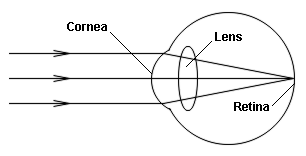
Everything that we perceive in this world is formed through our eyes. However, have you ever wondered how images can physically form in these biological objects? Well, let’s analyze this question scientifically to find out. If one were to take an eyeball and cut it in half through the midpoint of the pupil, they will find a lens just behind the cornea. If you were to then shine parallel light beams through this lens, then you would find that all of the light would focus on to the backside of the eye. The back of the eye will then transmit information to the brain, which will invert the image “in the mind’s eye” enabling us to see!

Shear Stress

Shear Stress

Shear Stress

02/24/17

“What happens when stress is applied parallel to the surface area of a material?”
Any force acting upon a three-dimensional object will produce an internal stress. However, how do engineers classify the types of stress that are parallel to the material’s surface area? Well, after many years of research, this phenomenon has been classified as a shear stress. A shear stress will produce a shear strain in the object proportional to the object’s modulus of rigidity, which can be symbolically represented with the equation (Tau = G*(Gamma), with (Tau) being the shear stress (Gamma) being the shear deformation and g being the modulus of rigidity. The higher a material’s shear strength is, the more it will be able to resist shear strength.

Refracting telescope

Refracting telescope

Refracting telescope

02/22/17

“How do old-school telescopes work?”
Telescopes are one of the most amazing machines that humanity has constructed. Not only have they become a symbol for scientific endeavor but a cultural landmark as well. However, have you ever wonder how they worked (specifically the old-school ones)? Well, let’s use our engineering mindset to figure out this scientific device. If we were to uncover the case of these machines, we would find two convex lenses. Now, if we were to trace a ray diagram through the lenses, we would find something very interesting. First, the incoming light from the object would converge onto a real image on the opposite side of the first lens. The light from this image would then be received by the second lens, which shifts the light’s direction in such a way that their paths would converge on the receiving side of the lens, forming a magnified virtual image, therefore creating an enlarged image that the human eye can see. This form of a telescope is called a refracting telescope, and has been used since the days of Galileo!

Radius of gyration

Radius of gyration

Radius of gyration

02/13/17

“What would happen if we were to take the entirety of the object’s mass and concentrate it at a point?”
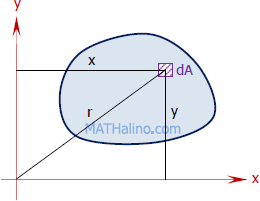
During one’s study of statics, one will have to work with the mass and moment of inertia for objects. However, could there be any ways in which we could simplify our calculations just a tad bit? Well, let’s think about it. Everything could be much simpler if we were to take the mass of the object and concentrate it at a single point away from the axis so that the resultant moment of inertia would be equivalent to original moment of inertia? This is the fundamental idea behind a concept known as the radius of gyration, and can be found with the equation k=Im, with k being the radius, I being the moment of inertia, and m being the mass.

Nuclear power generation

Nuclear power generation

Nuclear power generation

02/12/17

“How exactly is Nuclear power generated?”
We hear about nuclear power very frequently in our lives. However, how exactly does it work? Well, to start let’s look at the process. The fundamentals of nuclear power start with two elements, uranium-238 and uranium 235. U238 composes the majority of uranium in a nuclear power plant, but perhaps the most important of the two is u235. Uranium 235 is very unstable and will decompose rapidly through nuclear fission. When U235 decomposes, it’s neutrons will be thrust throughout space. When these neutrons collide with U238, the element will be shattered into a stream of different particles, which will hit other elements. This quickly sets up a chain reaction which produces a large amount of heat. This heat is then used to boil water to generate steam to move a turbine which generates electricity.

Focal point

Focal point

Focal point

02/07/17

“Why is the point that light will hit for a concentrated solar power system so special?”

Concentrated solar power is famous for its use of parabolic cylinders to concentrate solar energy. However, what special physical property gives it its strength? Well, let’s use a little bit of scientific thinking to find out. Since all light rays contain energy, and these solar systems work by absorbing energy from concentrated sunlight, would it not be logical that we would just place the water at the point of maximum sunlight? If we do enough experimentation, then we will find out that this point is where all of the rays will converge! This point has been termed the focal point and is used for a variety of other applications ranging from photography to telescopes.

The physics of a football tackle

The physics of a football tackle

The physics of a football tackle

02/05/17

“How do the laws of physics affect football tackles?”


Because of the excitement for the super bowl stateside, a fan recently asked for an article about the science of football.


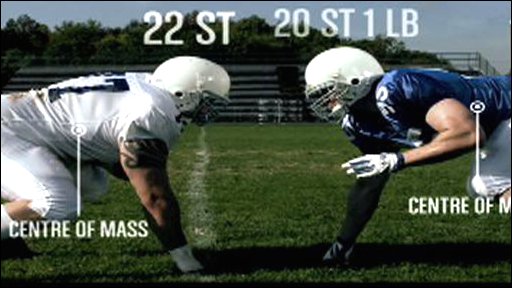
If you are from the United States, then you have probably seen or heard about a game called “football” where people divided onto two teams will fight each other for control of a prolate spheroid shaped ball using tackles. However, have you ever wondered about how one can make an optimal tackle? Well, it turns out that all you need is a rudimentary knowledge of physics to find out.

        Every object in the universe has a property called a center of mass, or the location of the mean position of matter in a body. When a force is applied on an object which does not go through the center of mass, a torque will be induced, causing a rotation on said body. So now let’s put this theoretical framework into practice. The average human male has their center of mass located slightly above the navel. When one football player tackles another in this area, the player will simply be moved in the direction of the tackle. But if the player were to give a tackle below this zone, a torque would be induced that would completely throw off the player! Luckily, professional coaches have taken note of this, and use this scientific knowledge to advise linemen to stay close to ground while running, making it far more prohibitive for a disabling torque to be thrust upon them!

Science always shows up in the most marvelous ways in our everyday life, and it goes to show that a small bit of knowledge of it can go a long way.