Category: Mathematics

Platonic solids

Platonic solids

Platonic solids

09/29/16

“What are some of the most symmetric polyhedra?”


Polyhedra are quite fascinating mathematical objects. Are there any special type of polyhedra that are especially symmetric? Well let’s think about it.We know that polyhedra are constructed by having flat shapes meet at each vertex. What if were to find polyhedra that have an equal number of shapes meet at each vertex? If that happened, then each vertex will have an equal angle, therefore the entire object will be completely symmetric! These solids are classified as the platonic solids, of which there are five of (proven by Euclid): The tetrahedron, the cube, The octahedron, the dodecahedron, and the icosahedron. These shapes can be found everywhere in nature, from the chassis of viruses to the framework of bee hives.

Polyhedra

Polyhedra

Polyhedra

09/28/16

“How do we classify geometric objects with flat faces?”


Think of an object in three dimensions. Any object. You can probably come up with a wide array of diverse and seemingly unending chaotic shapes. But in geometry, we need to organize everything into patterns with special properties. So since we have already started with three dimensional objects, let’s go classify the simplest possible three-dimensional objects. But what exactly are they? Well, let’s think about it. We know that two dimensional objects are simply flat faces. So what if we took many of those flat faces and strung them together in an organized manner? This is the primary principle behind polyhedrons. Polyhedrons are three dimensional objects made completely out of two dimensional faces, with no opening. Did you know that every day objects such as cubes and pyramids are polyhedra?

Vertices

Vertices

Vertices

09/27/16

“How can we classify the point where two lines meet?”


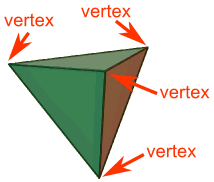
When working with Geometry, We will have to deal with alot of different and divergent phenomena. In order to organize all of this for practical use, we will have to give such special phenomena special terminology. So let’s do an example with the intersection of two lines.. Geometers (Mathematicians who research geometry) have decided to name this intersection a vertex. Since all vertices involve the intersection of two lines, vertices always include an angle.
But let’s not limit ourselves to just simple lines, let’s look at an interesting application of vertexes to more complex three dimensional structures. When two vertices meet in a polyhedron, a mathematical object called an edge is formed. But what is even more fascinating is that if you take all of the faces (the 2-dimensional shapes that make up the outer surface) of a polyhedron, and add the difference of the Vertices and angles, the answer will always equal two! We can represent this symbolically as F+E-V = 2

Scientific notation

Scientific notation

Scientific notation

09/01/16

“How do scientists and engineers represent complex numbers?”

When working in a technical subject, you will probably have to deal with numbers that are either extremely large or extremely small, or have to work with empirically obtained values. For example, the number 602000000000000000000000 is really to read, as well as 0.000027. So how can we make them simpler and more accurate?

Well, let’s try to tackle this problem ourselves. What if we took our understanding of significant figures, and applied it to this problem? Since the only numbers that  we actually need to care about is significant figures, how about we just remove all of the unnecessary zeroes? And how can we accomplish this? Well since we know that if we multiply or divide anything by 10 we will just shift the zeroes behind the numbers, how about we simplify all of the extra zeroes into a power of ten? the For example, when we have the number 602000000000000000000000, we can turn this in to 6.02*10^23. And for the number 0.000027, we can shift it into 2.7*10^-5. This way of working so much simpler! Scientists and Engineers have termed this framework scientific notation.

Now how can we apply this system for calculations? Well, first let’s divided it into two cases, multiplication/division, and addition/subtraction.  In the first case, we will multiply both numbers and round our final answer to the number of significant figures of the variable with the lowest amount of sig-figs. For example, 5.2*10.81 will be 56 instead of 56.212 since the former only has two significant figures. For addition and subtraction, We will simply put all of the numbers in terms of the highest amount of digits after the decimal place, and then round to the lowest amount of significant figures. Let’s do an example. Suppose we have the numbers 3.14 and 2.1, and 1. When we ad the numbers together, we will notice that 3.14 has the highest amount of digits (2), and then rewrite everything else accordingly to become 3.14 + 2.10 +1.00 = 6.24, and then we will round down to one significant figure to finally arrive at 6.

Scientific notation is an amazing tool for scientific accuracy, because when working with complicated systems such as mechanical engineering precision or particle physics, a single bit of inaccuracy could destroy all of our hard work!

Divergence and convergence

Divergence and convergence

Divergence and convergence

07/30/16

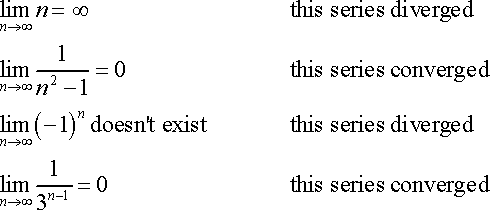
“How can we test when a mathematical pattern will converge to a single number or diverge into infinity?”


Let me ask you a question. Suppose that I were to tell you that a country was completely made up of immortal individuals. And let’s say that these individuals were to reproduce their population at an ever changing rate. How could we tell if their population would expand into infinity, or stop at a certain number? Well, let’s solve a numerical example to figure this out.

Suppose that this same country starts out with one hundred people. And let’s have these people reproduce so that the first year, they would produce half of the population (50 in this case), and the next year, they would produce only half of a half of their initial population (25 ), and so on. Eventually, the number of the people in this country would converge into a single, static number! (200 for this example).

Now let’s the the same population but with a different rate. In this case, the rate of the change of population will be double rate of the prior time, so after the first year, the country will add 200 people, and the next year, the country will add 400 people, and so on, until the number of people in this country will diverge at infinity!

So let’s think about this some more. If the rate of reproduction decreases with each value, then it will eventually shrink down to zero, and if the rate of reproduction increases with each value, then it will expand into infinity.

Well, now let’s apply this mindset to a more abstract mathematical entity. Let’s take the infinite series n=01xn, with the condition that we ourselves can choose that values for x!. Well, for all x values that are greater than one, the value will get smaller as time goes on, and eventually the number will converge onto a single number. Likewise, if our x values are smaller than one, then the rate will be increasing, resulting in an ever expanding number.

Laplace transformations

Laplace transformations

Laplace transformation           05/03/16


One of the most powerful techniques used to solve first order differential equations related to physical phenomena is known as the Laplace transformation. A laplace transformation takes a function f(x) and simplifies it into an equation (s)by using the transformation technique  F(s)={f(x)}=0e-s*x*f(x). This will simplify the function in to a less complex one of variable s.

Fractal Geometry

Fractal Geometry

Fractal Geometry                       

        05/01/16


Have you ever that it many natural objects, there seems to be some form of a repeating pattern? Like how the branches of a tree look similar to the route of a tree? If you are able to discern this, then you probably have a mathematical mind, because you have just stumbled on the field of fractal geometry. Fractal geometry deals with ever repeating sets of geometric patterns, where the patterns branches of from the end and becomes smaller and so on. Basically, the pattern will repeat at every scale. Fractal geometry can be found everywhere, from art to fossils to 3-D animation techniques to coastlines to clouds and even in complex physical and biological systems!

Image:

A classic example of a fractal set, A sierpinski triangle. Notice how the triforce pattern ever repeats on the triangular regions.

Fundamental matrix

Fundamental matrix

Fundamental matrix  04/26/16


A Fundamental matrix is a very interesting application f matrixes. Suppose you have a matrix solution x(t) y(t) = C1[A(t),C(t)]+ C2[B(t),D(t)], then you put the following into a 2×2 matrix (t)=[A(t),B(t),C(t),D(t)]and multiply by the inverse matrix evaluated at 0, or (0)-1

Solving first order systems using matrices

Solving first order systems using matrices

      Solving first order systems using matrices               04/21/16


Suppose we have a first order system with equations x(t)’ =ax(t)+by(t)and y(t)’=cx(t)+dy(t). We can solve these equation by putting the equations into a matrix form. The matrix will end up with a, b, c, and din progressing order. By taking the determinant, we can find the eigenvalues. We then transform this in to what looks like a solution to a second order differential equation C1*e1t*V1+C2*e2t*V2. We then solve for x(t)and y(t), with the front and bottom rows for the vectors are correlated with the x(t)and y(t)respectfully.