Category: Mathematics

Vector Field Diagrams

Vector Field Diagrams

Vector Field Diagrams          04/19/16


A most intuitive way of geometrically representing a solution of equations is through the use of a Vector field Diagram. To construct a vector field diagram, take two sets of equations dxdt=f(x,y)and dydt=g(x,y), set them equal to zero, and then isolate the xand y values on opposite sides. These sets of equations will determine the series of ordered pairs in which the slope is zero (in the horizontal or vertical direction for the f(x,y)and g(x,y) functions respectively). If one wants to see when the values are greater or less than zero, set the functions to a constant c greater than 0, and then solve with yas an isolate. These new solutions will determine the new slope in the x or y directions. One must combine the horizontal and tangential slopes to make the final value

Representing axises with values

Representing axises with values

Representing axises with values         04/16/16


We can Algebraic functions on numerical axises through the use of geometric descriptions. For a linear 1-dimensional axis, we use the variable. For a two dimensional axis, we use and for the First and second dimension respectfully. For a third dimensions, we will add in z, for a 4th we add in w, and when we get to 5 we just convert everything in to roman numerals (becomes I, y becomes II, etc.)

Eigenvalues and eigenvectors

Eigenvalues and eigenvectors

Eigenvalues and eigenvectors           04/09/16


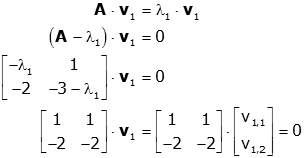
In Linear Algebra, Eigenvectors and Eigenvalues  are special sets of vectors and scalars respectively that  if one takes a Matrix A and multiplies it by some eigenvector xthen A*x=*x, with being the eigenvalue. To solve for the eigenvector, first set it up so the top right to bottom left diagonal values are subtracting an eigenvalue. Then take the determinant of the system and solve for zero. Those will be your eigenvalues. Then lug those eigenvectors in and solve for the equation to get your eigenvectors. I really have no fucking clue about how this works

Matrices

Matrices

Matrices          04/05/16

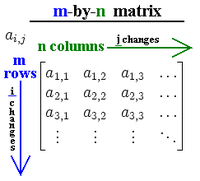
Matrixes are one of the most important facest of mathematics, especially in relationship to linear algebra. A matrix is a rectangular array of number, with m rows and n columns. One can think of matrices as vectors with 2 dimensions of organization. Two matrixes can be added and subtracted from one another given that they are the same size, and they can be multiplied together if they have the number of columns of Ais equal to the number of rows of b


Matrix addition is very simple, one just adds up all of the of the common elements together. For example, if the Matrixes aand b have elements in [2,3], then they will be added up and placed in [2,3] in the final matrix c. A matrix can also be multiplied by a constant number c, such that c*Awill multiply all of the elements contained in Aby c.Matrixes can also be multiplied by each other, in which each column of matrix awill be cross produced to each row of matrix bto make a new matrix of c, which is as large as the common elements of both matrixes. A matrix can also be flipped to such that a matrix of m x nwill become one of n x m, and can be represented by the modificationAT

Applications of derivatives

Applications of derivatives

        Applications of derivatives          03/25/16


Derivatives have a myriad of applications in all of science. One of the most practical uses of differential calculus is the evaluation of newtonian mechanics. The most fundamental of facest, kinematics, is simply derivatives. Velocity is the derivative of position in respect to time, or v(t)=dxdt, and acceleration is the derivative of velocity in respect to time, or a(t)=dvdt=d2xdt2. This means that if our function is a defined variable, then we can find all sorts of information about it by applying the fundamental rules of calculus


Another interesting application of differential calculus is the mean value theorem. The mean value theorem states that if we have a function whose graph is continuous on [a,b]and differentiable on (a,b), and that f(a)=f(b), then f(x)’must be equal to 0 at some point in that line. This makes perfect intuitive sense because if a graph goes up then it must come down or vice versa, and if is continuous and differentiable then the sign of the derivative must change and when it changes it hits 0.


A further application includes Linear approximation. If we have a very complicate function to evaluate, then we can take the derivative at a known point and evaluate it further from there. Because the value of derivatives do not change much for close values, we can use a linear tangent from a known variable to make a fairly accurate approximation. The formula for this equation is y=y0 +f(x0)*x.Take for example the function f(x)=x. It is rather difficult to find  the numerical value for 1.1off hand, however, it is extremely easy to find f(1)’ as well as f(1). from there, we can evaluate it using our equation which becomes 1+12*1-1/2*0.1=1.05This is  extremely close to the true value of 1.0488. In fact, there is only a 0.114%difference! Truly remarkable!


Another useful feature of Differentiation can be used in finding critical points. A critical point is where the derivative of a function  f(x)’=0 or f(x)’=undefined When this happens, a graph of a function will either start to decrease or increase.  We can find these point using calculus, and then we can determine if it is a maxima or a minima by proceeding with the following steps. If the f(x)” is positive, then it is a minima because the function was decreasing until the point c where it changes signs, and vice versa for a minima

Differentiation

Differentiation

        Differentiation          03/24/16


Differentiation is by far the most important topic in a calculus course. Let’s turn the clock back. When you were in algebra, you were able to find the slope of a linear line that contained a rise over a run. Now, you were told that you were unable to find the slope for a line that was not constantly linear in nature. This is where calculus comes in. What you do is that you start out with your simple yxequation (y-y0x  →  f(x)-f(x0))xf(x0+x)-f(x0)xf(x0+h)-f(x0)h ) and you evaluate it at smaller and smaller increments, until it becomes zero. Mathematically speaking, you are taking the limit as the change in x approaches zero, which can be symbolically analyzed as x0yx. We call this a derivative and we represent this concept with dydx, or the derivative of y in respect to x. Differentiation is a most useful way to find the instantaneous slope of tangent lines.

Integration

Integration

Integration             03/23/16


During one’s study of calculus, Integration will be one of the most fundamental facets learned. To put it simply, integration is the a method used to find the area under the graph of a known function. The basic concept of Integration is to take a Riemann sum and take the limit as xapproaches 0. When this happens, we can have an infinite number of infinitesimal lines, and when summated they will give us the area under the curve. Integration is represented by the ubiquitous symbol. To numerically evaluate an integral, all you need to do is reverse differentiate the function or antiderive it.

Overlapping in NHDQs

Overlapping in NHDQs

Overlapping in NHDQs           03/22/16


During a course of study of Differential equations, one may encounter Non-Homogeneous Differential equations where the yand yhave overlapping terms!!! To avoid this entanglement, one must solve for yand then check the terms of ythat overlap, and then multiply whatever terms of yoverlaps by x!

Second order Non-homogeneous differential equations

Second order Non-homogeneous differential equations

    Second order Non-homogeneous differential equations   03/15/16


Let me tell you something, non-homogeneous differential equations are just as painful as they sound. Let’s say that you are given a 2nd order differential equation in the form y”+by’+ay=g(x). What you do to solve this equation is to divide it into a Particular solution and a general solution, which can be represented symbolically as y(x0=yp+yc). To solve for the general solution we set the entire equation equal to zero and solve from there, and to solve for the particular solution we just solve for the solution in the current form.