Category: Mathematics

The elements by Euclid

The elements by Euclid

The elements by Euclid   03/13/16
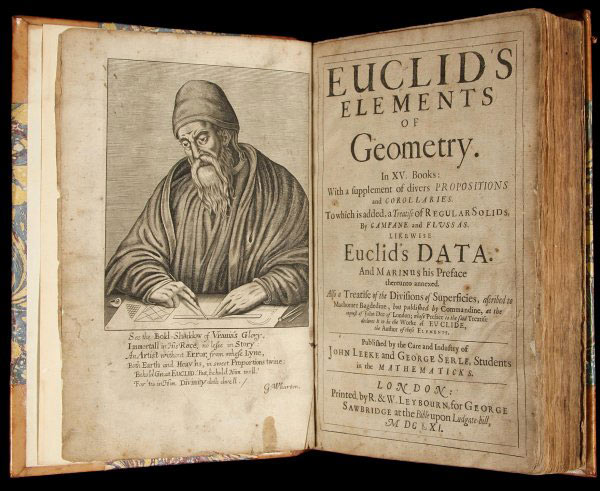
Would you believe it if I told you that one of the most important books ever made was in fact a Geometry textbook? How about if I told you that the same textbook had a shelf life of nearly two and a half thousand years and was only replaced very recently? And that this same textbook is also one of the foundations for the entirety of modern western thought? Well, all of the postulations are in fact complete truth. The elements is a book containing 13 volumes of treatises (all addressing different facets of mathematics). The elements begin with a simple set of postulates or innate ideas. Postulate 1: A straight line segment can be drawn between any two points. Postulate 2: Any straight line segment can be extended into an infinitely straight line. Postulate 3: Given a line segment, a circle can be drawn with that line segment as a radius.Postulate 4: All right angles are congruent. Postulate 5: If two lines are drawn which intersect a third in such a way that the sum of the inner angles on one side is less than two right angles, then the two lines inevitably must intersect each other on that side if extended far enough. This postulate is equivalent to what is known as the parallel postulate. (if it sounds strange, it’s because it has been proven to be only true in a flat space, violating this postulate gives rise to non-euclidean geometry). The elements has been a vast influence on all of western thought. The Dutch-Jewish Philosopher Spinoza created an entire system of ethics using a euclidean style of organization. Abraham Lincoln even studied the elements to assist him in his pursuit of understanding a rigorous proof for law
Modelling a pendulum using differential equations

Modelling a pendulum using differential equations

   Modelling a pendulum using differential equations     03/10/16


A most interesting intellectual exercises for anyone with a mathematical mind is to model the swing of a pendulum using differential equations. We know that the two forces that act upon a pendulum are the damping force Fdamping=-cx’and the restoring force Frestoring=-kx. When we combine this with Newton’s second law, we get mx”=-cx’-kxwhich can be rearranged to make the following second order differential equation mx”+cx’+kx=0. We can then use any solution method to solve for this differential equation

Secondary Differential Equations

Secondary Differential Equations

Secondary Differential Equations   03/08/16


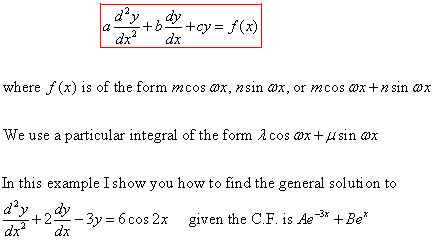
During one’s course of study of mathematics, a most peculiar set of problems will arise. These problems  involve not only a variable and it’s derivative of the derivative of it’s derivative! Mathematicians have labelled the problems secondary differential equations. SDQs are often written in the form ad2ydx2+bdydx+cy=0, with a,b, and c being constants. The solution for such differential equations is as follows, one supposes that the solution for yis y=erx, with r being a constant. We then substitution this postulation into the equation and factor the result. Depending on how the constants work out into the quadratic formula, if b2-4ac>0, then the solution will be y= C1er1x+C2*er2x, since the quadratic will have two distinct roots, with C1and C2being different constants as well as r1and r2. If b2-4ac=0, then the solution will be y= C1erx+C2*x*erx, with only one rsince the quadratic will only have one root. If b2-4ac<0then the solution will be y=C1*ex*cos(x)+C2*ex*sin(x)because it’s an irrational root, with and being constants.

The Rutta Kunga method

The Rutta Kunga method

The Rutta Kunga method        03/01/16

Numerical analysis is one of the most pertinent topics in the field of applied mathematics. The first technique a student learned, euler’s method, is often too inchoate and ineffective for higher accuracy problems. Consequently, the Rutta Kunga methods was developed in response for such a problem. suppose we have a differential equation y’=f(x,y). We then use this really complicated equation yn+1=yn+x6*(k1+2k2+2k3+k4), with k1 =f(xn,yn), k2=f(xn+12x,yn+12*k1*12*x), k3=f(xn+12x,yn+12*k2*12*x), k4 =f(xn+x,yn+k3x). And then magic happens and you get a really really accurate answer after you account for all of the step sizes

Existence and uniqueness for differential equations

Existence and uniqueness for differential equations

Existence and uniqueness for differential equations   02/29/16


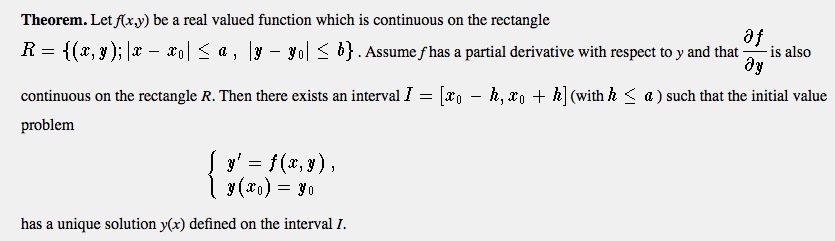
One of the quandaries that a student of mathematics must face is proving existence and uniqueness for differential equations. Suppose we come across a differential equation dydx=f(x,y)with the initial value y(a)=b. If we want to prove that a solution exists for some xvalue, then we just have to discern if f(x,y)is continuous “near” some value (a,b) then a solution does in fact exist. Furthermore, if we would like to find if the solution is unique same near the same (a,b) value we have to take the partial derivative f(x,y)yand observe if it is continuous near (a,b)

Differential Equations

Differential Equations

Differential Equations    02/20/16


During one’s study of calculus, one may encounter a peculiar set of derivatives known as Differential equations. Differential equations ae equations in which the derivative of the function is proportional to the function itself, examples including dydx=kyand dydx=y+x. These equations can not be solved through ordinary integration since we would be integrating in respect to a separate variable (yand dx), so one must use a method called separating and integrating, which involves moving the dxto the right side and all of the y’s to the left side (our first example would become dyy=kdx)and then integrate in respect to their variables. This is how the Exponential function comes into existence. Differential equations have an extensive range of application to other branches of science, particularly Physics, Economics, Biology, and Engineering. In fact, Differential Equations are so useful that there is an entire class at Universities dedicated to them that all Physics and Engineering majors must take!

Exact Differential Equations

Exact Differential Equations

Exact Differential Equations 02/19/16


During a course of study through Differential Equations, one may encounter a set of problems known as exact differential equations. Exact Differential equations are usually from a result of a differentiation of a multivariable function, and usually come in the form M(x,y)+N(x,y)dydx=f(a,b)’=0 with f(a,b)=c and M(x,y)is assumed by be the partial with respect to x and N(x,y)is assumed to be the partial in respect to y. One can check if this is an Exact DE by differentiating M in respect to y and N in respect to x and checking if it’s valid (Since f(x,y)xy=f(x,y)yx). If these are equal, we then integrate M(x,y)in respect to x to get back f(x,y). However, instead of a constant, we use a function of y h(y)since differentiating a y-based function in respect to x will nullify it. We then derive our new f(a,b)in respect to y and set f(a,b)’=n(x,y)and use the remainder to find h(x,y)’. Once we do that, we integrate h(a,b)’with respect to y and then add it to our equation and set it all equal to 0 to complete everything. That is how we solve such equations

Power Homogeneous DE

Power Homogeneous DE

Power Homogeneous DE    02/16/16
Power homogeneous Differential equations are differential equations that can be written as a function of yx. One can easily recognize a power homogeneous Differential equation if it is written in the form y’= G(x,y)H(x,y). If the equation is in this form, then we can make a substitution v= yxand then put in all in terms of Y.