Category: Earth/Climate science

What happens to topsoil when it becomes overused?

What happens to topsoil when it becomes overused?

Topsoil erosion

12/14/16

“What happens to topsoil when it becomes overused?”


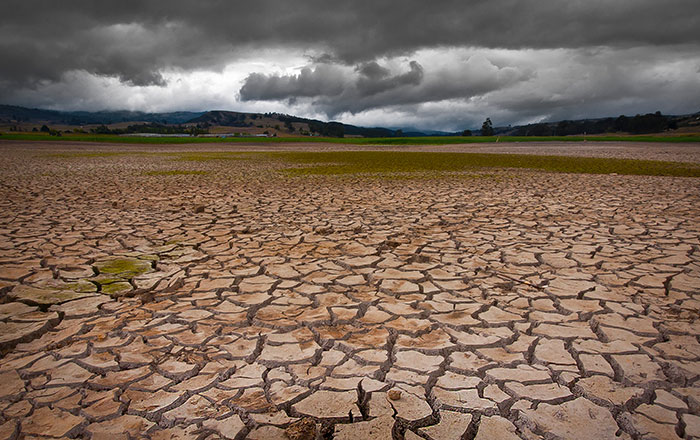
The topsoil of the earth is indisputably one of the most important factors for human agriculture. But what would happen if such a fundamental material erodes away? Well, as scientific thinkers, it would only be logical to take a look at it. Topsoil can be carried away by a multitude of natural processes such as wind, water, and ice. However, nature is not alone in diminishing the supply of useable soil. In fact, the leading cause of topsoil erosion is human activity! By committing to unsustainable processes such as overgrazing (by putting too much animals on open land, the creatures will overeat the grass and stomp on much of the useable dirt), overcropping (when too much agriculture is harvested in an area, the large multitude of plants will over consume the nutrients of the soil, inducing a vacuum of natural provisions), and deforestation (a lack of dead leaves will accompany a lack of trees, which in turn will cause a loss of nutrient supply, inducing soil aridity). The loss of usable topsoil will make land for agricultural work unavailable, which in turn will trigger grave economic and social instabilities. Since topsoil will often take 1,00 years to grow back, such a vital resource must not be seen as something yo be nonchalant about.Topsoil erosion is one of the most imposing existential issues our civilization has on hand, with a United Nations official stating that humanity may have only 60 years of farming left if this process continues at the current rate

Topsoil

Topsoil

Topsoil

12/12/16

“What does the upper layer of soil do?”


Even though humanity is becoming more urbanized every year, soil is still one of the strongest underpinnings of human civilization. However, what exactly about soil causes it to be so important? Well, it all has to do with the uppermost layer, known as the topsoil. The topsoil  is the top 5-20 centimeters of the Earth’s soil contains all of the essential nutrients for vegetation. Topsoil is filled with life microbial life which can break down dead organic matter present on the surface.

Greenhouse gases

Greenhouse gases

Greenhouse gases

12/06/16

“What causes global warming in our atmosphere?”


On the news and social media, you will probably hear much discussion relating to a planet destroying phenomena called “global warming” which raises the temperatures of the Earth’s atmosphere. However, what exactly causes this malignant circumstance? As scientific thinkers, let’s get to the bottom of this. To start with, it would be rational to understand what keeps heat on our planet in the first place. In our atmosphere, there are components known as greenhouse gases (namely carbon dioxide, methane, and others) which are capable of absorbing infrared radiation, thereby trapping the warmth emitted by our sun on to our terrestrial home. Before the beginning of the industrial revolution, the levels of greenhouse gases present were just enough to keep the Earth in a temperature equilibrium. However, the many fuel sources used by humanity such as coal, petroleum, and natural gas emit greenhouse gases themselves, therefore adding to this stockpile, and causally a higher amount of heat will be trapped. This rising buildup is most worrying to the future of humanity, with the amount of  CO2 in the atmosphere being over double pre-industrial levels and the average temperature rising over 2 degrees celsius! However, with the use of non-greenhouse gas emitting technology such as solar power and wind turbines, humanity can finally get of this trepidation-filled trend.

Groundwater

Groundwater

Groundwater

11/17/16

“What is the water held underground like and how is it useful?”


Water is one of the most important substances in the universe, if not the most important. It keeps humans alive, causes plants to grow, and generally causes life to exist. And luckily for us, water is also one of the most plentiful resources as well, with over 71 % of the surface area of the Earth being composed of it! However, water is not just found in the ocean, but in a myriad of other locations. In fact, an immensely important storage area for water is in the subterranean world. This water (termed groundwater by geologists) is contained in geological structures termed aquifers (the spaces between soil particles and pores in fractured rocks). Groundwater can be replenished when rain and melted snow seeps down into the aquifers, and water from aquifers can be discharged through lakes, streams, and springs. Groundwater is so plentiful that it supplies 51 percent of the drinking water to the residents of the United States and 99 percent of it’s rural inhabitants. Much of our civilization runs off groundwater, as a whopping 64 percent of American agriculture is produced using groundwater. Although humanity uses groundwater for a multitude of uses, groundwater can be easily polluted with the leakage of waste into aquifers, which in turn will cause damage to the nearby population. An event of this sort illustrates how humanity is not disconnected from it’s surrounding environment, as as such we must take care of it to take care of ourselves. 

Microbeads

Microbeads

Microbeads

11/10/16

“What component of personal care products cause a high amount of pollution?”


Cleanliness is a necessity for modern day civilization. And as human civilization advances, so does our standards and means obtaining cleanliness. And one such advancement comes in the form of microbeads. Microbeads, also known as microplastics, are solid plastics that are less than 5mm in diameter that are used as exfoliating agents (meaning that they can wipe off dead skin cells) This small size combined with the cleansing property poises microbeads to be very useful in personal care products, but they come with a most unfortunate environmental consequence. When flushed down the drain, microbeads are able to pass through filters normally designed to catch larger pollutants, allowing them to seep into a body of water. The microbeads will stay around for a long period of time due to their lack of biodegradability, and nearby fish will consume these products  (believing them to be small eggs) which in turn will cause physiological harm. In an interesting turn of events, these fish can be harvested and consumed by humans, therefore causing detriment to ourselves. In summation, microbeads are a stalwart example of how humanity impinging on the environment will cause long-term impairment on humanity. Microbead pollution has become so prevalent that the Rhine river in central Europe is thought to contain one million particles per square kilometer! Luckily, numerous governments are already taking action, and in the United States the Microbead-Free Waters Act of 2015 will phase out microbeads in rinse off cosmetics by July 2017.

Tidal locking

Tidal locking

Tidal locking

09/14/16

“How can one face of a celestial object always face the same side of the object that it is orbiting?”


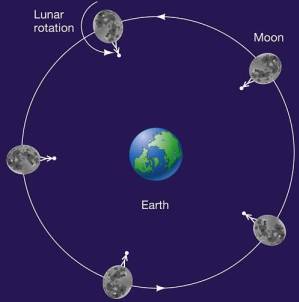
We all know that objects in space revolve around other objects. The moon revolves around the Earth, the Earth around the sun, and the sun around the center of the galaxy. These objects also usually have their own spin. For example, this spin gives rise to the days and nights on Earth. But what if an object’s rotation was in sync with it’s orbit, so that one side always faced the object it was orbiting? Well, not only is this phenomena possible, but it is also happening in our very own backyard, with our very own moon exhibiting this! When the moon revolves around the Earth, the gravity from our planet will cause the moon’s shape to be slightly from solid tides making the moon distorted to give it an almost (American) football shape to it. This distortion means that there will alway be a portion of the moon closer to the Earth then the rest, which results in that side experiencing a greater force being “hooked” to the Earth, causing it to stay on one side. Astronomers and Astrophysicists have termed this phenomena tidal locking as a result of the solid-tide induced locking on the moon.


Proxima B

Proxima B

Proxima B

09/10/16

“Is one of our nearest rocky planet habitable?”


A discovery has been made that is possibly so great that it can change the course of humanity forever. Or not. A new planet has been discovered in Proxima centauri (the nearest solar system to ours) only 4.2 light years away from us called Proxima B. We already know a few things about Proxima B, specifically has a mass that is just over a third greater than the Earth’s, it is only slightly more than seven million kilometers away from the star that it orbits, and is tidally locked (meaning one face of the planet will always be facing the star). But more importantly, this planet falls within the habitable zone of it’s star, which means that this planet has temperatures in the range  that is “just right” to host liquid water.

However, there are many factors of this planet that might just burst our bubble. First of all, we have no idea what the atmosphere of proxima B is composed of. In fact, for all we know, it could be completely toxic! Also, since the host star of Proxima B is a red dwarf, the habitable zone for the distance for the habitable zone of this planet is merely 5% of our own. This means that Proxima B is extremely close to it’s orbiting sun. So close in fact that the time for a single year to go by is merely 11 Earth days, and since red dwarfs can be very volatile, there is a strong possibility of unpredictable flairs from the planet.

Proxima B is a perfect example of why as a scientific thinker one must express excitement yet restraint when hearing possibly paradigm shifting news, since we must not bee to short-sighted to observe that such news could be false, yet not too cynical to take joy in the wonder and mystery of the universe.

Hydrothermal vents

Hydrothermal vents

Hydrothermal vents

9/09/16

“What are some geographic anomalies near underwater volcanoes?”
Underwater volcanoes are quite fascinating structures, but does the presence of these mechanisms cause the creation of other alien-like structures? Well, it turns out to be true. If you were to look at underwater volcanoes near spreading ridges and convergent plate boundaries, then you will find a very interesting series of structures known as hydrothermal vents. Hydrothermal vents are fissures in a planet’s surface that are produced when hot magma from the underwater volcanoes meet the near freezing seawater and reemerges from the surface. The seawater produced by hydrothermal vents can reach temperatures of over 700 degrees Fahrenheit! These unique conditions of hydrothermal vents are actually the living space for many communities of extremophiles. Hydrothermal vents are actually a unique discovery, being found only less than 40 years ago.

Underwater volcanoes

Underwater volcanoes

Underwater volcanoes

09/08/16

“Are there such things as underwater volcanoes?”

Volcanoes are some of the most bewildering natural structures of the earth. They’re big, they’re ominous, and most importantly they spout lava. But is there an underwater equivalent to them? Well, not only do these structures exist, but the vast majority of volcanoes are actually beneath the ocean! The reason for this is that volcanoes form near tectonic plate boundaries, and since most of these plate boundaries are in the ocean, the plurality of volcanoes end up being underwater volcanoes. In fact, underwater volcanoes make up such a high proportion that around 75 percent of all magma deposited is done by underwater volcanoes!  Most of these structures occur in a belt that wraps around the pacific ocean known as the “Ring of fire”.