Category: Earth/Climate science

Underwater volcanoes

Underwater volcanoes

Underwater volcanoes

09/08/16

“Are there such things as underwater volcanoes?”

Volcanoes are some of the most bewildering natural structures of the earth. They’re big, they’re ominous, and most importantly they spout lava. But is there an underwater equivalent to them? Well, not only do these structures exist, but the vast majority of volcanoes are actually beneath the ocean! The reason for this is that volcanoes form near tectonic plate boundaries, and since most of these plate boundaries are in the ocean, the plurality of volcanoes end up being underwater volcanoes. In fact, underwater volcanoes make up such a high proportion that around 75 percent of all magma deposited is done by underwater volcanoes!  Most of these structures occur in a belt that wraps around the pacific ocean known as the “Ring of fire”.

Reverse osmosis

Reverse osmosis

Reverse osmosis

09/04/16

“How can we use pressure to purify seawater?”

Already humanity is facing a major water problem. As the water reservoirs start to dry up, there will be entire areas with no hydration to speak of. So what is one way we could solve this? Well, how about we look to the most plentiful form of water, the ocean, to solve our problems. Ocean water is normally unusable for humanistic concerns due to it’s salty nature, but what if we were to desalinate it to make it usable?

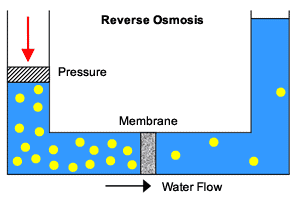
Now that we have the idea, let’s think about how we could make this a reality. Well, first of all, we should notice that salt water probably has other elements in it that are a result from exposure to the rest of the environment, such as seaweed and dead animals parts. These items are usually larger than the molecules of water and salt, so they can be filtered away easily through the use of a permeable layer. We can accomplish this by extracting sea water, and then using pressure to force it through a permeable layer. However, the leftover water will still have a high concentration of salt. But to our luck, it is still possible to separate the salt if we notice one factor, that both water and salt have different evaporation points, and more specifically, water has a lower point of evaporation. So what we can do with this leftover salt water is boil it until the point of evaporation for water, and then pass this steam off into another area, and then cool it until it solidifies again. After all of this, we will finally have ourselves some freshwater! This process is known as reverse osmosis, and plants are currently being used in arid regions such as California, Israel, and Saudi Arabia to create a usable water supply.

Lightning

Lightning

Lightning          05/15/16


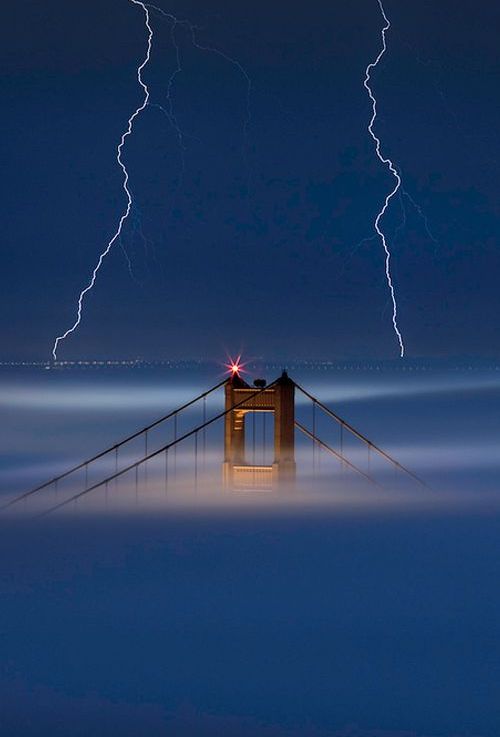
As a young child, you probably had trepidations about lightning, but did you ever wonder how it worked? To illustrate, let us visualize a cloud. Often time, there is internal movement inside the cloud, which leads to movement of charge inside the cloud. This leads to Polarization of the cloud. This buildup of electrons will have further effects on the ground level, with the negative electrons being pushed away and the positive charge being attracted to the cloud. In fact, all objectives within the vicinity will become polarized. This buildup of opposing charges will create a voltage. If the voltage grows high enough, then a dielectric breakdown will occur through the air, turning it from an insulator to a conductor, and creating a bolt of lightning.

The Mariana trench

The Mariana trench

                  The Mariana trench             05/08/16


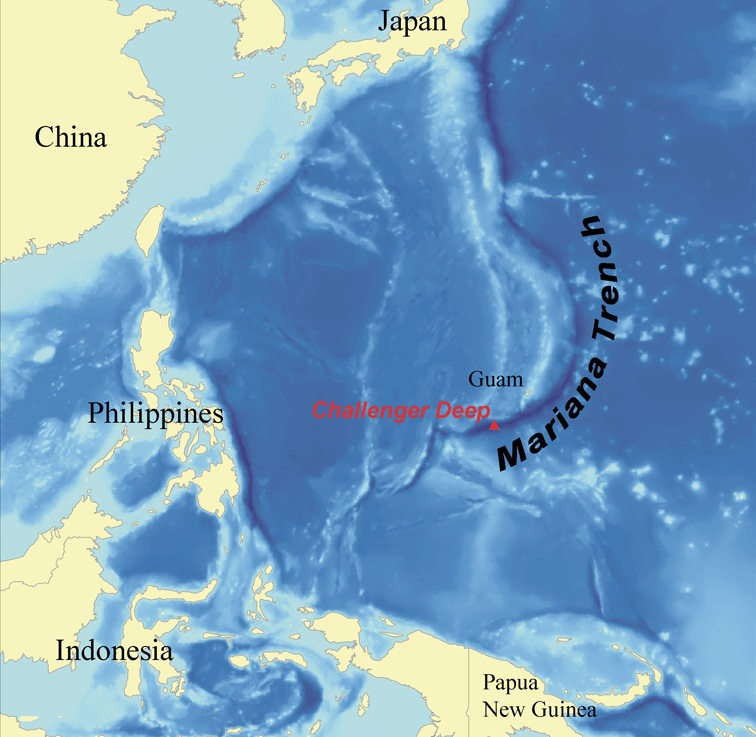
If you think that scaling Mount Everest is challenging, then wait until you hear about the Mariana trench. The tench is the result of the collision of two tectonic plates. The Mariana trench is the deepest part of the world’s oceans. This ominous area goes runs nearly 11 Kilometers deep (By comparison, Mount everest is only 8.4 Km). The Mariana trench is situated near the isle of Guam, putting it in U.S controlled waters.

Wave power

Wave power

Wave power           05/06/16

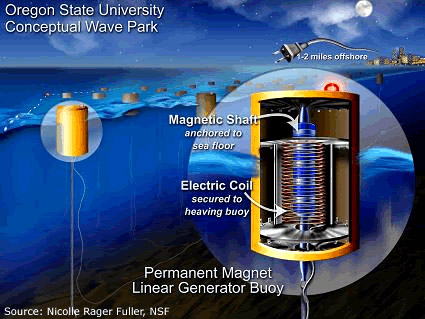
What if I told you that Engineers have built machines that are able to convert the kinetic energy of waves into usable power? This is the very principle behind Wave energy. By capturing the energy propagated by these waves, we can power up to around 40% of humanity’s energy needs.

How clouds are formed

How clouds are formed

How clouds are formed         02/02/16

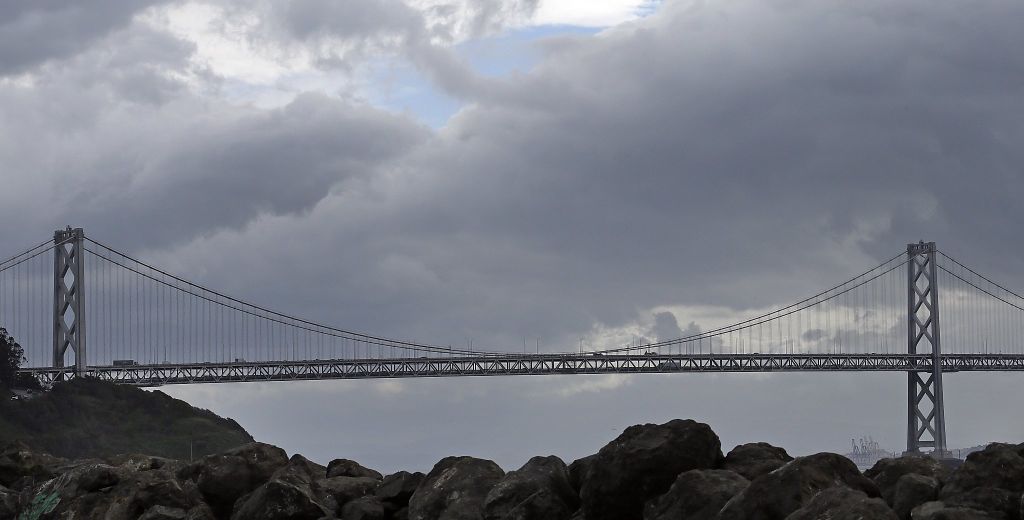
How are clouds formed? This a very interesting question for such habitual objects. Clouds are intrinsically floating droplets of water in the sky. Clouds start their lifecycle as water vapor (the gaseous form of water vapor), formed from the evaporation of water from nearby aquatic bodies. As a byproduct of the laws of physics, when water rises in the atmosphere it loses heat and is under less pressure. Eventually, it becomes so cold that the water vapor begins to condensate and becomes water droplets who supercombine to become a cloud