Category: Chemistry

Ion-dipole forces

Ion-dipole forces

Ion-dipole forces

11/27/16

“What exactly causes ionic compounds to be dissolved in dipole solvents?”


One of the first facts one will learn in a Chemistry course is that ionic compounds such as salt (NaCl) will dissolve in dipolar solvents. However, have you ever wondered why does this phenomena take place? Well, as scientifically minded people, we should explore anything that we don’t know. Ionic compounds are held together by ionic bonds, which are the result of two or more atoms sharing electrons. And since these ionic bonds depend upon factors of charge distribution, they susceptible to the influence of external electric forces. As such, if they come into close contact to polar substances such as dipole solvents, the resulting ion-dipole force would rip apart the compounds.

How heat affects capillary action

How heat affects capillary action

How heat affects capillary action

11/29/16

“How does the temperature of a liquid affect it’s capillary action?”


Heat has an effect on a myriad of different properties of materials, but could it possibly have an effect on capillary action? Well, let’s use some of our scientific thinking to find out. We know that increasing the temperature of an object will weaken the intermolecular force of it, and we also know that the strength of capillary action is based upon the relative strength between the adhesive and cohesive forces of a liquid (Which we can symbolically summarize as cohesive force = adhesive – cohesive). So wouldn’t it be logical that if we could weaken the internal cohesive forces of a liquid through heating, that the adhesive forces would have more pull? According to scientific research, this hypothesis proves to be empirically valid!

How intermolecular forces affect the boiling of a substance

How intermolecular forces affect the boiling of a substance

How intermolecular forces affect the boiling of a substance

11/28/16

“How does the molecular bond type of a chemical affect the boiling point of a substance?”


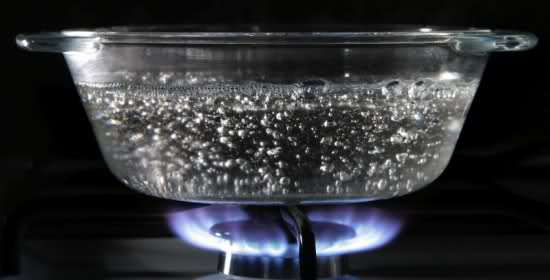
In a Chemistry class, you will probably learn that a chemical’s intermolecular force type will have an effect on the boiling point of a substance. However, there is also a good chance that you will never be explained why such a phenomena occurs. And since we were just told a fact without an explanation, we must investigate. Well, first of all, we know that raising the temperature of a substance will increase the kinetic energy of molecules, and if the kinetic energy is raised high enough, then the molecules will be able to escape from their intermolecular constraints. consequently, if the molecules in a liquid are able to escape, then a the free molecules will form a gas, causing the liquid to boil. And since the different types of intermolecular forces have different strengths, then these more powerful bonds will have more force, and as a result the more powerful the type of bond, the higher the boiling point. To give an example, let’s examine two different chemicals with a similar molecular geometry but different types of bond, Water [H2O] and Hydrogen Sulfide [H2S]. Even though H2S has a higher electron count than H2O, since H2O exhibits hydrogen bonding, the boiling point of H2S (-60 C)  is far lower than the boiling point of H20 (100 C)

Using the ideal gas law to calculate the molar mass

Using the ideal gas law to calculate the molar mass

Using the ideal gas law to calculate the molar mass

08/26/16

“How can we use the ideal gas law to calculate the molar mass of an object?”

During a student’s course in Chemistry, they will probably realize that the ideal gas equation is one of the most useful equations in the entire subject. However, is it possible to use this equation to do more, such as calculate the density of a gas? Well, let’s use our mathematical skills to find out. We know of course that the ideal gas equation is PV=nRT, with P being the Pressure in atm, V being the volume of the gas, n being the number of moles, and T being the temperature. Now, there seems to be no appearance of density anywhere in this equation, but let’s take a closer look at the value n. Since n is the number of moles in an object, we can use the molar mass equation to derive that n = mass/(M), with M being the molar mass. However, we still do not have density in our equation, but could we go any further? Well, it turns out that density is mass per volume, so mass can be represented as density times volume (rho*v). By substituting these value back into the ideal gas law, we can obtain PV=(rho*V/M)*RT, and after doing a bit of rearranging we will be obtain rho = M*P/(R*T).

The scientifically optimal way to cook a Turkey

The scientifically optimal way to cook a Turkey

The scientifically optimal way to cook a Turkey

11/24/16

“What is the most efficient way to cook a Turkey?”

Thanksgiving is a most special holiday in the hearts of Americans. It represents a time when friends and family coming together to  participate in social activities and dine on delicious food. And the most important food of all of Thanksgiving is the Turkey, with it’s rich, savoring flavor. However, cooking a Turkey is not always an easy task. Specifically, the plump and rounded shape of a Turkey is most inefficient for heat conduction, forcing it to have a high cooking time (especially if one wants to cook the Turkey to an internal temperature 74 degrees celsius to prevent salmonella).  So how can we apply our scientific knowledge to solve this problem? Well, let’s think about it. We know that the temperature of objects raise based upon the amount of heat added, and that if an object has more surface area, then it has more heat it will receive. So how about we do just this? First, let’s take the Turkey out. Then, flip it over, and cut off the back bones. Subsequently, flip it over again, and apply pressure to break the breastbone. Once this has been completed, you can put the Turkey. Chefs have termed this process the spatch cocking method, and it can save the chef anywhere from 45 to 80 minutes of cooking time!.

Finally, in the Thanksgiving spirit, I would like to give a big thanks to Sarah Kaplan of the Washington Post for teaching the world about this most innovative method.

Emission and absorption spectrum

Emission and absorption spectrum

Emission and absorption spectrum

11/22/16

“Why do elements absorb light?”


Light is something that we literally see everyday, whether it be from the sun shining down on civilization during the day, the incandescent light bulbs lighting up our night, or the flashlights we use to read in bed. However, as light is both a wave and a particle, it has to interact with material objects when it makes contact, so what happens when it does so? Well, let’s think about it. We know that light is composed of atomic-size forms of matter known as photons, and we also know that as a result of the wave-particle dualistic nature of light, these photons will have a wavelength associated with them. And since light is emitted by radiation, these photons will have a distributions of multiple wavelengths, all of which have a corresponding energy. Furthermore, all material objects are comprised of atoms, which have discrete energy levels. So when a photon wave hits a material object, the atom can only absorb the photon if it corresponds to the precise energy level. This energy level will stay elevated for a limited amount of time, and will soon fall back down to the original energy level, emitting  a wave of the same energy level. If one were to take an empirical measurement of the wavelengths being emitted by constructing an emission and absorption spectrum, then one would be able to identify the element present! 

Liquid meniscus

Liquid meniscus

Liquid meniscus

Isaac Gendler

“Why do liquids have a bent top when put in containers?”


Have you ever placed a liquid in a container, and noticed that there was a bend in the top it’s shape? And have you ever wondered why this happens? Well, let’s use our knowledge of science to find this out. As discussed earlier, we know that liquid molecules exhibit cohesive forces towards one another and adhesive forces towards molecules of other substances, such as a solid beaker. So what if these two types of forces do not cancel one another out? This would mean that one side (the beaker or the liquid) would have a greater force than the other side, causing a pull on the liquid towards it. This in turn would cause a “bent” shape called a meniscus to form in the liquid. If the liquid exhibits a concave shape, then the adhesive forces are more powerful, and if it exhibits a convex shape, then the cohesive forces are more powerful. The net forces resulting from a meniscus will frequently result in the spectacular phenomena of capillary action.  

Capillary action

Capillary action

Capillary action

11/16/16

“Why is it that liquids can move up against gravity in containers?”


Liquids are objects that we often see everyday, whether it be in the water that we drink or in the blood that runs through our veins. We also know that objects are held down to the Earth by gravity, but for some ominous reason liquids seem to have the ability to move upwards by themselves in a container against gravity. Why is this so? Well, like I always say, let’s think about it. When liquids are placed in containers, a concave meniscus will form from adhesive forces. If the diameter of the containing vessel is small enough, then the adhesive forces from the container will cause a vertical force on the fluid, and if these adhesive forces are more powerful than the internal cohesive forces will pull the liquid along with it, therefore causing vertical movement. Because this phenomena is so special not only has it been given a special name by scientists and engineers (Capillary action), it is found in many wonderful applications in nature. Plants use capillary action to absorb water from the soil using their roots, and human eyes utilize capillary action using two small diameter tubes called the lacrimal ducts to drain tear fluid in the eyes.

London dispersion

London dispersion

London dispersion

11/11/16

“What is the weakest of the intermolecular forces and how does it form?”


As a result of the nature of quantum mechanics, we know that in atomic structure, electrons do not orbit around the nucleus in a newtonian fashion, but instead are located in probability densities surrounding the core. Since electrons will move around in such a manner, the charge distribution of an atom is bound to become slightly asymmetric with time. Consequently, these asymmetric atoms will interact with other asymmetric atoms to form very subtle electric dipoles, resulting in a very weak intermolecular force. Scientists and Engineers have termed this phenomena to be London dispersion, and it is found to be the weakest of all the intermolecular forces. Despite this, as a result of it’s universal nature, all molecules are found to exhibit london dispersion