Category: Chemistry

Adhesive forces

Adhesive forces

Adhesive forces

11/07/16

“What causes liquids to stick to surfaces?”


Have you ever wondered why liquids seem to have sticky properties? Well, let’s think about it. We know that molecules of a liquid substances are attracted to each other through the phenomena of intermolecular forces, but since all materials in the universe are made up of molecules, wouldn’t it be logical that molecules of these liquid substances could also be attracted to molecules outside of the substance? This is the fundamental idea behind adhesive forces. Because of adhesive forces, liquids have the ability to “stick” to the containers in which it rests. And most peculiar application of adhesive forces are utilized by the insect known as water striders, who can literally glide upon water.

Cohesive forces

Cohesive forces

Cohesive forces

11/06/16

“What causes liquids to stick together?”


Liquids are a most peculiar state of matter. Their shape will change depending on the container that they’re in (just like gases) , but at the same time their volume will remain consistent (just like solids). Why do liquids have this paradoxical combination of features? Well, let’s investigate it. On a microscopic level, the molecules of liquids move around in semi-free state, not being as rigidly bound as a solid but not having the level of separation as a gas. The molecules of a liquid are attracted to one another through a phenomena known as cohesive forces, in which molecules of the same type experience an intermolecular force attracting one another. Now with this fact, we can deduce something very interesting. Volumes of a material are composed of units of molecules. And since molecules in liquid experience cohesive forces that makes them stick together, the amount of molecules in this liquid will not change unless a more powerful force rips away some of the molecules, therefore giving liquids a constant volume! Due to cohesive forces, liquids can be fluid like gases but maintain their volumes when poured into another container or experience mechanical stresses, or exhibit properties such as surface tension.   

Intermolecular forces

Intermolecular forces

Intermolecular forces

11/05/16

“What exactly keeps groups molecules together?”


Have you ever wondered why even through objects are made of molecules moving around in space, they seem to be able to keep their form? Well, let’s think about it. First of all, let’s view everything from a microscopic standpoint. When molecules are close to one another, they have a tendency to form associations with one another resulting from a phenomena called intermolecular forces. The forces (in increasing order of strength) include london dispersion (in which all molecules experience), dipole-dipole interaction (when two or more electrically charged molecules come in close proximity within one another), and hydrogen bonding (when a hydrogen atom of one molecule comes into close proximity of an oxygen[O], nitrogen[N], or fluorine[F] of another). What I find personally amazing is how billions of these forces over time will manifest into the everyday material objects that we experience everyday!

Vapor Pressure

Vapor Pressure

Vapor Pressure

11/04/16

“What happens to water in a closed container?”

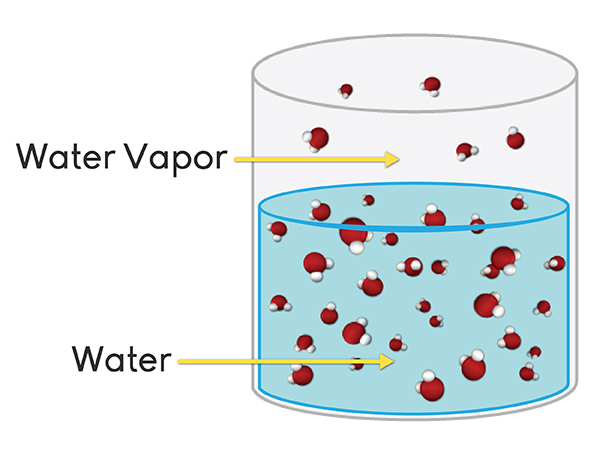
Liquids have many fascinating facets, and one of the fascinating facets about them is when put in a closed container, a gas will gradually form over time. What is this substance and how does it affect the surrounding environment? Well, let’s start by looking at it from a microscopic viewpoint. Well, first of all we know that molecules in a liquid move around in a semi-free fashion but are held together by cohesive forces resulting from intermolecular interaction. But what happens if the energy of one of these moving molecules overcomes such internal forces? As it turns out, this molecule will be freed from the constraints of the liquid substance and be allowed to float around as a gas. And if this liquid is trapped inside a closed container, then the gas molecules will be too. Some of these gas molecules will eventually lose kinetic energy and in turn will be dragged back into the liquid. Eventually, a steady state will be formed with the number of molecules leaving the liquid will equal the number returning to the liquid. As a result, this steady gas will exert a vapor pressure on the liquid beneath it.

Now here is where things become interesting. If one were to increase the temperature of the liquid, then then the kinetic energy of the molecules of the liquid will increase, causing a greater amount of liquid to be released into the gas, therefore increasing the vapor pressure of the gas!

Alloys

Alloys

Alloys

11/02/16

“What is special about a mixture of two elements?”

Materials are composed of elements. Some are composed of many. However, what are some special properties of mixtures that involve metal? Well, after much research into the subject, Chemists have defined these materials as alloys. Since different elements have different size, and alloys are made up of different elements, the internal structure of alloys will become fairly irregular, therefore giving alloys a much harder nature. As a result, alloys are regularly applied in industrial applications where durable materials are necessary.

Root-mean-square speed

Root-mean-square speed

Root-mean-square speed

10/31/16

“How can we find the average kinetic energy of all of the atoms in a gas?”


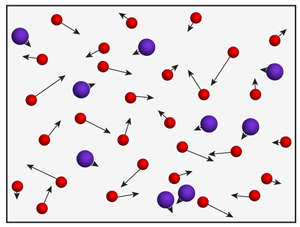
We see gasses everyday, whether it be the atmosphere that we breathe, the substances that drive pneumatic controls, or the air that flows through air conditioner. However, we also know that the temperature and kinetic energy of a gas is contingent upon the speed of the gas itself. The problem is, since gases are composed of individual particles moving with only weak connections to one another, measuring the average velocity of the entire system probably sounds like a near-impossible task! Luckily, due to the labors of countless scientists, it turns out that such an endeavor is not impossible at all with the use of a conceptual tool known as the root-mean-square-speed. The root-mean-square-speed states that the average speed of all of the individual particles in a gas is proportional to the square root of the temperature of the gas divided by the molar mass of the molecules that compose the gas, all of which can be represented symbolically as vrms=3*R*T/(Molar-mas) ., with R being the gas constant 0.08205 Liter atm/molar * k, and T being the temperature in kelvin.

Ionization energy

Ionization energy

Ionization energy

10/25/16

“How can we measure the amount of energy needed to remove an electron from an atom?”

From common knowledge, we know that if we want to remove an object, it would require energy. So it would logically follow that if we would want to remove an electron from the orbit of an atom, it would require energy as well. Now since atoms come in a diffuse number of sizes as a result of the different combinations of protons and electrons, how can we find a pattern to quantify which elements require more energy to remove an electron? Well, let’s think about it. As mentioned earlier, each atom will come in a different number of sizes. Furthermore, it can be observed that the larger the size, the more decrepit the hold of the nucleus will be on the orbiting electrons. From this reasoning, we can deduce that the larger the radius, the smaller amount of energy would be required to take an electron. This phenomena is termed Ionization energy, and to observe the pattern for ionization energy, one simply has to remember that since ionization energy is inverse to the size of an element, the further up and right one goes on the periodic table, the stronger the hold of the nucleus on the electrons will be. As a result, elements on the left side of the periodic table tend to be better oxidizers since it does not take too much energy to ionize them, while the opposite is true for elements further to the right side of the periodic table.

Electron affinity

Electron affinity

Electron affinity

10/23/16

“How can we measure the energy used when an electron is added?”


We know that the energy of an atom changes when an electron is added. But how can we measure so? Well, we know that electrons are always placed into orbitals. And we know that an element’s oxidation state is contingent upon the numbers of orbitals filled. And on top of that, the more orbital shells are filled, the smaller the radius becomes, therefore magnifying the force. So wouldn’t it make sense that it is easier for an electron if most of the valence shells are filled? Therefore, electrons become easier to add the higher occupancy of orbitals.This makes sense because as we move from left to right, elements tend to become more negative in their reactions. Scientists have termed this principle electron affinity.

Chemical reactivity lists

Chemical reactivity lists

Chemical reactivity lists

10/22/16

“How can we determine the reactivity of an element?”

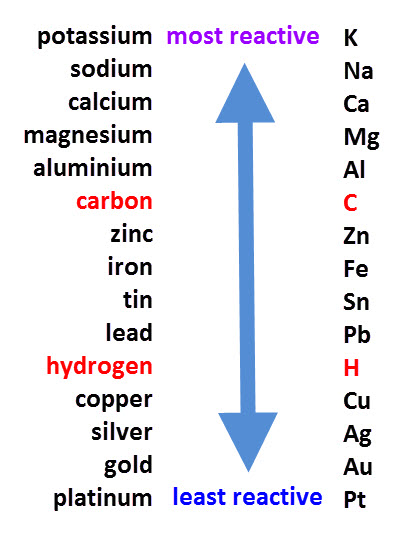
We all know elements can react with one another. However, how can we quantify the level of an element? Well, let’s think about it. We are aware of the fact that we can use a tool called Empiricism to organize external information. And we know that external information can include overseeing Chemical reactions. So what if we were to observe which elements reacted with which ion, and then wrote down the result? This is the root behind Chemical reactivity lists. What makes these lists so interested is that they can be organized linearly, Meaning that if you can make a vertical list of all of the elements, than they would be able to react with everything below their position, and be unable to react with everything above it, therefore allowing for future predictions.