Author: Isaac Gendler

Dielectrics

Dielectrics

Dielectrics

06/27/16

“Is there a way to increase the capacitance of a capacitor without actually modifying the capacitor itself?

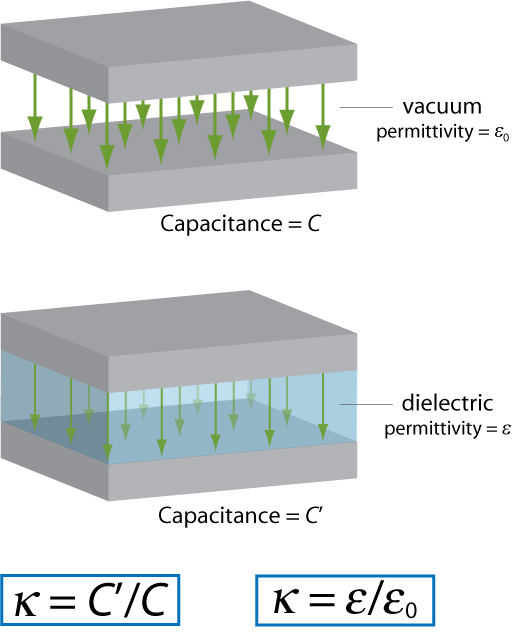
Scientists and Engineers are very practically minded people,so when working with electronics, they would like to make the components as efficient as possible. So when applying this mentality ro capacitors, one way to accomplish this is by increasing the capacitance of the capacitors themselves. So let’s think about how a capacitor works in the first place. If you remember, what makes such components function is that two conducting plates are placed parallel in between a non-conducting material. Let’s call this material a dielectric. When placed in between the two charged plates, this dielectric will react to the net charge on each plate and become polarized. As a consequence, some of the negative charge of the dielectric will be oriented towards the positive plated and vice versa for the negative plate. This causes some of the charge to cancel out, which reduces the effective voltage, which increases the space for extra charge which allows the capacitor to store more charge! We can symbolically relate the old and new capacitance with the equation C=kc, where the capital C represents the new capacitance, k representing the dielectric constant (basically the quantity of the material to store energy in an electric field) and c representing the old capacitance. As one can see, dielectrics are very practical devices that can have many potential uses

Supercapacitors

Supercapacitors

Supercapacitors

06/26/16

“Are there capacitors that can store much more energy than average?”

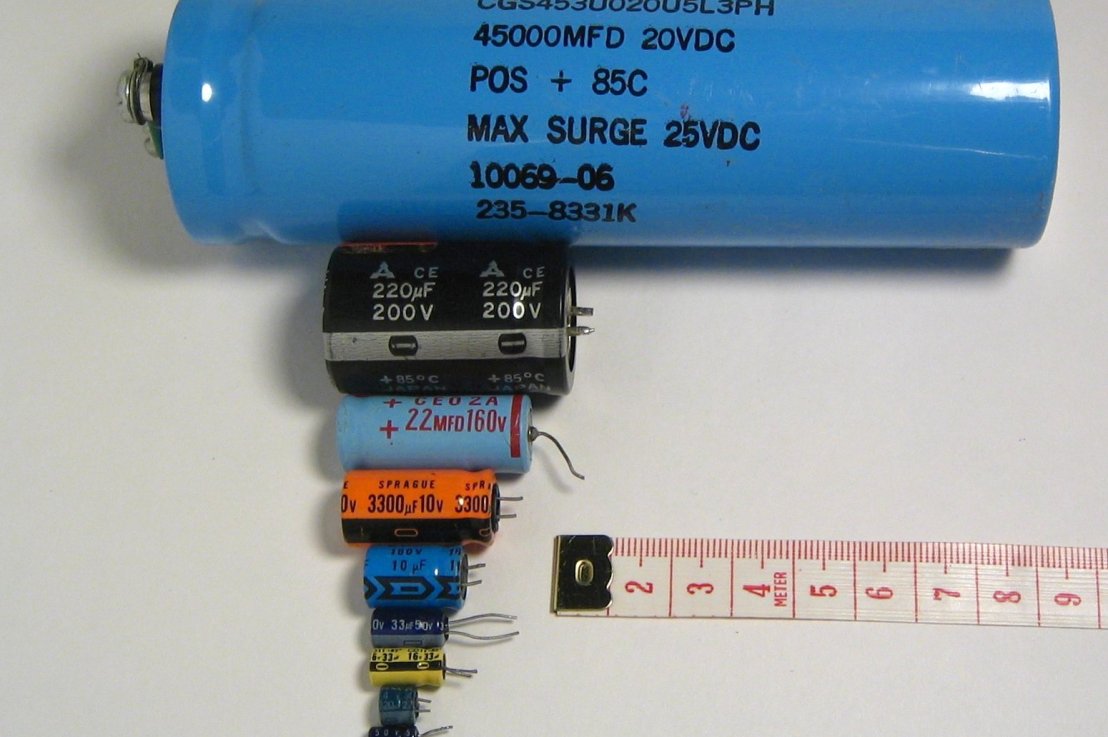
Let’s think about something. With the advancement of technology, new ways to store sufficient energy for machines needs to be introduced. One way we can do that is by identifying an existing concept and modifying it suit our needs. Let’s take capacitors. they’re simple, useful, and have a lot of potential for applications. One of the main bottlenecks with capacitors is that they can only store so much energy. Specifically, most capacitors are rated in Microfarads, (one farad = charge/voltage, or the ratio of charge to voltage). This means that with a certain voltage only a very tiny amount of charge can be stored (specifically, one microfarad means that it would take one million volts to store one coulomb of charge).

Now, how could we modify capacitors to store a higher density of charge? Well, as discussed earlier, the capacitance of a capacitor is proportional to the area of the plates divided by the distance between them, so what if not only we used special materials, but we also used very large plates separated at a very small distance? Scientists and  engineers have termed such an invention supercapacitors. Supercapacitors can have capacitance values usually rated in the farad level, or one million times the ratio of noraml capacitors! This means that such inventions can store much more energy than.Supercapacitors (also known as ultracapacitors) have many applications, ranging from being used as a storage medium for regenerative braking systems to Defibrillators. In fact, supercapacitors are deemed to be so practical that major that major transportation networks such as the Portland MAX are starting to use them 

Practice of Capacitors

Practice of Capacitors

Practice of Capacitors

06/25/16

“How can we apply capacitors to accomplish practical tasks?”

Capacitors have many uses in application. The most common utilization for capacitors is to store energy. Energy can be stored within the electric field of a capacitor, and this energy can continue being stored even if the battery has been disconnected! Capacitors also have a very quick discharge time (often only in the milliseconds) so they can serve as a quick battery. Capacitors can also be used a sensors, accomplishing tasks such as measuring the fuel levels in an airplane. However, one of the most powerful uses of a capacitor is to be a low pass filter. Since the resistance of capacitors in an AC circuit increases inversely proportionally to the frequency of an object, a low frequency current will be hampered by the filter, which means that a minimum threshold of frequency must pass through.

Theory of Capacitors

Theory of Capacitors

Theory of Capacitors

06/24/16

“Is it possible to store electricity in an electric field?”

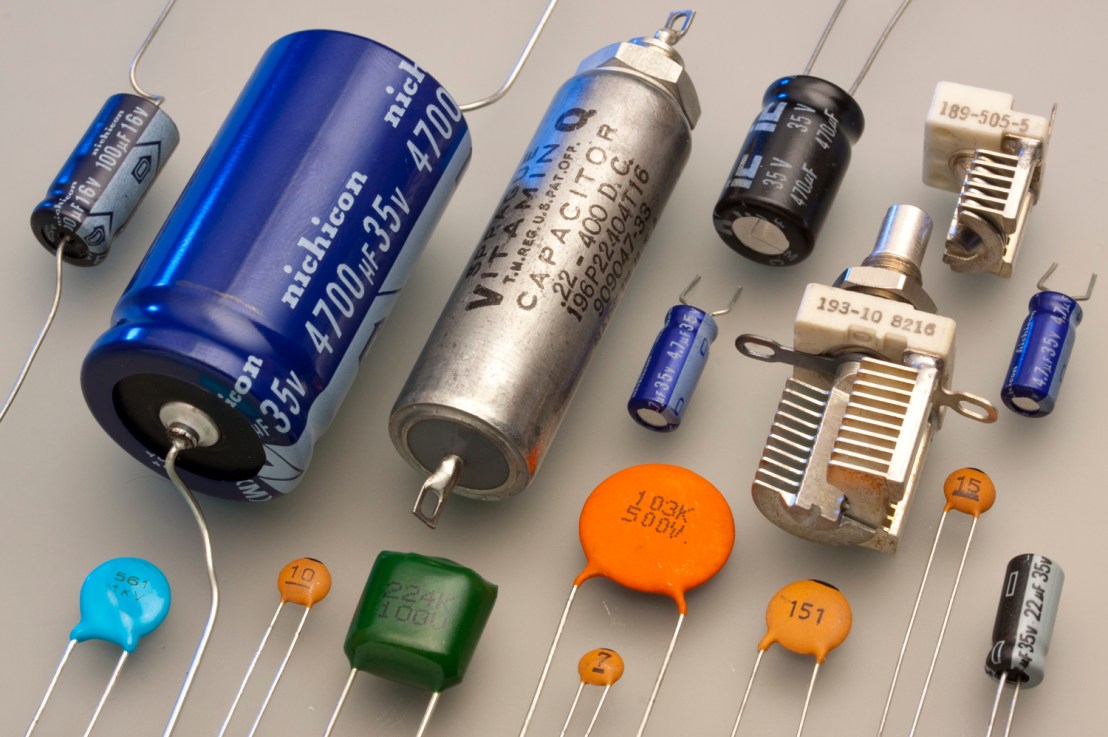
Let us consider the following. Two conductive plates are placed on the positive and negative terminals of a circuit with a battery, both in parallel with one another and separated by an insulating material. When the battery turns on, electrons will rush from the “positive” terminal plate, causing a net positive charge on the aforementioned plate. This net charge will then induce electrons to flow from the negative side of the battery to the other plate The balance of these two charges will create an electric field, which in turn will store voltage. This device is called a Capacitor

 We can symbolically analyze capacitors using the equation C=qv, with C being the capacitance, q being the charge, and V being the voltage. Now let’s think about this equation from a real world perspective. We know that Capacitance is caused by a charged particles emiting voltages, so the higher the ratio of maximum charged particles to voltage, the more that this capacitor can store. An equivalent  way to put this equations is C=e*A/D, where e is the electric permittivity constant, A is the area, and d is the distance between the plates. Again, let’s put this in a real world perspective. This seems to be a ratio of the area of the plates to the distance between them, so the more area, the more charge we can store, and the greater distance the smaller the electric potential will be between the charges In addition, we can analyze the energy of the capacitors using the equation E=½ * C* V2, so the more capacitance and voltage, the more energy can be stored in in the object. In summation, capacitors are an intriuing way to store energy

Flywheels

Flywheels

Flywheels

06/23/16

“Is there such thing as a battery solely made out of mechanical parts?”

With the current climate change crisis, there is a greater need for clean ways of storing energy. In face of this trouble humanity has invented a most peculiar device called the Flywheel. In essence, Flywheels are massive wheels use rotational motion to store energy. Now, let’s get into the details. The wheel flywheel has a large mass, which in turn causes the object to have a high inertia. This high inertia is what allows the flywheel to store a high amount of kinetic energy (Due to the laws of angular momentum). To make sure that this energy is not lost to friction, flywheels are encased in near-vacuum conditions to minimize air resistance and use magnetic bearings to reduce internal friction. Power is supplied to the flywheel through an electric motor, and during discharge the flywheel will spin in the other direction, causing it to shift into a generator.

The advantages of using flywheels include a high power density, a high lifetime, and the disadvantages include a low energy density and a high potential for danger in case of an accident (the wheel could become unhinged, which would cause it to fly out with dangerous levels of kinetic energy). All in all, flywheels are a innovative way to store energy for further use. In fact, the Los Angeles metro system is planning to incorporate flywheel technology to store the energy from their regenerative braking system, and a current student research project in the bay area is considering doing the same thing.

Kinetic energy

Kinetic energy

Kinetic energy

06/22/16

“What quantity can we give to a moving object?”

As discussed earlier, energy exists in all kinds of forms, but we want to to be specific, how exactly do we define the energy of a moving object? We call this quantity Kinetic energy. Kinetic energy is a measurement of energy of a

A young physicist might have two questions on their mind. First of all, how what quantity can we give to a moving object, and how can we apply the idea of energy to a moving system? Well, more seasoned veterans of science have already debated and answered the question, with the end result being kinetic energy. Kinetic energy is the quantity of energy associated with a moving object. The unit for Kinetic energy (here on will be abbreviated as K.E) is the Joule, and the formula is K.E = 1/2 * m *v2, with m being the mass of the object and v being the velocity. From this relationship, we can notice an interesting relationship, when the velocity of an object increases, the kinetic energy will increase to the square of the difference! For example, if an object goes twice as fast than another object of the same mass, then it will have four times as much kinetic energy.

Furthermore, the Kinetic energy of an object is directed related to the work that was done on to the object. We can put this numerically as F*d=1/2 * m*v2, Where F is force and d is distance. This means that by knowing the work done to an object, we can find the change in kinetic energy, and if we know the mass, the we can use this to find the change in velocity! On top of this, due to the conservation of energy, K.E can be transferred into all sorts of other forms of energy, such as potential energy.

Mechatronics engineering

Mechatronics engineering

Mechatronics engineering

06/21/16

“What is the future of engineering?”

Day by day the nature of engineering is changing. It seems that as time goes on, all of the myriad of different disciplines of engineering seem to be coming closer together, almost like how trees that grow near each other slowly but eventually merge. Processes that used to be solely governed one field are now an intersection of many others. For example, automobile transportation used to be completely under the control of mechanical engineers, but with the advent of computer technology, cars now have a multitude of “smart” systems to account for greater control of the vehicle.To account for such change, an entirely new branch of engineering called Mechatronics Engineering has emerged to analyze and explore such intersections. Specifically, mechatronics focuses on the interactions between mechanical, electrical, computational, and control systems. A mechatronics engineer would take their knowledge about these systems and then apply it to create an entirely new machine. Examples of mechatronics technologies include industrial robots, rotary actuators, linear actuators, servos, and regenerative braking systems. The future of mechatronics is quite exciting, as digital systems become ever more integrated with mechanical equivalents.


Electric motors

Electric motors

Electric motors

06/20/16

“How can we use electric energy to create mechanical motion? ”

Given that energy is a conserved quantity, isn’t logical that energy in one form could be transformed into energy of another form? And since two of the most used forms of energy for human civilization is electrical and mechanical energy, wouldn’t it be useful if we can convert from one to another? This is the basis behind an Electric motor. Principally, an electric motor performs one simple function, it uses electrical energy to create mechanical motion.  Because they perform such a useful function, electric motors are one of the most prolific inventions of the human race. In fact, they are the most used electrical machines on the planet! Motors can be found as components in a wide range of machines, varying from regenerative braking systems to electric fans to rail transportation. Because of this, there are many types of electric motors, ranging in all types of technology.


Industrial robots

Industrial robots

Industrial robots

Isaac Gendler

06/19/16

“What are those strange machines that I see in factories?”

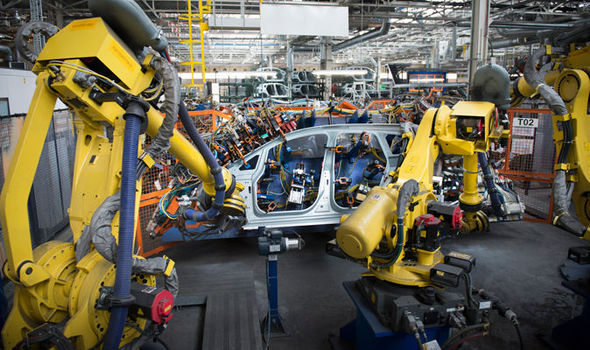
With the advent of modern mechatronics systems, a new type of machine has been introduced to the world, Industrial robots. As the name implies, industrial robots are programmable mechanical objects that are setup to perform industrial related tasks, such as manufacturing, welding, and assembly. In order to accomplish their tasks, most robots are set up with a programmable 6 Degrees of freedom movement system. Speaking of programming, industrial robots are able to perform their task 24 hours a day for years on end! In summation, Industrial robots are truly a marvel of the modern world