Author: Isaac Gendler

Track gauge

Track gauge

Track gauge

03/05/17

“How does the width of railroad tracks affect transportation?”
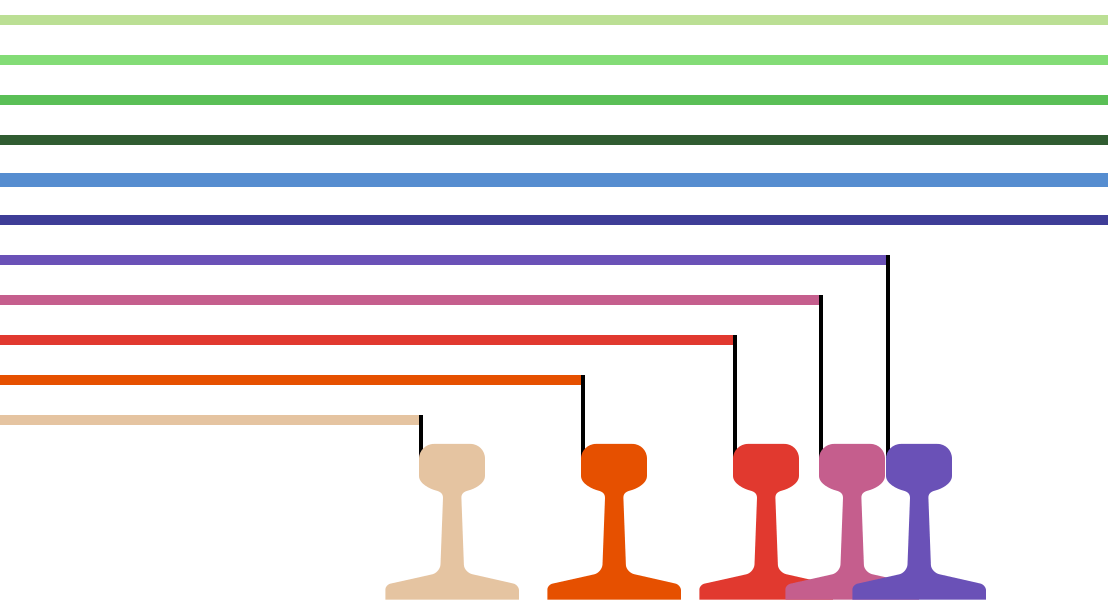
Trains of all shapes and sizes have made affordable and efficient transportation a modern day reality. However, as mechanical devices, these machines are contingent upon multiple components, such as track. So how can we classify the different types of track spacing and their resulting physical effects? Well, let’s use our engineering mindset to figure this out. We know that the geometry of railroad tracks are primarily composed of one flat path and two vertical blocks to encase the wheels. And since the flat paths are variable in nature, the length of them can be different depending on the system being used, therefore a standard measurement system known as a track gauge must be used to distinguish the different types of tracks. The larger the track gauge is, the faster the maximum speed and the easier it is to control at the expense of cost and ease of turn. The standard track gauge is known as standard gauge in the U.S and is measured at 1,435.1 mm (4 feet 8 1⁄2 inches)

Diffraction grating

Diffraction grating

Diffraction grating

03/04/17

“What happens when we shine wave through a large chain of small holes?”
Optics is a most enjoyable branch of science. And one of it’s most peculiar facets occurs from a most simple setup. Suppose that one were to have two sheets of metal facing each other. Then one were to cut a large number of rectangular holes evenly spaced throughout one sheet and finally shine a light upon it. What exactly would happen? Well, let’s use our knowledge of science to figure this out. We know that when a ray of light hits a small opening, a wave will be produced. And we also know that when waves interfere with one another, a superposition will be produced. Now let’s apply this to this physical system. The light incident upon these holes will produce many waves, which will then collide on the opposing sheet. These waves will then either interfere constructively or destructively with one another, causing a pattern of bright and dark spots to occur. These spots will be spaced from one another in a ratio corresponding to the wavelengths of the light beams, the width of the diffraction gratings, and the distance between the two sheets

Screw dislocation

Screw dislocation

Screw dislocation

03/03/17

“What happens when a shear stress acts upon a crystal lattice?”
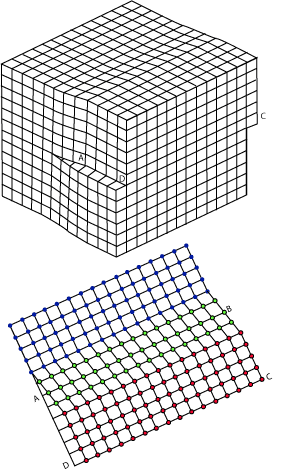
Crystal lattices are prone to imperfections, such as line defects. However, what happens when the crystal pattern experiences a shearing effect? Well, let’s use our scientific mindset to investigate this issue. Well, this will cause a rupture in the geometry which will result in a phenomenon known as a screw defect. Screw defects are so named due to the fact that if one were to walk from one edge of the dislocation to the other without jumping or falling, a screw like path would be formed.

Line defects

Line defects

Line defects

03/02/17

“How do we classify one-dimensional defects in crystals?”
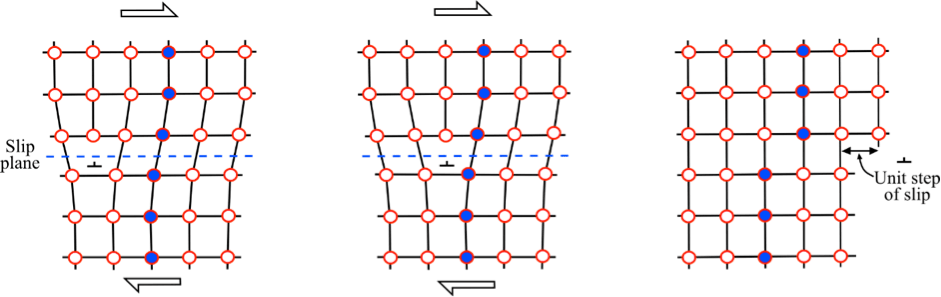
Crystals are well-known for their ever repeating structure. However, because of the intricacies of nature, these patterns are bound to have flaws. One such flaw is when the repeating pattern fails to be in a straight line, curving and bending. So how do materials scientists and engineers classify these materials? Well, after many years of hard work and research, these phenomena have been termed line defects. Owing to the fact that these defects are one-dimensional in a three-dimensional world, there are numerous forms of different line defects out there

True Stress-Strain diagrams

True Stress-Strain diagrams

True stress-strain diagrams

03/01/17

“Why is there a negative slope on a stress-strain diagram and how can we fix it?”
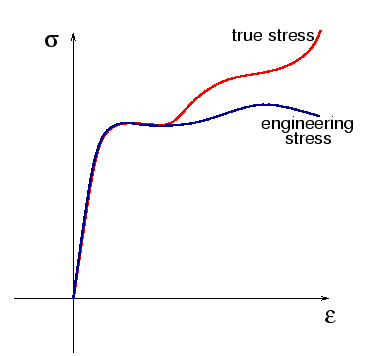
The stress-strain diagram is probably one of the most used concepts in all of engineering. However, there seems to be one counterintuitive aspect to it. Specifically, after the ultimate strength is reached, the stress-strain slope seems to become negative. This can’t be, since the stress can only increase with strain, not the other way around. So what exactly is behind this incongruity? Well, it all comes down to one simple fact. When constructing an engineering stress-strain curve, the cross-sectional area of the object is assumed to be static. However, due to the law’s of Poisson’s ratio, an elongation in length must be countered by a decrease in the associated cross-sectional area. And since this cross-sectional area will have s smaller capacity to carry force, the force distribution will go down. Therefore, if we do not include an updated area with the force, the stress will decrease with strain. Structural Engineers and Materials Scientists have recognized this flaw and have created true stress-strain diagram in response, which uses an ever-changing cross-sectional area. True stress-strain diagrams never have negative slopes, and are commonly used for research purposes.

Ray tracing

Ray tracing

Ray tracing

02/28/17

“How can we represent light rays interacting with lenses and mirrors?”
Even through the field of optics is a deep one, it is also quite simple. At its fundamental core, it is about the properties and interaction of light. This includes the subset of mirrors and lenses. So wouldn’t it be logical that we should develop a system to represent the interaction with lenses and mirrors? To start off, let’s construct the mirrors, lenses, and objects that we would like to work with. Next, label the center and focal point of the mirrors and lenses. Afterward, draw lines emanating from the object, and have it realistically interact with the optical instruments. Then draw the resulting image where all of the rays converge onto one another. This process is known as ray tracing, and is one of the most important tools used by researchers and students in optics.

Active solar water heater

Active solar water heater

Active solar water heater

02/27/17

“How can we create another iteration of an active solar water heater?”
Batch-collector solar water heaters are one way of heating water using solar power, but as engineers, we are never satisfied with just one way of doing things! So, how can we innovate on this design to create a new system? Well, let’s think about it. We know that using a cylinder to store heated water is a well thought out design choice. But how about we were to modify how it is heated up? Instead of just having a passive system where the cylinder is warmed by the sun, let’s instead extract it using a solar powered pump, push it through a solar panel, and let it come out back into an isolated part of the cylinder as heated water, which has a pump to escort it to the user’s house. These pumps will come equipped with two ball valves to stop the pumps in case the solar panel is no longer in use.

Diffusion couples

Diffusion couples

Diffusion couples

02/26/17

“Why does diffusion happen between two solid materials?”
Diffusion is a most fascinating chemical and physical phenomenon, allowing a dense collection of an element to expand and suffuse itself into another. However, What is required for such an effect to occur between two solid items? Well, after many years of research, Materials Scientists and Engineers have discovered a little thing called diffusion couples. Diffusion couples are two items with point defects that are in close contact. When the temperature is elevated, then the atoms of these materials are more likely to moves around, and can “jump” into the holes of its neighboring material. As time approaches infinity, these two materials will become homogeneous with one another, therefore stopping the diffusion process.

How images form in the eye

How images form in the eye

How images form in the eye

02/25/17

“How exactly do we see things with our eyes?”
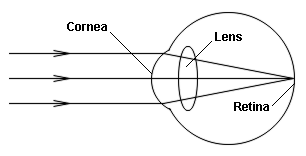
Everything that we perceive in this world is formed through our eyes. However, have you ever wondered how images can physically form in these biological objects? Well, let’s analyze this question scientifically to find out. If one were to take an eyeball and cut it in half through the midpoint of the pupil, they will find a lens just behind the cornea. If you were to then shine parallel light beams through this lens, then you would find that all of the light would focus on to the backside of the eye. The back of the eye will then transmit information to the brain, which will invert the image “in the mind’s eye” enabling us to see!