Author: Isaac Gendler

Combined Loading

Combined Loading

Combined Loading

04/18/18

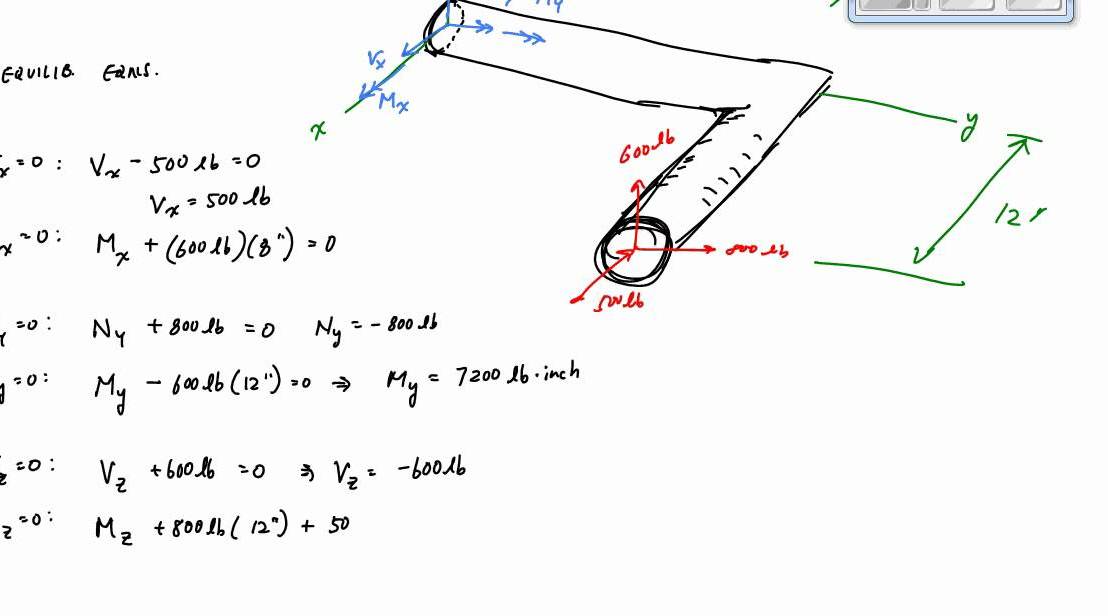
“What happens when an object experiences multiple types of loading simultaneously?”


Objects are subjected to loading all the time, whether it be torsion or bending. However, sometimes objects have to experience both at the same time. So what can we do to analyze these cases? Well, Engineers have developed a technique known as combined loading which takes into account both factors and produces a more accurate output.

Von Mises Stress

Von Mises Stress

Von Mises Stress

04/16/18

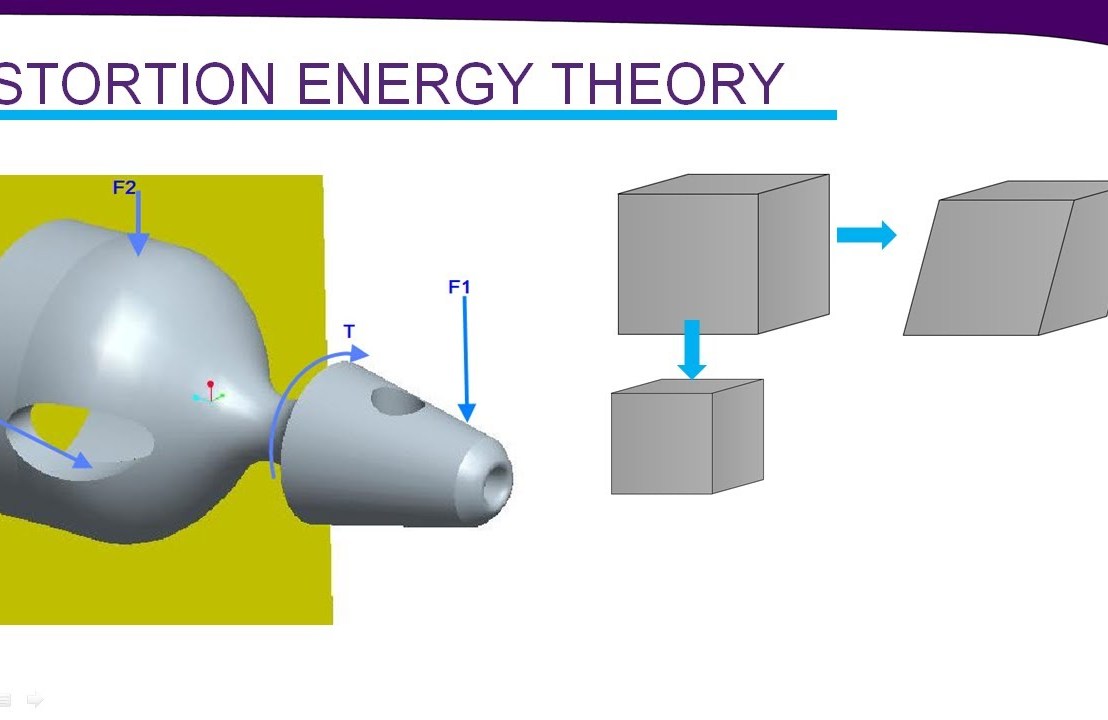
“How can we more accurately predict an object’s failure?”


One of the most important duties of a design engineer is to ensure that objects do not fail. However, classical failure theory does not always suffice. Instead, we must use more advanced concepts. One example of this is the Von Mises Stress, which is characterized by a superposition of all of the stresses on the object. If the Von Mises Stress is greater than the yield stress, then failure will occur. The formula for Von-Mises Stress is given by sigma_v = sqrt (sigma_1^2+sigma_2^2+sigma_3^2-sigma_1*sigma_2-sigma_2*sigma_3-sigma_1*sigma_3), where sigma_v is the Von Mises Stress and sigma_1,sigma_2, and sigma_3 are all stress superposition values. The Von Mises Stress can be visualized as an ellipse in 2 and 3 dimensions.

Undergrounding

Undergrounding

Undergrounding

04/15/18

“How can we distribute electricity underground?”


Most of the time, when we think of electricity distribution, we think of overground cables. However, sometimes cables can be laid underground. This allows for an area to have a better aesthetic and the wires to be less prone to earthquakes, wind, or malfunctioning. On the flipside, doing so is much more expensive and difficult.

Design for the Environment

Design for the Environment

Design for the Environment

04/14/18

“How can we design items so that they are not harmful to human health and the environment?”


Traditionally, human-made items and products have been designed without regard for the environment. However, how can we use our engineering mindset differently? Well, through one method known as Design for the Environment, items will be designed such that processing, manufacturing, packaging, and energy efficiency of their life-cycle will use as little resources as possible.

Biogas from Pig Farms

Biogas from Pig Farms

Biogas from Pig Farms

04/13/18

“How can we make sure to not waste pig waste?”


Every day, pigs in farms make waste. And oftentimes this waste is thought to be useless. However, energy officials from Duke University think a bit differently. Plans are being made to create an energy system that can take in pig waste in surrounding North Carolina farms and use it as power. Therefore, we can create biogas from pig farms!

Prandtl Number

Prandtl Number

Prandtl Number

04/12/18

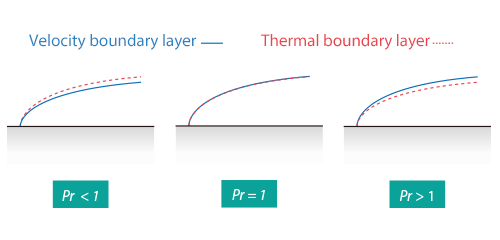
“How can we quantify the ratio between momentum and thermal diffusivity?”


For fluids flowing over an object’s surface, momentum and heat will be transferred, oftentimes at different rates. How quickly one changes with respect to the other will completely affect its properties. As a result, engineers have devised something known as the Prandtl Number, which compares the diffusivity of momentum and heat as a ratio, symbolized as pr = c_p*Mu/k with C_p being the specific heat capacity of a gas at constant pressure, Mu being the dynamic viscosity and k the thermal conductivity.

Non-Inverting Op Amp

Non-Inverting Op Amp

Non-Inverting Op Amp

04/11/18

“How can we make an Op-Amp amplifier without inverting the output?”


Inverting Op-Amps are great for changing the sign of a signal, However, sometimes we would like to simply amplify instead of invert. So how can we accomplish this using our engineering mindset? Well, What if we were to simply reverse the inputs to the op-amp? That way, we can create a Non-Inverting Op Amp, whose gain is represented by 1+R2/R1, with R2 being the second resistor and R1 being the first.