Author: Isaac Gendler

Containment Structures for Phase-Changing Materials

Containment Structures for Phase-Changing Materials

Containment Structures for Phase Changing Materials

09/10/18

“How can we make contain phase-changing materials in building integrated solar PV?”


While building integrated PV holds so much promise for distributed energy generation, inefficiency from overheating can be a terrible bottleneck. This is commonly solved by integrating the structure with some phase-changing materials. But how can we actually mount it onto the system? Well, what if we were to build a containment structure with adiabatic materials at the top and bottom to ensure temperature stability? This is an example of Containment Structures for Phase Changing Materials. An air gap is usually provided at the back to ensure proper cooling. The extra thermal energy from the PCM can also be used to heat vital building components such as water.


Photo credit ClimateTechWiki

Diesel-Electric Transmission

Diesel-Electric Transmission

Diesel-Electric Transmission

09/09/18

“How do trains and ships convert diesel fuel into electricity?”


Trains and ships are able to move great loads across greater distances through their own internal processes. But how exactly do they accomplish this? Well, it’s quite simple actually. They just hook up a diesel engine to an electric generator to spurn massive amounts of electrical power. This is known as Diesel-electric transmission and can be found everywhere on the planet. If the generator produces enough electricity, then the extra can be stored in a rechargeable battery, making a quasi-hybrid system!


Image credit Wikipedia

Phase Changing Materials for Solar Panels

Phase Changing Materials for Solar Panels

Phase Changing Materials for Solar Panels

09/08/18

“How can we use phase-changing materials to cool down solar panels?”


Solar PV is the fastest growing energy system in the world. But that doesn’t mean that it’s without its problems. When they become too hot, they become very inefficient and reject a lot of heat into nearby structures. One way to counter this is to attach a layer of Phase Changing Materials at the back of the panel. The phase-changing material is a material at its critical value so it can absorb a voluminous amount of latent heat without changing its temperature. Not only does it act as a passive heatsink but it can store this thermal energy to be used in other applications such as heating water. Phase changing materials are usually attached in a capsule behind the PV panel and have an air gap behind them to ensure cooling. This is a great example of Phase Changing Materials for Solar Panels.

California might be 100% Carbon-Free by 2045

California might be 100% Carbon-Free by 2045

California might be 100% Carbon-Free by 2045

09/07/18

“Will the world’s 5th largest economy be carbon-free by 2045?”


States around the world are launching bolder and bolder Renewable Energy targets. But one place might be shattering the all-time record. California, the 5th largest economy in the world, has recently passed in its Assembly SB 100, which mandates that the state must achieve 60% renewables by 2030 and 100% by 2045! If this passes the Senate and gets the Governor’s signature then this idea will become reality!

How Accurate Weather Prediction can Help Grid Resiliency

How Accurate Weather Prediction can Help Grid Resiliency

How Accurate Weather Prediction can Help Grid Resiliency

09/06/18

“How can weather forecasts help stabilize the grid?”


Weather forecasts have become apart of our daily lives. But did you know that they can also help with grid resiliency? By being able to forecast the future, we can obtain how large our cooling loads will have to be. And with this knowledge, we can get ancillary reserves ready when the time comes. This way, Accurate Weather Prediction can Help Grid Resiliency!


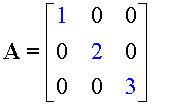
Diagonal Matrices

Diagonal Matrices

Diagonal Matrices

09/05/18

“What happens when we have a matrix where everything outside of the diagonal is zero?”


Matrices come in all shapes and sizes. But some of them are very special indeed. One of these include matrices where everything outside of the main diagonal is zero. These very special easy to solve matrices are known as Diagonal Matrices and are great for solving equations.


Image credit http://www.mathsmutt.co.uk

Row Echelon Form

Row Echelon Form

Row Echelon Form

09/04/18

“How can we simplify matrices to solve them?”


Solving matrices is one of the most fundamental parts of modern day science and engineering. But how can we put it into a form where it’s easy to solve? Well, we could take the top row, make sure that all entries under the leading column are zero, and then repeat the process until we are at the end. Putting a matrix in this form is known as Row Echelon Form, and is one of the most common ways to solve Linear Algebra problems.  


Image credit Maths Resource Youtube

Virtual Power Plants

Virtual Power Plants

Virtual Power Plants

09/03/18

“How can distributed energy resources match the generation capacity of more traditional power plants?”


With the ascent of distributed energy resources, power plants are becoming an emblem of bygone days. However, many people still want to emulate the generation capacity. So how can we do this using our new technology? Well, what if we were to coordinate all of the distributed energy resources together such that they achieve the volume of traditional plants? These are known as Virtual Power Plants and are becoming a hot topic in renewable energy.


Image credit Solar Power World

Some thoughts on how the peculiar but personal effects that Climate Change has had on me

Some thoughts on how the peculiar but personal effects that Climate Change has had on me

Some thoughts on how the peculiar but personal effects that Climate Change has had on me

09/02/18

“A small little note on Climate Change”


Right now in the United States it’s Labor Day Weekend. For many people this means an extra day off to finally relax or catch up on work. But for me it has become a personal reminder of how climate change has affected my life.


Last year, I decided to celebrate by having a lot of fun hanging out at First Fridays in Oakland and cruising down Russian River in Sonoma County. But this was during the greatest heatwave the San Francisco Bay Area had experienced on record. Once the weekend was done I had to travel over 70 kilometers (45 miles) from Berkeley to San Jose on public transportation. The air conditioning (AC) systems onboard malfunctioned, leading me to becoming greatly dehydrated. This condition was only exacerbated when I had arrived at my living space with no AC. Within a few hours, my medical condition had destabilized, leading to a series of painful events that ended with me being thrust into the emergency room for the first time in my young life.

When I had returned home, I had to recover by being in a cooler environment. This meant being stranded in the only room with working air conditioning. However, the water fountain and restrooms were in a completely different room, requiring me to travel. I soon noticed how the temperature would vary widely from room to room, and how if I had left my one area of the house I would be in extreme pain.

In this dark episode, I had came to a stark conclusion. As global temperatures rise, people will become more dependent on their climate control systems. The more these processes are used, the more electricity will be used. If this electricity comes from a non-renewable source, the global temperatures will further rise, making people even more dependent on air conditioning. This creates a positive feedback cycle that will only cause further suffering.

This weekend has brought in much of the same experience. Again there are abnormal climate conditions.  Again I have gone up to Berkeley to see friends. Again I am sick. Again the bad climate has exacerbated my conditions (the air pollution from the wildfires have worsened my runny nose considerably). And heck again I have even eaten too much!


Just a few personal notes on how Climate Change has affected my life.