
Month: November 2017

Muscular Hydrostats

Muscular Hydrostats

Muscular Hydrostats

11/21/17

“Why do tongues work?”


One of the most fascinating facets of the human body is the tongue. Its ability to move food around in one’s mouth without any bone structure is quite marvelous. However, how exactly can it do this? Well, let’s use our scientific mindsets to find out. If we analyze our tongues further, we should see that these appendages are in fact in fact constructed of muscular material. Because of this, they have an inherent flexibility where any region of the tongue can lengthen, shorten, twist, or bend at any time, allowing for a wide arrange of movement. These Muscular Hydrostats can be found in many other animals, such as the tentacles of octopi and the Trunks of elephants. Because of their diverse applications in the animal world, engineers are researching how to implement similar materials into robotics systems
Psychrometric Charts

Psychrometric Charts

Psychrometric Charts

11/20/17

“How can we create a chart of a temperature comfort range?”


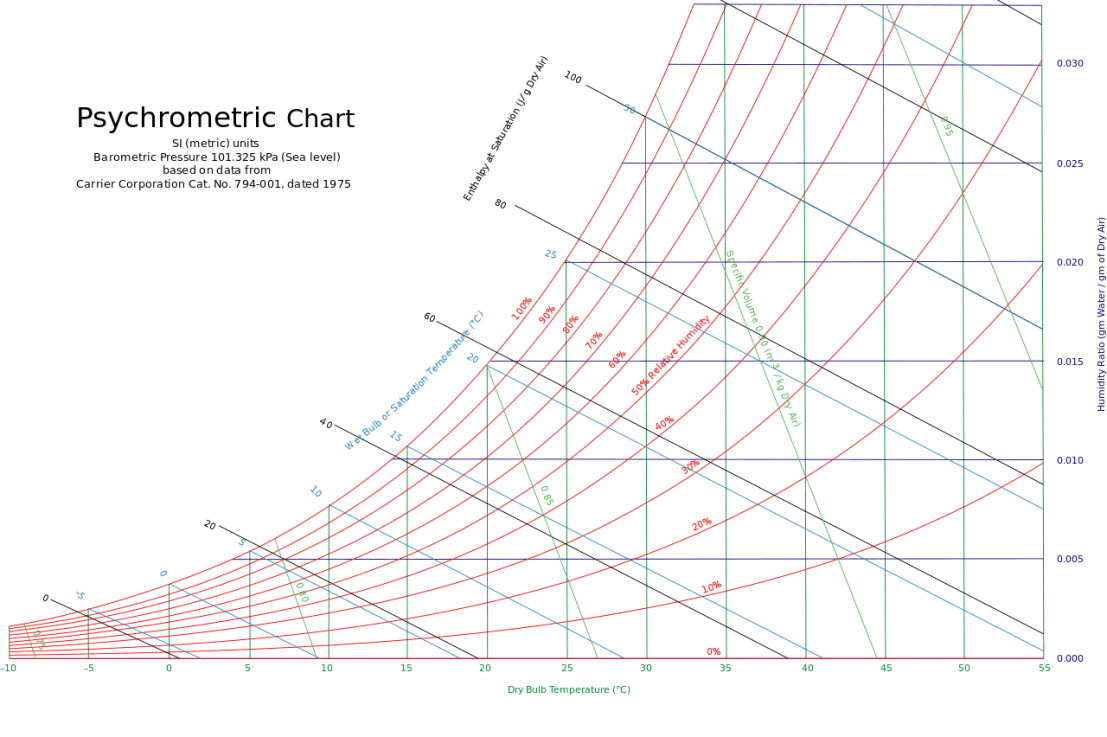
We all know that many different external factors can affect one’s temperature comfort zone. For example, 28 degrees centigrade can feel either pleasant or horrific depending on the relative humidity. So how can we relate all of these complex variables together in a coherent way? Well, many good Engineers, Architects, and Scientists took on this challenge, and decided to create a chart that takes in Dry-bulb (or absolute) temperature, Wet-bulb, Dew Point, Relative Humidity, Humidity Ratio, Specific Enthalpy, and Specific Volume of the local atmosphere to produce a visualization of a temperature comfort range. This is known as a psychometric chart and is one of the most important foundations of modern HVAC engineering.

The Dew Point

The Dew Point

The Dew Point

11/19/17

“How can we measure the point in which saturation occurs?”


When it gets humid outside, it’s very easy for moisture to appear on surfaces. However, why does that happen? Well, the answer lies in a most interesting property called the Dew Point. The dew point is the temperature at which the gas in a given area will condense into a liquid. If an object cooler than this point comes in contact with air, then it is possible for dew to form. HVAC system engineers must keep this value in mind when designing dehumidifier equipment.

The Heat Index

The Heat Index

The Heat Index

Isaac Gendler

11/18/17

“How can we measure how a temperature really feels?”


We all know how to read a normal thermometer. However, when it gets really humid, then oftentimes it will feel much hotter than it really is. So how can we use our scientific mindset to quantify this phenomenon? Well, what if we were to create a formula that combines both the absolute temperature and the relative humidity to produce a value? Well, this is the idea behind the heat index and is used by weather forecasters and HVAC systems analysts all over the world.

Relative Humidity

Relative Humidity

Relative Humidity

11/17/17

“How can we measure the amount of humidity in a system?”


If you have ever traveled to moist locations such as India or the East Coast of the United States, then you will learn very quickly of something called humidity. This feature of air can make it feel like you are swimming in a sauna. However, have you ever wondered how can we measure this phenomenon? Well, we know that the more water is contained within a local atmosphere, the more humidity is experienced. And we also know that the total amount of pressure within water vapor at this temperature will be unable to exceed the equilibrium vapor pressure of the water (because if it did, it would just sink right back into the water!). So what if we were to take the ratios of these values for an area? Well, this value is known as the relative humidity and is used in vital for weather forecasts and HVAC system control.

Dimensional Similitude

Dimensional Similitude

Dimensional Similitude

11/16/17

“How can we analyze grand scale engineering projects without spending too much money?”


Engineering projects can really range in scale. They can go as large as skyscrapers pushing over a hundred floors, or as small as microdevices that inhabit the mystical world of quantum mechanics. However, if we want to perform any tests at this scale, it would be prohibitively expensive. So how can we use our engineering mindset to get around this problem? Well, we know that equations for physical phenomena tend to be the same regardless of scale. So what if we were to build a model at a more manageable size, perform our tests, retrieve the data, and then use the scale ratio to convert it? Well, this method known as dimensional similitude is used every day by engineers to drastically reduce costs. Dimensional similitude is often employed in wind tunnel tests when full scale aircraft become prohibitively expensive.

Wind Tunnels

Wind Tunnels

Wind Tunnels

11/16/17

“How can we analyze how objects fly without flying?”


Whether it be the drones used to deliver boxes, planes to fly across the world, or satellites launched into space, flight has revolutionized human society. As such, these systems need to be tested rigorously before operation. But doing in-flight analysis is not only difficult but expensive. So how could we use our engineering mindset to solve this problem? To begin, let’s think about what makes in-flight analysis so improbable. After searching, we should find that it’s controlling the and maintaining the vehicle while in flight moving with respect to the wind. But we also know from basic physics that one object moving against another object in a frame of reference in respect to a stationary object is the same as the latter moving while the former is static. So logically, if we can control the wind and keep the machine stationary, the analysis should be the same or similar. And if we can take from our HVAC systems knowledge then we know that we can control airflow using a VAV setup. So how about we construct a facility that can hold an object in a steady position while the air blows on it? Well, this is known as a wind tunnel, and is employed by NASA to simulate drag on their aircraft!

Air Filters

Air Filters

Air Filters

11/14/17

“How can we remove solid particles from the incoming air?”


When working with ventilation based applications, we often have to deal with particulates such as bacteria and dust coming into the mixture. An influx of these materials at the wrong time can prove hazardous and even disastrous for the system. So how can we use our engineering mindset to solve this problem? Well, what if we were to simply apply a layer of fibrous materials that could absorb such materials? Well, this is the idea behind a technology known as air filters, and are used in applications ranging from wind tunnels to internal combustion engines.

Cradle to Gate Life-Cycle Assessments

Cradle to Gate Life-Cycle Assessments

Cradle to Gate Life-Cycle Assessments

11/13/17

“How can we analyze the portion of the lifecycle of a product?”


Life-cycle assessments are done on projects to determine their total impact upon the environment. However, sometimes we may only want to know the impact of a portion of their life, specifically from resource extraction up until it leaves the factory. One way to accomplish this is to use something known as a cradle to gate life-cycle assessment. This process is very useful for manufacturers to determine what their contribution to climate change is.