Month: May 2017

Direct Air Capture

Direct Air Capture

Direct Air Capture

05/04/17

“How can we capture carbon dioxide directly from the air?”
There is a global problem. Carbon dioxide emissions from industrialization have polluted the atmosphere to the point where a worldwide rise in temperatures has been induced. However, would it be possible if we could use our engineering mindset to take CO2 out of the atmosphere? Well, let’s start by using a little bit of knowledge of basic science. There are chemicals that are able to capture CO2 through a “sticking” process while leaving other atmospheric molecules such as nitrogen and hydrogen unabated, therefore creating a barrier. And this mechanism can then be heated such that the CO2 molecules are free from the material, allowing new CO2 to come in. So what if we were to take a pool of industrial fans, stack them up in rows and columns, place a CO2 absorbing material behind it and have them suck up all of the air? This method is known as Direct Air Capture and can be used to help in the fight against global warming
Soldering

Soldering

Soldering

05/03/17

“How can we fuse two metals together?”
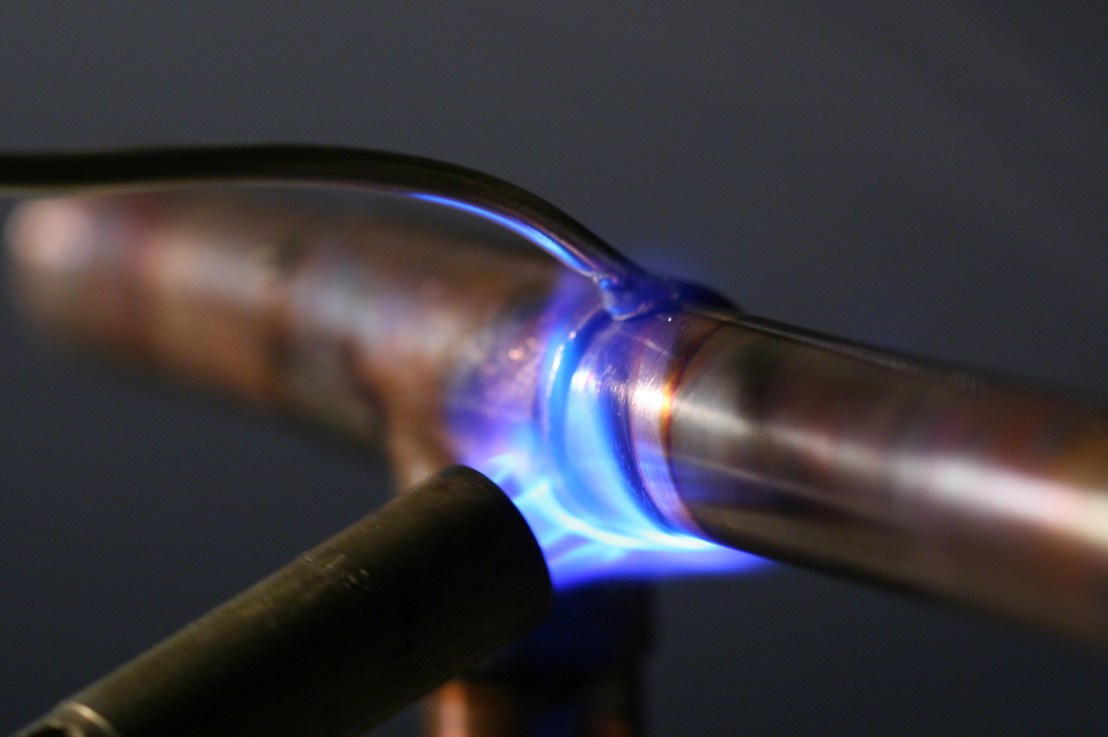
Imagine this scenario. You are working with some small metallic objects, and you want to merge them. However, you don’t want to work the too heavily with processes such as welding. So how can we devise a method to accomplish this? Well, let’s use our engineering mindset to solve this problem. We know that if a liquid solidifies between two objects, then it will join the two together. And we also know that solid metal is usually quite sturdy. SO what if we were to melt a metal into a liquid between these two object and then quickly solidify the object? Well, this process is known as soldering and is one of the most common methods that engineers use.

Complex fluids

Complex fluids

Complex fluids

05/02/17

“What happens when there is a fluid with more than one phase present?”
Most engineering or physics applications of fluid mechanics deal with only one phase of matter. However, what happens when there is there is a multiphase solution present, such as in shaving cream? Well, after much investigation, engineers and physicists have determined that such materials can not be treated as typical fluids and instead must be classified as complex fluids. Complex fluids exhibit often unusual stress-strain relations, are highly nonlinear, and relatively unknown. Perhaps readers of this blog will pursue research into this subject and illuminate us on this subject.

Adiabatic process

Adiabatic process

Adiabatic process

05/01/17

“Is there a thermodynamic process with no heat exchange?”
When most people think of thermodynamics, one of the first thing that pops into people’s minds is one phenomenon, heat flow. However, is it possible to have such a process with no heat flow? Well, let’s think about it. If we were to take our system and completely isolated it inside an insulator, no heat would be able to flow in or out. Therefore, all of the work done must come from the internal energy. This phenomenon is known an adiabatic process. In an adiabatic process, the pressure multiplied by the volume raised to the ratio of the specific heats of the gas is always equal to a constant (PV^(c_p/c_v)), leading to a steeper PV diagram than the isothermal process.