Month: March 2017

Slip (materials science)

Slip (materials science)

Slip (materials science)

03/13/17

“How does plastic deformation in a material affect the internal defects?”
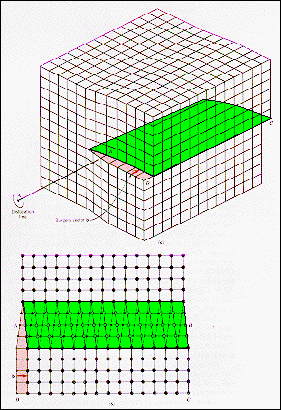
All physical materials have defects within their crystal structure. Furthermore, plastic deformations can cause the internal structure of a material to shift. So what happens when a plastic deformation is applied to a material with edge dislocations? Well, let’s use our scientific mindset to think about it. We know that these edge dislocations represent an absence of atoms along a chain. We also know that applying plastic deformations will cause a plane of atoms to move in the direction of the force. So logically, wouldn’t this plastic deformation cause the edge deformation to move within the lattice? This is the fundamental idea behind a phenomenon in Materials Science and Engineering known as a slip and can be used to characterize the internal movement of atoms.
Acids and bases

Acids and bases

Acids and bases

03/12/17

“What are Acids and bases?”


Think back to when you were younger. You were in your high school chemistry class, and you were learning about these items called acids and bases. You have heard these words many times in your everyday lives, but you had no idea what they were and what they actually did. Well, this lesson will fix that.
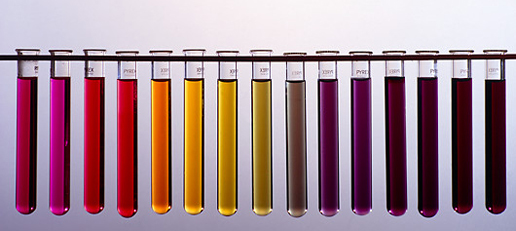
Before we begin everything, we must contemplate one fact, the presence of hydride[h-] ions within substances. In the case of water, there is 1 hydride molecule for every ten million water chemicals or 1*10^-7 hydride for every hydrogen! Since the scale of hydride ions in different substances are usually in orders of magnitude difference, it would be easier to take the log of the concentration level and flip the sign so we could put it on a standardized scale. Let’s use water as our example. Since water has 10^-7 hydride molecules for every of its own, we would represent this as -log(10^-7) which would output as 7. And if an element has ten times more hydride ions in its density, it would be 6, and ten times less, it would be 8. We call this standardized level a pH level (pH → power of hydrogen). This pH level is what Scientists and Engineers use to determine the level of acidity in a substance or the amount of hydroxide ions. If the pH level is below 7, then an acid is considered to be more acidic, and if it is above 7, then it is considered to be more basic. Acids taste sour and react strongly with metals, while bases taste bitter and feel slippery.

Grain size reduction

Grain size reduction

Grain size reduction

03/11/17

“Is it possible to increase the strength of a material by reducing the grain size?”
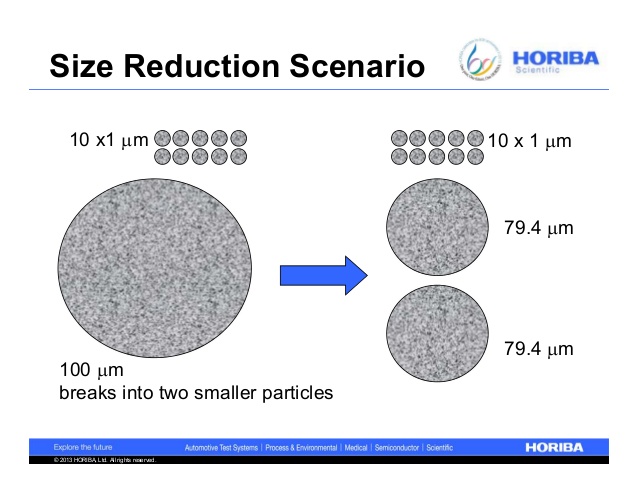
Many materials in their original form are not strong enough for practical engineering purposes. However, is there a way in which we could strengthen a material by modifying its grain structure? Well, let’s look into it. We know that the strength of a material is contingent upon its grain size. Specifically, the smaller the grain sizes are, the more of them will be able to be present within a material. So wouldn’t it logically follow that if we were to reduce the size of grains, the stronger our material would be? This is the fundamental principle behind grain size reduction, and modifies the yield strength of a material by the equation sigma =sigma_0+kdx, where sigma  is the new yield stress, sigma_is the original yield stress, k is a constant, and d is the grain size.

Precipitate hardening

Precipitate hardening

Precipitate hardening

03/10/17

“How can we use heat treatment to increase the strength of a material?”

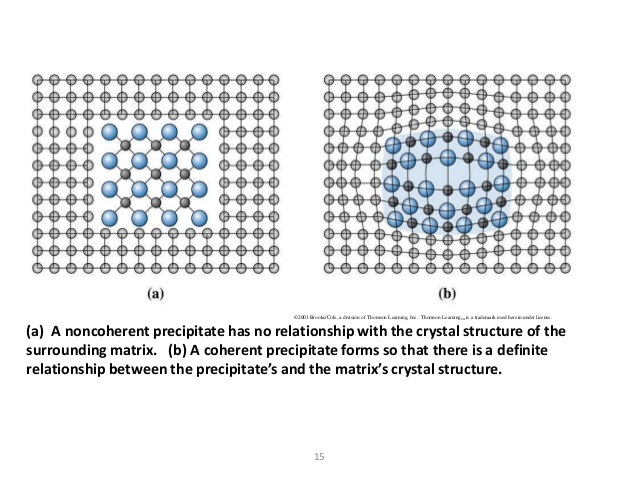
Often times, when we receive a material, it is not durable enough for our needs. So how can we use a readily available process to increase the strength of a material? Well, let’s use both of our engineering and scientific mindset to find out. Well, we know that if were to introduce an alloy into the crystal structure, then the material would be strengthened. However, if we were to increase the temperature of a material and then rapidly cool it, the material would form a highly regular crystal and the precipitates would seep into the grain boundaries, therefore greatly strengthening the material. This process is known as precipitate hardening and is used to make a variety of materials stronger ranging from everyday aluminum to the internal wing structure of a Boeing 767

Solution hardening

Solution hardening

Solution hardening

03/09/17

“What happens to a crystal structure when alloys are introduced?”
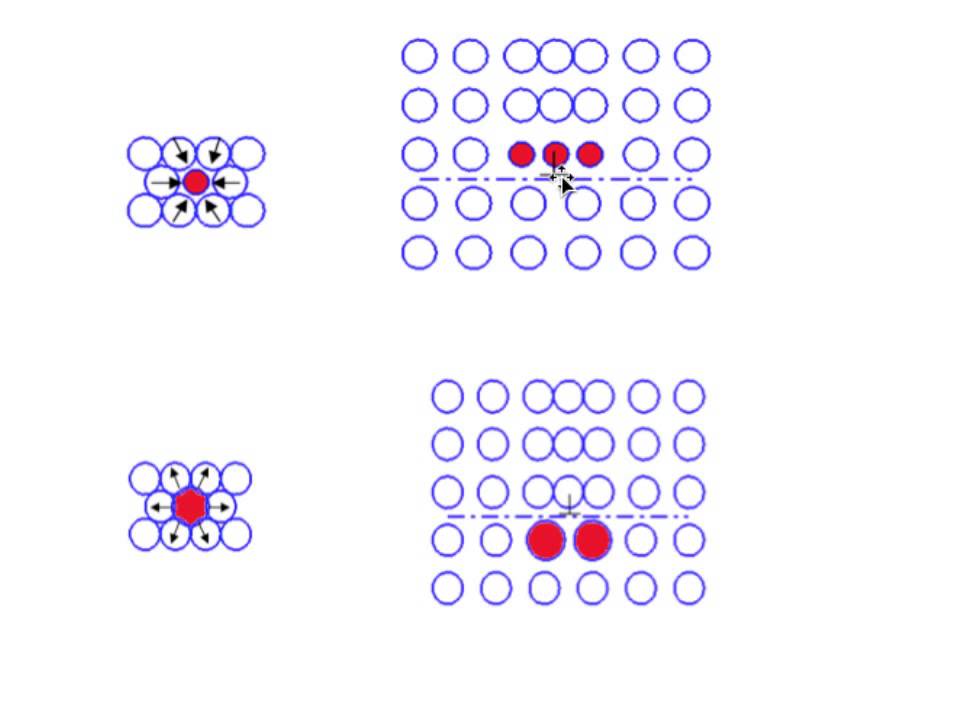
As pure elements, most crystal structures are fairly linear and homogeneous in nature. However, what happens when another element with a different atomic radius is introduced, disturbing this uniformness? Well, let’s use our scientific mindset to find out. We know that when these due to intermolecular forces that like elements will be more attracted to like elements. From this standpoint, we also can observe that this interlocking will impede further dislocations and lock the movement and slip of the atoms. This form of material hardening has been termed solution hardening my Materials Scientists and Engineers, and is dependent on the size of the inserted atoms.

Traffic barriers

Traffic barriers

Traffic barriers

03/08/17

“How can we control the flow of traffic away from dangerous road elements?”
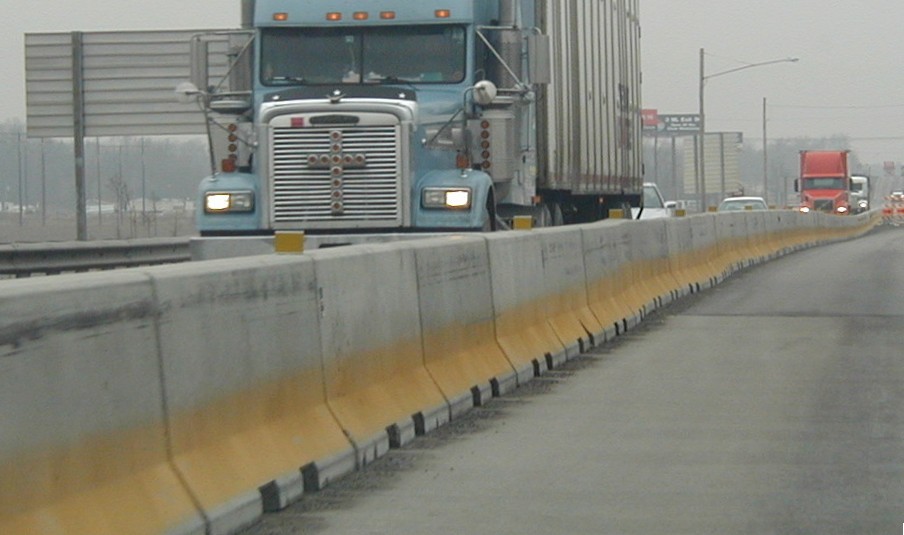
Personal vehicle transportation is one of the most used forms of transportation throughout the world. However, due to the autonomous nature of such machines, drivers can non-intentionally make collisions with errant road elements such as trees, boulders, and walls, or even the air if they run off an elevated freeway! So how could we change roads to make them much safer for general use? Well, let’s use our engineering mindset to figure this problem out. Well, we know that one way to stop an object from moving is to have it collide with a rigid object that will absorb all of its kinetic energy. So what if we were to take this idea and put it into reality? This is the exact type of thinking behind something known as a traffic barrier, which can be seen omnipresently around roads throughout the road. Examples of traffic barriers range from the exotic guard rail to the tiny traffic cone!

Critical angle

Critical angle

Critical angle

03/07/17

“Can we use refraction to make reflection?”
Refraction is a common physical phenomenon, and we know that if light from a denser medium passes into a lighter medium then it will bend further away from the normal angle. However, is it possible that this angle can bend so much that it will actually go back into the incident medium? Well, let’s use our scientific mindset to investigate this question. We know that light passing between two mediums behaves as dictated by snell’s law, or n1sin(1)=n2*sin(2). If we were to arrange this equation to find for 2, we would arrive at 2=sin(n1*sin(1)/n2)-1. Now if we analyze this equation, we can realize that if were to have the ray of light incident at an angle 1such that the output would be 90 degrees, the light would not pass to the other side! Physicists have termed this angle the critical angle and is used heavily in fiber optics, where light is trapped in and passes through a long tube of wire.

Interferometers

Interferometers

Interferometers

03/06/17

“How can we produce a controlled chromatic aberration for study?”


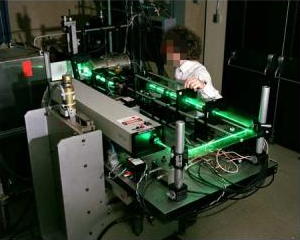
Chromatic aberration is one of the most perplexing phenomena in the study of optics. However, creating controllable versions for laboratory study are extremely difficult to accomplish. So how can we make a machine that will be able to make adjustable chromatic aberrations at our will? Well, let’s use our engineering mindset to solve this scientific problem. Well, we know that if we were to pass monochromatic light into transparent glass at an angle then some will be reflected and some will be refracted. This creates two beams of light of identical wavelength for us to study. Now, let’s take this a step further. We need to pass these beams of light back to each other so that they interfere, which can be accomplished by placing mirrors in the path of beams. So what if were to take this system and bring it into a reality? This machine is known as an interferometer, and is used in physics labs all over the world to study the intricacies of chromatic aberration.

Track gauge

Track gauge

Track gauge

03/05/17

“How does the width of railroad tracks affect transportation?”
Trains of all shapes and sizes have made affordable and efficient transportation a modern day reality. However, as mechanical devices, these machines are contingent upon multiple components, such as track. So how can we classify the different types of track spacing and their resulting physical effects? Well, let’s use our engineering mindset to figure this out. We know that the geometry of railroad tracks are primarily composed of one flat path and two vertical blocks to encase the wheels. And since the flat paths are variable in nature, the length of them can be different depending on the system being used, therefore a standard measurement system known as a track gauge must be used to distinguish the different types of tracks. The larger the track gauge is, the faster the maximum speed and the easier it is to control at the expense of cost and ease of turn. The standard track gauge is known as standard gauge in the U.S and is measured at 1,435.1 mm (4 feet 8 12 inches)