Month: February 2017

A new way to power rural communities

A new way to power rural communities

A new way to power rural communities

02/10/17

“How is Nigeria combating climate change and rural poverty in a most ingenious way?”
Nigeria is a country in western Africa which is home to nearly one hundred million people without electricity. In addition, because of it’s geographic location, it will be disproportionately affected by climate change. Luckily, this country is not a complacent one, and has already begun fighting back. A company called Lumos based in the Netherlands has developed a “micro micro grid” for the Nigerian market in which a single 80W solar panel will be attached to a housing unit which provides energy to a suitcase size battery which will power a home. These units have an upfront cost of only $75.00, and the electricity can be paid for using simple mobile phone text. after four years of using a model, the users will no longer have to pay for ongoing electricity use! This technology has the potential to electrify millions of rural homes in a safe and sustainable manner.
The wind turbines on the Eiffel tower

The wind turbines on the Eiffel tower

The wind turbines on the Eiffel tower

02/09/17

“Is renewable energy becoming so popular that even the Eiffel tower is starting to use it?”
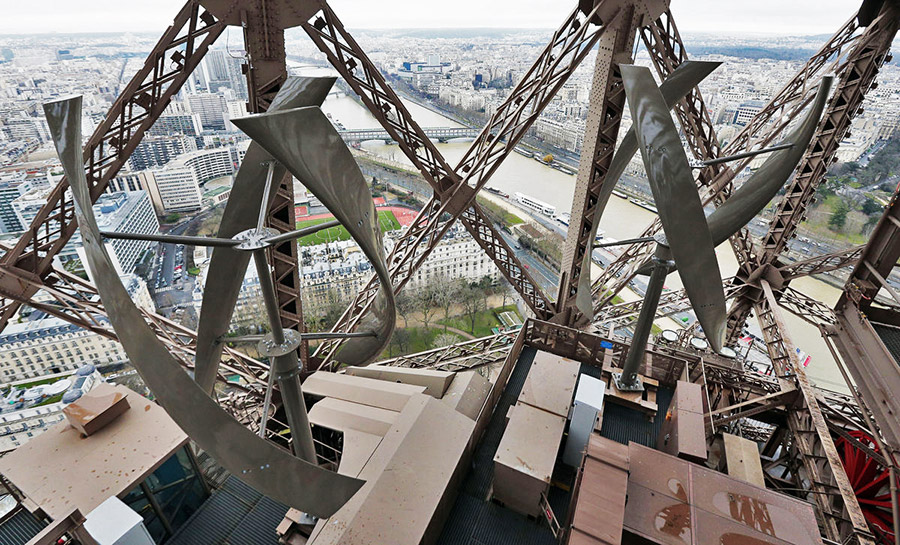
Interest in renewable energy is skyrocketing around the world. Investors have taken note that prices have fallen so low in many areas that renewables are now cheaper than their pollutive non-renewable counterparts. In fact, renewable energy is becoming so popular that even national monuments are starting to use them. As of 2015, The Eiffel tower in Paris, France has become outfitted with two wind turbines to increase power generation. These turbines utilize a vertical axis design that is 5.2 meters in height and 3.2 meters in width which can be expected to produce 10,000 kilowatt-hours of electricity per year!

Overhead power lines

Overhead power lines

Overhead power lines

02/08/17

“What structures are put in place to transmit electricity along long distances?”
Human civilization in its present form has a tremendous energy requirement to sustain itself, which is provided through the use of complex energy generation systems. However, such infrastructure tends to be placed a large distance away from inhabitation, so how can we transfer the generated energy safely into where humans need them? Well, we can accomplish such a task through the use of overhead power lines. Overhead power lines are constructed by using one or more conducting lines being suspended through strong mechanical beams. These conducting lines will be able to safely insulate from the external world and transfer it to other locations, while the beams will be able to support the weight. Overhead power lines are a cost effective way to distribute energy and are used around the world from the mountains of California to the streets of Istanbul.

Focal point

Focal point

Focal point

02/07/17

“Why is the point that light will hit for a concentrated solar power system so special?”

Concentrated solar power is famous for its use of parabolic cylinders to concentrate solar energy. However, what special physical property gives it its strength? Well, let’s use a little bit of scientific thinking to find out. Since all light rays contain energy, and these solar systems work by absorbing energy from concentrated sunlight, would it not be logical that we would just place the water at the point of maximum sunlight? If we do enough experimentation, then we will find out that this point is where all of the rays will converge! This point has been termed the focal point and is used for a variety of other applications ranging from photography to telescopes.

Concentrated solar power

Concentrated solar power

Concentrated solar power

02/06/17

“Is there a way to generate solar power without using photovoltaics?”


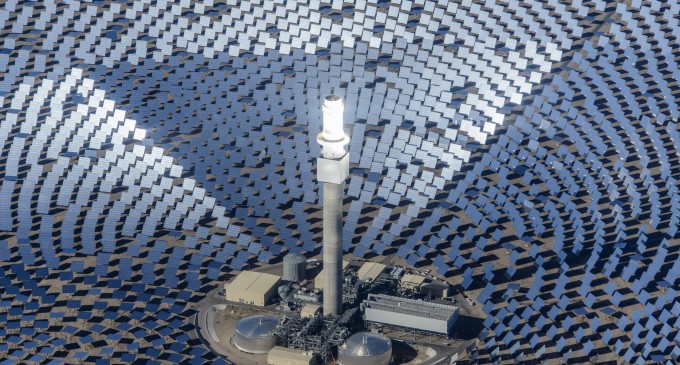
Solar PV systems are one of the most ingenious gifts that technologists have bestowed upon humanity. However, engineers are a rather creative people and like to do the same thing in multiple ways. So how can we “re-invent the wheel” when it comes to solar power? Well, we know that the sun produces sun rays. And if we focus these sun rays onto a focal point, then a large amount of energy can be transferred to an object that point. So what if we were to take a large array of concave lenses, focus all of the sunlight onto a source of water, and use the resulting energy to turn said water into steam to drive a turbine that generates electricity? This is the operating principle behind a system known as concentrated solar power and is commonly used in highly irradiated areas such as California, Spain, and South Africa.

The physics of a football tackle

The physics of a football tackle

The physics of a football tackle

02/05/17

“How do the laws of physics affect football tackles?”


Because of the excitement for the super bowl stateside, a fan recently asked for an article about the science of football.


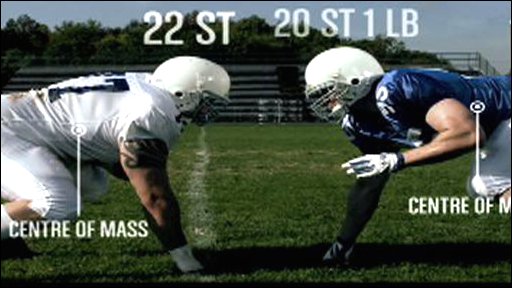
If you are from the United States, then you have probably seen or heard about a game called “football” where people divided onto two teams will fight each other for control of a prolate spheroid shaped ball using tackles. However, have you ever wondered about how one can make an optimal tackle? Well, it turns out that all you need is a rudimentary knowledge of physics to find out.

        Every object in the universe has a property called a center of mass, or the location of the mean position of matter in a body. When a force is applied on an object which does not go through the center of mass, a torque will be induced, causing a rotation on said body. So now let’s put this theoretical framework into practice. The average human male has their center of mass located slightly above the navel. When one football player tackles another in this area, the player will simply be moved in the direction of the tackle. But if the player were to give a tackle below this zone, a torque would be induced that would completely throw off the player! Luckily, professional coaches have taken note of this, and use this scientific knowledge to advise linemen to stay close to ground while running, making it far more prohibitive for a disabling torque to be thrust upon them!

Science always shows up in the most marvelous ways in our everyday life, and it goes to show that a small bit of knowledge of it can go a long way.

Dual rotor wind turbines

Dual rotor wind turbines

Dual rotor wind turbines

02/04/17

“Could we make wind turbines more efficient by adding a second rotor?”
       The wind turbine is one of the finest inventions that humanity has conjured. It is simply amazing how these machines can take in the kinetic energy of the wind and transfer it into power to be used by humans. However, the designs of these machines often come with a problem. The rotor of the turbine, one of the most important components of the device, disrupts the surrounding wind, inducing turbulence and lowering the amount of energy to be obtained. So how could we use our engineering mindsets to solves this problem? Well, Aerospace Engineers Anupam Sharma and Hui Hu of Iowa State University made a thorough investigation on this problem, and discovered that one way to solve this problem is actually to add a second rotor to the turbine! This would not only increase the amount of energy absorbed, but also prevent much of the unwanted turbulence. This team is currently working on optimizing the design, such as the location of the turbine, the direction it should take, the size, and what kind of airfoil the dual rotor wind turbine should have.

Transistors

Transistors

Transistors

02/03/17

“How can we apply our knowledge of semiconductors to create electronic switches?”


P and N type semiconductors are highly useful devices for creating a controlled electric current. However, how could we apply this technology to create something incredibly useful? Well, let’s use our technical mindset to figure this out. We know that if an N type and a P type were hooked up together and the P type had a higher voltage than the N type,, then a flow of extra electrons from the N type (called the “emitter” would come in to fill the P type (called the “base”). Furthermore, if there was an another N-type (called the “receiver”) electron on the other side of the P-type that was even more positively charged, then we would be able to not only have an electron flow but be able to control the amount of current flowing. However, our only problem is that this operation can only take place if both the base and the receiver had a positive voltage. This can be easily fixed through applying a positive voltage to the base, allowing not only for a current to take place but control of the current and voltage to happen as well, effectively making a switch with no moving parts! This is the foundation of an electronic component known as the transistor, and is what allowed for the modern computer revolution to have taken place!

P and N-type semiconductors

P and N-type semiconductors

N-type semiconductors

02/02/17

“What are the fundamentals of the fundamentals of solar cells?”
Solar cells are one of the most magnificent devices that humanity has conjured. However, what exactly makes them tick? To find out, let’s go take a look. If one were to analyze a solar cell with a magnifying glass so powerful that it could see in the microscopic level then we would find a multitude of small, three terminal devices. These devices are known as Transistors and have very special properties. Specifically, it can work as a switch without moving parts! However, before we understand transistors, we must understand what cause them to work. Half of the composition of transistors are composed of objects known as P-type and N-type semiconductors. P-type semiconductors hold an impurity of boron[B], which holds one less electron than silicon, while N-type semiconductors are  have a small impurity of phosphorous [P], which holds an extra electron than silicon. When combined, these semiconductors will have more mobile charges and can conduct current better.