Month: November 2016

Schmidt hammers

Schmidt hammers

Schmidt hammers

11/21/16

“How can we learn about the compressive strength of a material without destroying it?”


In engineering, knowing the compressive strength of the materials that you are working with is vital for all forms of analysis work. However, many testing methods are very expensive, and involve actually deforming some of the material. So what if we were to have a material that is both expensive and irreplaceable? Well, luckily for us, engineers are a very clever people, and have invented a device known as a Schmidt hammer to solve this problem. The schmidt hammer is comprised of three main parts, a solid chassis, a cylinder going through the center of, and a spring in the inside of the cylinder. When held vertical and pressed against a solid surface, the cylinder will stand in place, causing the chassis to move downwards, compressing the spring. When the cylinder moves all the way down, the user can press a button on the chassis, which in turn will release the compressed spring, and the resulting rebound will give a reading on the body of the chassis which corresponds to compressive strength.

Operating temperature

Operating temperature

Operating temperature

Isaac Gendler

“In what temperatures can a machine operate?”


As a modern civilization, we operate and use machinery everyday. Whether it be something as simple using an alarm to wake us up in the morning or something as exciting taking as plane to another continent, technology has firmly integrated itself into the nuances of human life. However, as engineers, we must realize that such machines have constraints to them. One such constraint is the temperature that the system can operate in, also known as the operating temperature. Since objects and materials have different properties at different temperatures, a system will change depending on the temperature input. And since machines, (both mechanical and electrical) require all parts to work in a highly precise manner, such perturbations in properties could cause drastic failures. To illustrate, let’s analyze a device very familiar to us, the computer. If the internal temperature of a computer exceeds the operating temperature, then component failures will ensue, causing a shutdown. As a result, when designing as an engineer, one must always take into account the operating temperature.

Factor of safety

Factor of safety

Factor of safety

11/19/16

“How do engineers deal with loads near the failure point?”


When doing engineering, one has to deal with the maximum load that a system can handle. However, in the real world, it would be quite unwise to have loads even near this limit. The rationale behind this is that such a system could experience an unexpected impingement. To illustrate, let’s suppose that enough people stand in an elevator to have it at maximum capacity, if even a rat were to climb into this elevator, then this capacity would be overloaded and the elevator would experience failure. Luckily, engineers tend to be foresightful people, so when developing structures, instead of designing them just to sustain the expected loads, they are created in respect to a factor of safety. A factor of safety an extra “margin” that a structure can support (in terms of a multiple of the expected load), and can be calculated using the formula FoS =Ultimate stress/actual stress . An example of the factor of safety in use is the famous Eiffel tower, which is designed to sustain 4.5 times as much stress than it typically does. In summation, the factor of safety is an intrinsically necessary tool in modern engineering, and has saved countless of lives all over the world.  

Liquid meniscus

Liquid meniscus

Liquid meniscus

Isaac Gendler

“Why do liquids have a bent top when put in containers?”


Have you ever placed a liquid in a container, and noticed that there was a bend in the top it’s shape? And have you ever wondered why this happens? Well, let’s use our knowledge of science to find this out. As discussed earlier, we know that liquid molecules exhibit cohesive forces towards one another and adhesive forces towards molecules of other substances, such as a solid beaker. So what if these two types of forces do not cancel one another out? This would mean that one side (the beaker or the liquid) would have a greater force than the other side, causing a pull on the liquid towards it. This in turn would cause a “bent” shape called a meniscus to form in the liquid. If the liquid exhibits a concave shape, then the adhesive forces are more powerful, and if it exhibits a convex shape, then the cohesive forces are more powerful. The net forces resulting from a meniscus will frequently result in the spectacular phenomena of capillary action.  

Groundwater

Groundwater

Groundwater

11/17/16

“What is the water held underground like and how is it useful?”


Water is one of the most important substances in the universe, if not the most important. It keeps humans alive, causes plants to grow, and generally causes life to exist. And luckily for us, water is also one of the most plentiful resources as well, with over 71 % of the surface area of the Earth being composed of it! However, water is not just found in the ocean, but in a myriad of other locations. In fact, an immensely important storage area for water is in the subterranean world. This water (termed groundwater by geologists) is contained in geological structures termed aquifers (the spaces between soil particles and pores in fractured rocks). Groundwater can be replenished when rain and melted snow seeps down into the aquifers, and water from aquifers can be discharged through lakes, streams, and springs. Groundwater is so plentiful that it supplies 51 percent of the drinking water to the residents of the United States and 99 percent of it’s rural inhabitants. Much of our civilization runs off groundwater, as a whopping 64 percent of American agriculture is produced using groundwater. Although humanity uses groundwater for a multitude of uses, groundwater can be easily polluted with the leakage of waste into aquifers, which in turn will cause damage to the nearby population. An event of this sort illustrates how humanity is not disconnected from it’s surrounding environment, as as such we must take care of it to take care of ourselves. 

Capillary action

Capillary action

Capillary action

11/16/16

“Why is it that liquids can move up against gravity in containers?”


Liquids are objects that we often see everyday, whether it be in the water that we drink or in the blood that runs through our veins. We also know that objects are held down to the Earth by gravity, but for some ominous reason liquids seem to have the ability to move upwards by themselves in a container against gravity. Why is this so? Well, like I always say, let’s think about it. When liquids are placed in containers, a concave meniscus will form from adhesive forces. If the diameter of the containing vessel is small enough, then the adhesive forces from the container will cause a vertical force on the fluid, and if these adhesive forces are more powerful than the internal cohesive forces will pull the liquid along with it, therefore causing vertical movement. Because this phenomena is so special not only has it been given a special name by scientists and engineers (Capillary action), it is found in many wonderful applications in nature. Plants use capillary action to absorb water from the soil using their roots, and human eyes utilize capillary action using two small diameter tubes called the lacrimal ducts to drain tear fluid in the eyes.

Lunar apogee and perigee

Lunar apogee and perigee

Lunar apogee and perigee

11/15/16

“What are the   furthest and closest distance of the moon from the earth?”


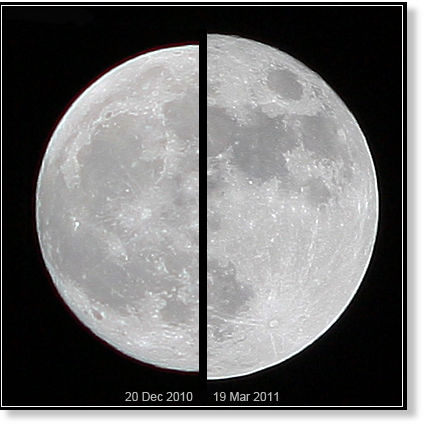
One of the most intriguing aspects of the moon is that it has an elliptical orbit. As a result, it will be closer to the Earth at certain time periods and farther at others. And since in science it is useful to classify special and important cases, astronomers have decided to term the closest point of the moon to the Earth as perigee (around 405,696 km) and the furthest point as apogee (around 363,104 km). A most fascinating consequence of these varying orbits is the varying size of the moon in the night sky, which can result in the most elegant phenomena known as supermoons

Supermoons

Supermoons

Supermoons

11/14/16

“Why is it that the moon appears larger in the sky some nights than others?”


Have you ever wondered why the moon appears to be larger on some nights than others? Well, let’s think about it. We know that the moon revolves around the Earth every night. In addition, this orbit is elliptical, meaning that the moon will be closer to the Earth at some times rather than others. So wouldn’t be logical when the moon is closer to the Earth in it’s orbit, it would appear larger in the sky? This is the very principle behind a supermoon. Supermoons occur at a frequency of once every 14 months, with the most recent one (as of writing) happening on November 14th, 2016 (The largest one in nearly 8 decades!). As a natural consequence of the close proximity of supermoons, the tidal force amplifies up to 19 percent!

What makes something edible?

What makes something edible?

What makes something edible?

11/13/16

“Why is it that my body can digest some foods and not others?”

As a human in order to survive, you probably need to consume food everyday.But in order for this to happen, our bodies must be able to break down this food to extract useful materials such as amino acids for protein. If the food material that we consume is unable to be broken down (or if the material contains toxic elements), then it will be rejected.