Month: August 2016

Hydrogen bonding

Hydrogen bonding

Hydrogen bonding

08/22/16

“Why is water such a special element?”


Water is a very special element. This single molecule allows for the scientific miracle of life to occur, whether it be the smallest of fungi to the largest of whales. Water allows for humans to hydrate themselves, and to create agriculture.

But why is it so special? Well, believe it or not, it all comes down to one basic property of water, the special way that it bonds. Water is made up of one oxygen atom and two hydrogen atoms (hence the name H2O). Both of these atoms have shared electrons. However, due to the electronegativity of the oxygen atom, the electrons will be closer to the oxygen than the hydrogen atom. This means that the water molecule will become polarized, resulting in a dipole. This type of charge is so special that scientists and engineers have termed this type of bond a hydrogen bond.

Because of this asymmetry of charge, water can dissolve electrolytes such as sodium chloride [NaCl] easily. This hydrogen bond also allows water to hold together DNA, proteins, and other macromolecules. The polar quality of hydrogen molecules also allows for other water molecules to attract one another very easily, with the oxygens reaching out to the hydrogens. This form of bonding gives water some of it’s special properties, such as a high boiling point (100 degrees C) and surface tension.

Motor armatures

Motor armatures

Motor armatures

08/21/16

“What component causes an electric motor to spin?”


We know that Electric motors have two main mechanical parts, a stationary stator that encapsulates a rotating rotor. Now, how is this rotation induced? Well, in addition to having the aforementioned two mechanical components, electric motors has two electrical components. The first electrical component is called the field, which is simply the magnetic field component inside the airgap. This field will turn the armature, which is the primary power producing component in the motor. The armature carries current that is oriented perpendicular to the magnetic field, which in turn will induce a force which will cause a torque to take place. The armature usually consist of several conductive windings for this effect to happen. The field and the armature can be on either on the rotor or the stator but one must only occupy one other.

Resistor coloring

Resistor coloring

Resistor coloring

08/20/16

“Why do resistors have different colors?”


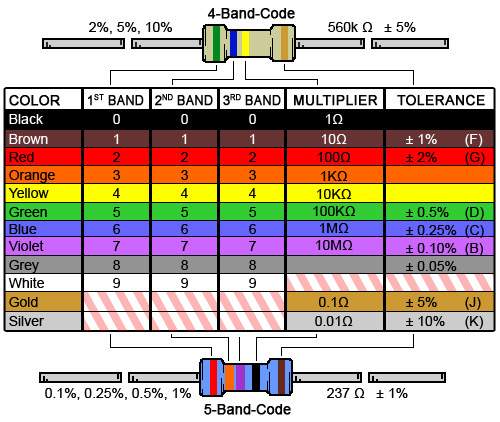
When looking at resistors, you might notice that they seem to have different colors. Four in fact, all in different bands. What do they mean and what do they imply? Well believe it or not, this different resistor coloring corresponds to different resistance values. This means that users such as yourself can easily find the resistor they require just by looking at the band colors.

The first band (called band A) represents the first figure, the second one t(band b) represents the second figure (some more precise resistors may have an extra band to indicated a further figure), the third band the Decimal multiplier (meaning how much this figure  constructed by the earlier bands will be multiplied by), and the final band represents the tolerance percentage (no band means a 20% tolerance level). A chart of the colors and the corresponding values can be found in the picture above

To get a better idea about how this works, let’s do an example. Let’s say that you find a band with the first band colored gray, the second band colored blue, the third green, and the final one red. This resistor will have a value of 86*10^5 ohms, and a tolerance of +-2%. Now go out there, find yourself some resistors, and try to apply these rules to try to estimated the values!

Divergence and convergence

Divergence and convergence

Divergence and convergence

07/30/16

“How can we test when a mathematical pattern will converge to a single number or diverge into infinity?”


Let me ask you a question. Suppose that I were to tell you that a country was completely made up of immortal individuals. And let’s say that these individuals were to reproduce their population at an ever changing rate. How could we tell if their population would expand into infinity, or stop at a certain number? Well, let’s solve a numerical example to figure this out.

Suppose that this same country starts out with one hundred people. And let’s have these people reproduce so that the first year, they would produce half of the population (50 in this case), and the next year, they would produce only half of a half of their initial population (25 ), and so on. Eventually, the number of the people in this country would converge into a single, static number! (200 for this example).

Now let’s the the same population but with a different rate. In this case, the rate of the change of population will be double rate of the prior time, so after the first year, the country will add 200 people, and the next year, the country will add 400 people, and so on, until the number of people in this country will diverge at infinity!

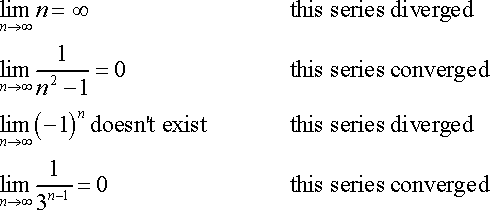
So let’s think about this some more. If the rate of reproduction decreases with each value, then it will eventually shrink down to zero, and if the rate of reproduction increases with each value, then it will expand into infinity.

Well, now let’s apply this mindset to a more abstract mathematical entity. Let’s take the infinite series n=01xn, with the condition that we ourselves can choose that values for x!. Well, for all x values that are greater than one, the value will get smaller as time goes on, and eventually the number will converge onto a single number. Likewise, if our x values are smaller than one, then the rate will be increasing, resulting in an ever expanding number.

Series and Parallel

Series and Parallel

Series and Parallel

08/18/16

“How can different elements in a circuit be hooked up and what are the effects on current?”


When studying electronics, one might wonder, “What are the different ways that we hook up different resistors in a circuit, and how do they affect the circuit current itself?”. Well, let’s think about it.

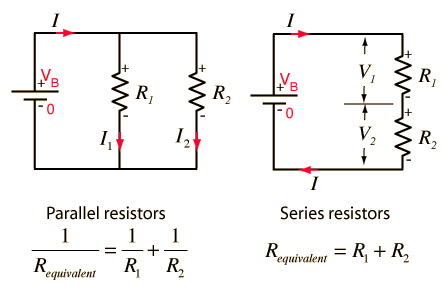
One way we could hook up everything is to directly connect each element in series. This way, the voltage from the power source will pass through each individual part, giving an associated drop at each one. Due to the fact that they are all directly connected, each resistive element will have the same current pass through it. This makes calculating the final current easily, because we can solve symbolically as follows. Let’s say we have a circuit with 3 resistors, all of different values R1, R2, and R3. Each one of them will have the same current I. Because the voltage drop through all of them combined must be equal to the total voltage V, we can construct the algebraic equation I*R1+ I*R2 + I*R3=V. Due to a common factor of I, we can simplify this equation to be I*(R1+R2+R3)=V. We can then divide the voltage by the total resistance to find the current I = V/(R1+R2+R3). This pattern holds for any number of elements in series. Let’s do a numerical example to cement our knowledge. Let’s take R1=1 ohm, R2= 2 ohm, R3 = 3 ohm, and V = 12 volts. If we do our math right, then we should end up with I=12/(1+2+3) → I=12/6 → I = 2 amps.

Another example that we could do is to to elements, hook them up directly to the voltage source, but do not directly connect them, only have them in parallel. Let’s work out the framework for these paradigm. Since each element is directly hooked up the voltage source, not only must it provide a current to go through each element, but the voltage drop must be the same as the voltage source. So how can we find out the current? Well, it’s actually surprisingly simple. First we must notice that each of the elements obtain an individual current, corresponding to the voltage divided by the resistance, or v/r. We must then notice that the total current I will be all of the individual currents added up, I = V/R1+V/R2+V/R3+….Then, since there is a common factor on each of these elements V (as I = V/R), we can divide everything by the Voltage V, to obtain I/V=1/R1+1/R2+1/R3+… , and if we simply notice that I/V is equal to the inverse of the total resistance Req, we can then represent this equation as 1/Req=1/R1+1/R2+1/R3.. We can obtain an equivalent resistance for all of the elements in parallel, and find the total current by setting it equal to the total voltage or I=V/Req, and find our answer! As one can observe, and a parallel setup, the more elements one adds, the higher the current will be, because all of those elements will need to be supplied with the same voltage drop

Lithium

Lithium

Lithium

Isaac Gendler

08/17/16

“What are some special properties of Lithium?”


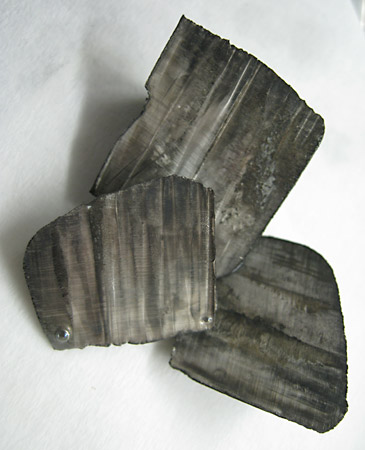
When taking a chemistry class, one will learn about an element known as lithium. Lithium has an atomic number of three, so it contains around three neutrons and is an alkaline metal as a result. The atomic weight of lithium is 6.941, and has a density of 0.534 grams per cubic centimeter. Since Lithium has a melting point of 180.5 degrees Celsius,  and a boiling point of 1342 degrees Celsius, this element is a solid at room temperature. Lithium is light and soft, so soft in fact that it could be cut with a knife. For Astrophysicists, Lithium poses a problem, since the amount of Lithium that has been predicted to have been produced during the big bang is actually three times as high then what is empirically observed in stars!

Electric arcs

Electric arcs

Electric arcs

08/04/16

“What are those electric discharges that I see in highly ionized gasses?”


You might be curious what exactlymakes welding work. Well, it turns out to be very simple. All that is going on is that there is a continuous, high density electric current that passes through a gas or vapor with a relatively low potential difference across the conductors. This allows for the high intensity of heat that is used for engineering applications such as welding

Oxidation-reduction reactions

Oxidation-reduction reactions

Oxidation-reduction reactions

08/15/16

“What happens when two elements of different oxidation numbers magnitudes come into contact with one another?”

Let’s think about something. Different elements tend to have different electronegativity. This different electronegativity gives different elements a tendency to obtain different ionic charges when near other atoms. So with this information, what can we construct when such an event occurs?

Well, let’s organize some information. Let’s classify these different ionic tendencies as oxidation numbers, or the number of charge that an element has when it reacts with another one. And let’s classify the current ionic charge that an element is in as an oxidation state. So when an element is by itself, it has an oxidation number of zero, but when it reacts with an element it will have it’s oxidation number. The elements that become positive are called oxidized ions and the elements that become negative are called reduced ions. These types of reactions are called oxidation-reduction reactions

Now let’s put this framework into reality. Let’s take two elements, lithium [li], with an oxidation number of +1, and fluoride [f], with an oxidation number of -1. Before these two elements combine, they will have an oxidation state of zero, but when they react with one another, they will obtain their oxidation states of +1 and -1. We can represent this symbolically with Li + F → LiF, with LiF being called lithium fluoride.

To go further, let’s try a second example. First, let’s take two chemicals that we all know, hydrogen and oxygen. Hydrogen has an oxidation number of +1, and oxygen has an oxidation number of -2. So when the chemicals react, not only will the elements become ionized, but there must be two hydrogen atoms to balance out the negative charge of the oxygen atom. We can represent this symbolically as 2H+O→ H_2O [water]

Electrical resistors

Electrical resistors

Electrical resistors

08/14/16

“What causes electrical resistance?”


When working with circuits, you have probably read about how resistance causes a current to slow down. However, what causes this resistance, and how does it work?

Well, these items are simply called resistors. Resistors are simple by construction, being only a ceramic round surrounded by a winding of copper. Resistors are able to causes an impedance to current flow by dissipating power, with the power loss being equal to the square of the current times the resistance, which can be represented analytically as P=I^2*R. Some resistors actually have an adjustable resistance. The surrounding heat can have adverse effects on the resistivity of a resistor, however, some resistors are designed to apply this heat for their daily functioning.