Tag: Physics

Adiabatic process

Adiabatic process

Adiabatic process

05/01/17

“Is there a thermodynamic process with no heat exchange?”
When most people think of thermodynamics, one of the first thing that pops into people’s minds is one phenomenon, heat flow. However, is it possible to have such a process with no heat flow? Well, let’s think about it. If we were to take our system and completely isolated it inside an insulator, no heat would be able to flow in or out. Therefore, all of the work done must come from the internal energy. This phenomenon is known an adiabatic process. In an adiabatic process, the pressure multiplied by the volume raised to the ratio of the specific heats of the gas is always equal to a constant (PV^(c_p/c_v)), leading to a steeper PV diagram than the isothermal process.

Isothermal process

Isothermal process

Isothermal process

04/30/17

“Can we have a thermodynamic process in which the temperature of the system remains constant?”
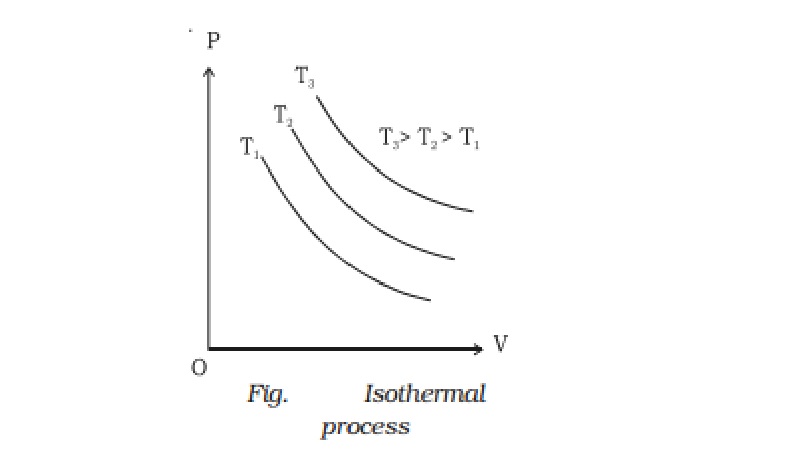
When working with thermodynamic systems, it is very easy for the internal temperature to change when other properties change as well. However, is it possible to have a fixed constant temperature process? Well, let’s think about how this can be accomplished. We know that when a system does work (such as a gas expanding) it will lose some of its internal energy and therefore cooling it. However, if we were to then supply heat to counteract this loss, the temperature would remain consistent, therefore resulting in what engineers and scientists call an isothermal process. In an isothermal gas expansion, the change in volume is directly equal to the number of moles present in the gas times the (fixed) temperature times universal gas constant divided by the change of pressure, which can be summarized symbolically as (Delta)V=nRT/(Delta)P. Isothermal processes are used to study highly structured mechanical systems such as Carnot cycles and chemical reactions.

Carnot cycle

Carnot cycle

Carnot cycle

04/29/17

“What is the most efficient possible heat engine?”
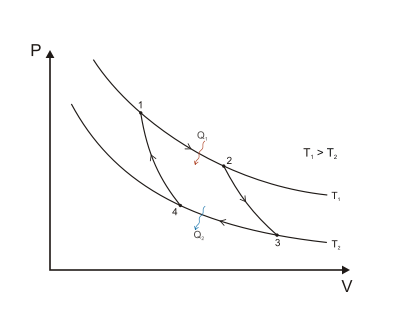
The Heat engine is one of the most productive inventions of humanity, allowing our civilization to take in exterior heat and channel it into useful energy. However, since there are so many different processes to choose from, which one is the most efficient? Well, let’s think about it. A heat engine cycle can be boiled down (pun definitely intended) to one core principle, an oscillation between a hot temperature and a cold temperature. One very efficient way to accomplish this is to have an isothermal process to expand the gas for a given amount and then use an adiabatic one to cool it down while further expansion takes place. Then, one can reverse this process by using an isothermal compression combined with an adiabatic one to raise the temperature and pressure back up to the original value, therefore completing the process known as a carnot cycle.

Carnot efficiency

Carnot efficiency

Carnot efficiency

04/28/17

“How can we calculate the maximum efficiency of a heat engine?”


Due to the second law of thermodynamics, physics proves that there is a limit to the efficiency of all heat engines. However, we know that from practical experience that some heat engines are more efficient than others. So how can we predict what the maximum efficiency of a heat engine can be? Well, engineers and physicists have thought about this same problem for many long years, and after deep exploration into the subject an equation known as the carnot efficiency has been fabricated. This equation states that the maximum efficiency of an engine is the difference between the maximum temperature and the minimum temperature divided by the max temperature, or that (nu) = (T_max-T_min)/t_max. As a result, the efficiency can never be greater or equal to 100%, and if there is no difference in the temperature the maximum possible efficiency is 0%

Heat engine theory

Heat engine theory

Heat engine theory

04/27/17

“How can we turn heat into useful energy?”
It is a well-known fact that energy can be converted into heat. However, is it possible to accomplish the opposite? Well, let’s think about it. We know that if we connect two points with different temperatures, then a heat flow will take place. And since this means that there is a  transfer of energy, it can be redirected into useful work. A machine that accomplishes this is known as a heat engine, which is used in everyday life from jet engines to electricity generators.

Thermal resistance

Thermal resistance

Thermal resistance

04/12/17

“How can we measure how the flow of heat will be impeded in a material?”
All objects have a temperature. And this temperature can change whether by convection, conduction, or radiation. However, because of an object’s material makeup, this flow of heat may not be uniform. So how can we measure how much an object will resist a change in temperature? Well, let’s use our scientific mindset to think about it. We know that temperature consists of a measure of the random kinetic motion of particles and that a change in this value is caused by energy entering or exiting the system. Rationally speaking, it would follow that materials with different forms of internal properties have more or less impediments in the way of this heat flow. After years of research, scientists have quantified this property as thermal resistance and is one of the bedrocks of thermodynamic physics.

How to make a hologram

How to make a hologram

How to make a hologram

03/30/17

“How can we use physics to make a hologram?”


Most photographs are composed in two dimensions. However, wouldn’t it be really cool if we could have three-dimensional photographs? Well, instead of just imagining it, let’s apply our engineering mindset to build it. To begin, let’s start off with  a few tools, a laser, some lenses, a beam splitter, mirrors, and holographic film. Next, let’s point the laser to the beam splitter to divide the beam into two separate parts. Next, let’s direct both of these beams through diverging beams so they begin to “spread out”. Let’s also make sure that one of these beams (Called the “object” beam) envelops an object of our desired choice. The light impinging on this object will then be reflected, and let’s make sure that this light is directed onto a piece of holographic film. Let’s then use mirrors to guide the second beam of light (Called the “reference” beam) onto the mirror as well. The holographic film will capture the phase difference between the two beams, as well as the levels of darkness and light resulting from the reflection of the object. After all of this work, we would have just created our very own hologram! This process must be so precise that even vibration on the order of a ninth of the wavelength of the laser would destroy the image!

Hess’s law

Hess’s law

Hess’s law

12/05/16

“How can we find the change in enthalpy for a chemical reaction without actually performing the reaction?”

Finding the change in enthalpy for a chemical reaction is a rather straightforward procedure, one simply carries forward with the necessary steps and measures the temperature before and after the reaction took place. However, some reactions take an extraordinary long time to perform, or their process is highly volatile. So how can we find the change in enthalpy for such reactions? Well let’s think about it. We know that if we were to take one chemical reaction and reverse it, then the resulting change in enthalpy would reverse in sign. And we know that if we add one element of a chemical equation to the opposite side of an equation containing that element, then they would cancel out. So what if were to take the results of some reactions that we already know, modify them if necessary, and then add them together to fashion the equation of the reaction that we desire? This is the operating principle behind Hess’ law.

To illustrate, let’s examine the reaction Mg(s) + H2O(l) → MgO(s) +H2(g). Since Mg does not react with water, completing this experimentally would be a nightmarish process. However, we can easily obtain the results for Mg(s) +2HCL(aq) → MgCl2(aq) + H2 and MgO(s) + 2HCl(aq) → MgCl2(aq) + H2O. If we were to take the former equation and subtract the latter from it, we would be able to obtain our desired equation. All we need to do is obtain the change in enthalpies for these reactions, and then proceed forward with the mathematics, and next thing you know we would obtain our necessary results!

Change in Enthalpy

Change in Enthalpy

Change in Enthalpy

12/04/16

“How can we measure the change of energy in a thermodynamic system when the system itself changes?”


All thermodynamic systems have the summation of the parts of their energy represented by enthalpy. However, the universe is almost never in a static state, and is always changing. Consequently, all thermodynamic systems will be in perpetual change as well. And it turns out that this change in enthalpy has very practical results for scientific use. A change in enthalpy can be quantitatively described by taking the difference of the enthalpy of the system after the change and before the change. If the  enthalpy has gone up, then that means that energy must have been added to the system, making it an endothermic process. If the enthalpy has gone down, then heat was removed from the system and it was an exothermic process. The change in Enthalpy is often symbolically represented using a (delta)H