Tag: Physics

On water’s expansion with freezing

On water’s expansion with freezing

On water’s expansion with freezing

09/16/17

“Why does water expand upon freezing?”

The variation of volume with thermal energy for most liquids has a very simple characteristic. When heat is applied, the volume increases, and vice versa for cooling. This is because the added (or subtracted) energy will cause the amplitude of the vibrations of the molecules to change, thereby modifying the volume. For example, when a liquid freezes, the molecules will pack into one another, thereby shrinking the volume.

However, water exhibits a very peculiar phenomenon. When water is cooled to its freezing point, its volume will actually expand. Why does this happen? Well, let’s analyze it using our scientific mindset. Unlike most other molecules, water has a very unusual structure. Specifically, a water molecule’s primary form of bonding is based on hydrogen bonding. When temperature decreases, the strength of a hydrogen bond actually increases (since the lower thermal energy means that the hydrogen bonds will have less vibrational energy, therefore lowering the chance to shake out of position and increasing stability).

Once water is cooled into ice, the only bonding will be hydrogen bonding. Specifically, it will be bonded in a hexagonal structure, which is a much more “open” network than most structures. The tandem of hydrogen bonding and a hexagonal structure vastly decreasing the density (Levine, Scott 2013). And because density is described by the equation, with being the density,  being the mass, and being the volume, and as mass is constant, when the density decreases the volume must increase as a result. Consequentially, the volume of water increases upon freezing! This fact has multiple implications. For example, a lower density of ice means that ice will float in water, which allows for complex structures such as ice glaciers to occur naturally.


References

“Why Does Water Expand When It Freezes? .” FAQ: Water Expansion on Freezing, New York University, 3 Dec. 2013, http://www.iapws.org/faq1/freeze.html.
Diffuser (thermodynamics)

Diffuser (thermodynamics)

Diffuser (thermodynamics)

09/08/17

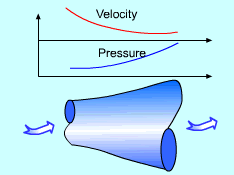
“How can we slow down a fluid while increasing its pressure?”


When working with fluids, we often want to modify its properties in some meaningful way. This could include changing more than one at once, such as slowing down its velocity while increasing its pressure. So how exactly can we accomplish this? Well, what if we were to just get a machine to do this? This is the exact idea behind a diffuser, which is the basis of operation for multiple types of HVAC systems.

How to solve farsightedness using physics

How to solve farsightedness using physics

How to solve farsightedness using physics

09/04/17

“How can we correct farsightedness using scientific knowledge?”


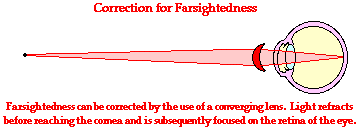
Although not as pervasive as near-sightedness, far sightedness is becoming an increasingly common problem, with 5-10 percent of Americans experiencing such a diagnosis. Nearsightedness, also known as hyperopia, is caused when the focal length of an individual’s eyeball is too large, causing the incoming light rays to focus on a point behind the eye (Make a link to how images form in the eye), which in turn will cause a fuzzy image. To correct this, we can insert a positive lens in front of the eye of an individual, which will cause the light to refocus at the back of the eye, enabling normal sight.

Undamped oscillations

Undamped oscillations

Undamped oscillations

08/26/17

“What are steady oscillations called?”


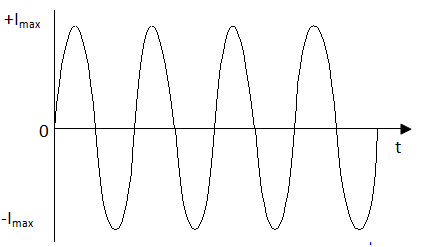
Many physical systems exhibit oscillating behavior. However, the natures of these oscillations can be different from one another. And in the most ideal oscillations, the amplitude is constant and unchanging. These oscillations are known as undamped oscillations and are rarely found outside equations and simulations.

Resonance Disaster

Resonance Disaster

Resonance Disaster

08/24/17

“What happens when a system’s oscillations actually destroy it?”
Mechanical systems have a tendency to oscillate until stability when their bodies are deformed. However, sometimes the oscillations are so powerful that they actually end up destroying the system itself! This phenomenon is known as a resonance disaster, and a most unfortunate example is the Tacoma Narrows Bridge when high-speed winds actually caused a bridge in the American State of Washington to shake into rupture.

The State Postulate

The State Postulate

The State Postulate

08/23/17

“What is the minimum amount of properties do we need to specify a thermodynamic system?”


In Thermodynamics, systems need to be specified by properties. But what is the minimum amount of properties do we need to specify a thermodynamic system? Well, after many hard years of research, Thermodynamicists have developed something known as the state postulate. With the State Postulate only two independent intrinsic variables are needed to specify a system. Once we have these variables, everything else can be derived through relationships.

Resonance

Resonance

Resonance

08/22/17

“What is the maximum amplitude of an oscillating system?”


In the physical world, systems can vibrate at different frequencies with different outputs. But when the system achieves maximum vibration at a certain frequency, it is called a resonance. Resonance has large impacts on the design of systems, from constructing electrical circuits to achieve certain characteristics to analyzing vibrational characteristics of bridges

Polytropic process

Polytropic process

Polytropic process

08/16/17

“What process in Thermodynamics holds the pressure and volume to a constant?”


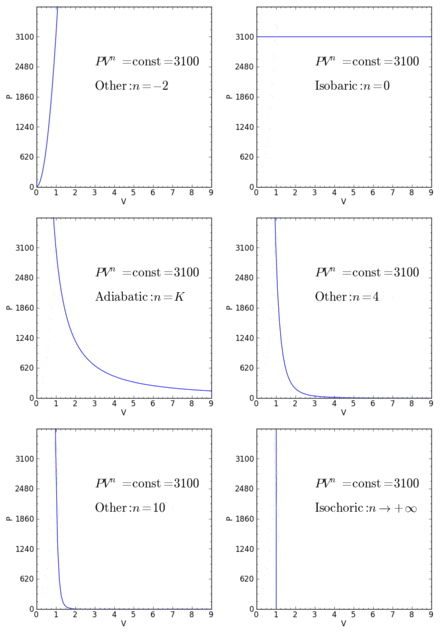
Thermodynamics is known for its intense reliance on processes. Some of the most important types are classified as Polytropic processes. In polytropic processes, the pressure and volume are held to the constant given by the relation pv^n=c, where p is pressure, v is volume, n is the polytropic index, and c is a constant. A process is polytropic if it obeys the ideal gas law and if the heat to energy transfer as work at each infinitesimal step of the process is kept constant


Duty Cycles

Duty Cycles

Duty Cycles

08/15/17

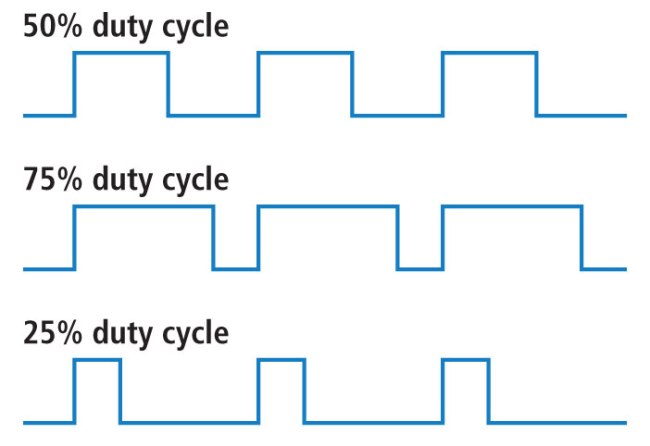
“What described the on and off period for a digital signal?”


Digital signals have only two modes: on and off. And sometimes they cycle through each at a constant period. So how can we describe this phenomenon? Well, after much research, engineers have come up with the concept of a duty cycle. A duty cycle determines for what time periods the signal is on duty and can be quantified by the percentage on vs off (for example, a signal that is active for 3/4ths of the time has a duty cycle of 75%)