Tag: Optics

Diffraction grating

Diffraction grating

Diffraction grating

03/04/17

“What happens when we shine wave through a large chain of small holes?”
Optics is a most enjoyable branch of science. And one of it’s most peculiar facets occurs from a most simple setup. Suppose that one were to have two sheets of metal facing each other. Then one were to cut a large number of rectangular holes evenly spaced throughout one sheet and finally shine a light upon it. What exactly would happen? Well, let’s use our knowledge of science to figure this out. We know that when a ray of light hits a small opening, a wave will be produced. And we also know that when waves interfere with one another, a superposition will be produced. Now let’s apply this to this physical system. The light incident upon these holes will produce many waves, which will then collide on the opposing sheet. These waves will then either interfere constructively or destructively with one another, causing a pattern of bright and dark spots to occur. These spots will be spaced from one another in a ratio corresponding to the wavelengths of the light beams, the width of the diffraction gratings, and the distance between the two sheets

Ray tracing

Ray tracing

Ray tracing

02/28/17

“How can we represent light rays interacting with lenses and mirrors?”
Even through the field of optics is a deep one, it is also quite simple. At its fundamental core, it is about the properties and interaction of light. This includes the subset of mirrors and lenses. So wouldn’t it be logical that we should develop a system to represent the interaction with lenses and mirrors? To start off, let’s construct the mirrors, lenses, and objects that we would like to work with. Next, label the center and focal point of the mirrors and lenses. Afterward, draw lines emanating from the object, and have it realistically interact with the optical instruments. Then draw the resulting image where all of the rays converge onto one another. This process is known as ray tracing, and is one of the most important tools used by researchers and students in optics.

How images form in the eye

How images form in the eye

How images form in the eye

02/25/17

“How exactly do we see things with our eyes?”
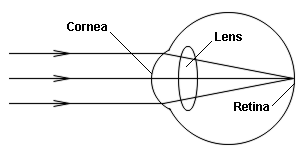
Everything that we perceive in this world is formed through our eyes. However, have you ever wondered how images can physically form in these biological objects? Well, let’s analyze this question scientifically to find out. If one were to take an eyeball and cut it in half through the midpoint of the pupil, they will find a lens just behind the cornea. If you were to then shine parallel light beams through this lens, then you would find that all of the light would focus on to the backside of the eye. The back of the eye will then transmit information to the brain, which will invert the image “in the mind’s eye” enabling us to see!

Refracting telescope

Refracting telescope

Refracting telescope

02/22/17

“How do old-school telescopes work?”
Telescopes are one of the most amazing machines that humanity has constructed. Not only have they become a symbol for scientific endeavor but a cultural landmark as well. However, have you ever wonder how they worked (specifically the old-school ones)? Well, let’s use our engineering mindset to figure out this scientific device. If we were to uncover the case of these machines, we would find two convex lenses. Now, if we were to trace a ray diagram through the lenses, we would find something very interesting. First, the incoming light from the object would converge onto a real image on the opposite side of the first lens. The light from this image would then be received by the second lens, which shifts the light’s direction in such a way that their paths would converge on the receiving side of the lens, forming a magnified virtual image, therefore creating an enlarged image that the human eye can see. This form of a telescope is called a refracting telescope, and has been used since the days of Galileo!