Tag: Mechatronic Engineering

On Peltier Elements

On Peltier Elements

On Peltier Elements

10/19/17

“How can we completely rethink cooling systems?”


              Engineers often run into a very peculiar problem. Machines and devices can create large amounts of heat during operation as a result of their high energy use. A common remedy for this conundrum is to implement a thermal cooling system. Examples of these systems include heat sinks (a special form of heat exchanger built for electronics that uses a working fluid to transfer heat away from the device to another location), air conditioning (machines that use a fluid refrigerant operating at a cycle to take heat from one area and transfer it into another).

But even with these current processes, there is a new, most intriguing technology that holds much promise. Consider this. When a current is drawn between two conductive objects, heat may be either added or removed at the junction, making one side hot and another side cold. The hot side will then be attached to a heat sink while the other side will go below room temperature.  This device has been termed by engineers a Peltier Element.

One can construct a Peltier Material as follows. First, take two semiconductors, one a p-type and the other an n-type, and place them in parallel thermally and in series electrically together. Then join them together using a thermally conductive plate. If one were to apply a D.C voltage between the free ends of these two semiconductors then a temperature potential difference will merge. The side with the cooling plate will absorb the heat, which is later transferred to the opposing side that contains the heat sink. The more Peltier Elements within a given space the more efficient that the system will operate at.

Peltier element devices have numerous advantages. First, they have they do not have any moving parts, so much less maintenance is required and less brake-down will occur. No Chlorofluorocarbons (elements commonly found in traditional HVAC systems that induce ozone depletion) are used in their operating process so these machines will be much less damaging to the environment. Furthermore, the control of temperature with these units is so granular that it can even go to the fractional level, much better than older systems. In addition, these systems are made to have a very flexible shape than older, more rigid cooling systems so they can be placed in much more convenient locations. Building on top of this more flexible geometry is their greater temperature bandwidth, meaning that they can perform in conditions not before seen in HVAC systems. This leads to a longer lifespan so Peltier elements can give an individual “more bang for their buck”. Finally, these systems are easily controllable due to their voltage input system.

We can accomplish many feats with Peltier element technology. Their small and modular geometry allows them to be placed in a variety of locations such as in camping equipment and portable coolers. The granular control on Peltier elements make them a strong contender for use in scientific equipment, making them effective in assisting with sunlight temperature irregularities on satellites and military technology.

This is not to say that Peltier Elements have no downsides. One of the biggest hindrances to further adoption is their low efficiencies. Specifically, Peltier Elements require a large amount of electricity to function properly. This also only make Peltier elements very expensive to maintain, as power costs money. Their small form factor also makes it difficult to use in larger scale applications such as industrial operations (Lorenzo, Sarah 2016).

In summation, Peltier elements are a novel technology that holds much promise. Their operating process, the Peltier effect, is a wonderful facet of the physical universe that grants it many useful properties, such as a smaller form factor, a modular geometry, and a longer lifespan. This also allows Peltier elements to be more useful for applications such as satellites and military equipment where flexibility and longevity are needed. However, many of these same advantages can also bring detriment to it, with Peltier elements being to electrically consumptive and too small for large industrial applications. Perhaps with enough time and investment into research, Peltier elements will be able to solve these problems and replace traditional cooling methods.


References

Lorenzo, Sarah. What is a Peltier Cooler? 6 June 2015, http://www.tech-faq.com/peltier-cooler.html. Accessed 18 Oct. 2017.

Robot Welding

Robot Welding

Robot Welding

10/14/17

“How can we use robots to do welding?”


Welding is one of the most important industrial processes. Because of it, we are able to construct machines with intricate metal designs. However, if it is performed by human hands, then things can become prone to error and harm the welder. So how can we use our engineering mindset to solve this problem? Well, what if we were to simply use industrial robots to weld? Well, engineers have already thought of this a long time ago, and now robot welding has become a mainstay of factories around the world.

Why Lithium-ion Batteries are Better for Renewable Energy Integration

Why Lithium-ion Batteries are Better for Renewable Energy Integration

Why Lithium-ion Batteries are Better for Renewable Energy Integration

10/11/17

“What is one possibility to solve renewable energy storage?”


Subject Solar Energy / Storage Innovations

Date: October 11, 2017

Purpose

I am writing to you to inform you about recent difficulties in solar energy integration. As it stands, solar energy is generated in an active form, meaning that once created it must be used immediately. To solve this, we can deploy Lithium-ion batteries to act as reservoirs.

Summary

Lithium-Ion Batteries have properties that make them a strong option for renewable energy integration. Lithium-ion batteries are composed of lithium and carbon, giving them special characteristics. However, these same properties also give Lithium-Ion Batteries special problems, such as being prone to spontaneous explosions. (Brain, 2006)


Background

One of the major bottlenecks to renewable energy integration is a lack of viable storage mechanisms. One of the most viable solutions, battery systems, has numerous drawbacks. They can take up large amounts of space, and provide a low energy to space ratio. Consequentially, the current battery technology paradigm needs to be overhauled.


Discussion

Introduction

Lithium-Ion Battery Technologies are a new battery technology. Because of their unique properties, they hold much potential for Renewable Energy Storage. However, this same composition that makes it special also makes it potent for mishap.

Advantages

Lithium-ion Batteries include numerous advantages. Their much more energy dense, meaning that a small volume can hold a lot of charge, bypassing the previous space issue. They also tend to keep this charge, losing only 5%/month compared to the average 20%/month, allowing renewable energy to be stored for a longer time. They also can also be charged before they run out of power and can handle hundreds of charge/discharge cycles, making them quite viable for being used as battery storage with the dynamic character of renewable energy. (Brain, 2006)

Drawbacks

These batteries also come with numerous drawbacks. They start degrading once manufactured, decay faster in the presence of high temperatures, are ruined upon complete discharge, require an onboard control system, and most importantly, may burst into flame spontaneously if it overheats. (Brain, 2006)

How we can overcome this

Keep these batteries in low-temperature facilities. This will keep their charge more stable, have it degrade slower, and most importantly prevent spontaneous explosions.


Conclusion

Even with their flaws, Lithium-ion technology holds much potential for use in renewable energy integration. Their high energy density combined with their ability to handle dynamics charging and discharging gives them an unparalleled capacity to work with renewable energy. If we can store them in colder locations, then we can also greatly reduce their drawbacks.


References

Brain, Marshall. “How Lithium-Ion Batteries Work.” How Lithium-Ion Batteries Work | HowStuffWorks, HowStuffWorks, 14 Nov. 2006, electronics.howstuffworks.com/everyday-tech/lithium-ion-battery.htm.


Grid Resilience

Grid Resilience

Grid Resilience

10/10/17

“How can we measure how resilient the grid is?”


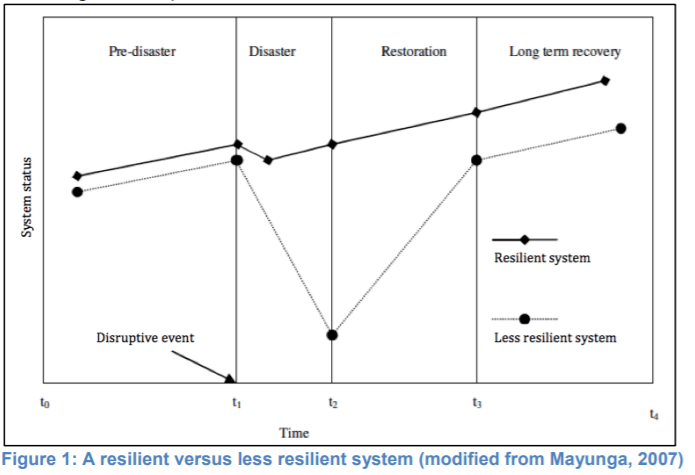
Grid reliability is a great way to measure the stability of the grid. But unfortunately, it does not give us the complete picture. When a grid systems experience are taken down, they need time to recover. The less time it takes, then the more resilient a grid will be. Taken the two systems in the picture for example. When the bottom one experiences a disruption,  not only will it need a long time to recover but it does not reach close to its full potential again. In contrast, the top one only experiences a brief hiccup and quickly flows back to normal. This measure is called Grid Resilience and is an important part of the analysis of electrical systems.

How microgrids can help get Puerto Rico back on its feet

How microgrids can help get Puerto Rico back on its feet

How microgrids can help get Puerto Rico back on its feet

10/03/17

“How can the people of Puerto Rico use microgrid technology to help get their infrastructure up and running?”


For those of you who are out of the loop, a recent hurricane has totaled the energy infrastructure of Puerto Rico. As much as 95% of the island is out of power, affecting around 3.5 million individuals! But how can the people of Puerto Rico use their engineering mindset to fix this problem? Well, if they have been keeping up on recent trends, then they might have heard of a little technology called microgrids. They can be set up much quicker than for a centralized grid to be repaired and are even cheaper to run. The German company Sonnen GmbH is already supplying the people of Puerto Rico with these much-needed systems.

Centrifugal Fan

Centrifugal Fan

Centrifugal Fan

09/25/17

“How can we use a fan to control gases?”


Most HVAC systems by moving around gases. However, materials at this phase can be quite difficult to control, so how can we use our engineering mindset to create such a mechanism? Well, we know that blades on a turbine react when a fluid passes through it, and through symmetry we can assume that a fluid will react to motor movement. So what if we were to construct something similar (like a motor) that would take in the gas, impart kinetic energy through its centripetal acceleration, and then change its direction by 90 degrees? Well, this is the fundamental idea behind a centrifugal fan and is one of the most fundamental components of modern HVAC systems.

Damper Controls

Damper Controls

Damper Controls

09/22/17

“How can we control an HVAC damper?”


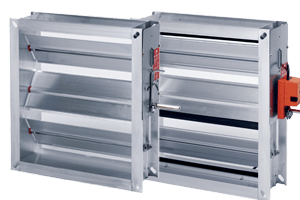
HVAC dampers are instrumental for controlling heating and cooling for buildings. However, since they are located in isolated air ducts, we will need to use some form of remote control to operate them. This is where damper controls come in. Damper controls allow for the angle of the ducts of a damper to be adjusted at will, inducing optimal living conditions.

Pulse-width Modulation

Pulse-width Modulation

Pulse-width Modulation

09/18/17

“How can we use a digital signal to control power appliances?”

Using sinusoidal analog signals for control applications has drawbacks. Specifically, the constantly changing signal can cause the resistors on a circuit to heat up and induce damage. However, how can we use our engineering mindset to fix this problem? Well, what if we were to replace this analog system with a discrete one operating at a duty cycle? That way we can imitate the perpetually switching signal while avoiding the issues that come along with it. This type of signaling is known as pulse-width modulation and is one of the fundamental ideas of modern control theory


Smart Zoning for HVAC Systems

Smart Zoning for HVAC Systems

Smart Zoning for HVAC Systems

09/15/17

“Can we solve the problem of temperature discrepancy in buildings?”


When we think of buildings, many of us assume that the temperature inside will be completely uniform in nature. However, more often there is significant temperature variation from room to room. Making this worse, most HVAC systems only base their setpoints on one of these rooms, causing improper heating and discomfort in the rest of the building. So how can we solve this problem using our engineering mindset? Well, what if we were to use multiple smart thermostats to divide the building into multiple zones, each with their own setpoints? This is the fundamental idea behind smart zoning for HVAC systems, nascent but intriguing technology which has the promise to vastly improve the ergonomic, economic, and ecological capacity of everyday heating and cooling.