Tag: HVAC

Evaporator Coils

Evaporator Coils

Evaporator Coils

01/17/17

“How can we remove heat from an area?”


HVAC systems are used to cool down rooms. However, how exactly do they do the cooling part? Well, if you were to move a cold fluid through a warm area, then heat would be transferred from the air to the working fluid. As a result, we can construct something called an evaporator coil, which moves the cooled refrigerant to be exposed to the surroundings.

HVAC Wind Turbines

HVAC Wind Turbines

HVAC Wind Turbines

01/16/17

“How can we use waste energy from an air compressor to power an HVAC system?”


Air compressors can generate a lot of waste steam when they are being used. However, if we use our engineering mindsets and think about the science of cogeneration, then we know that waste heat doesn’t have to be wasted. In fact, we if we install a wind turbine by a compressor, we can actually create energy from this process to power HVAC systems. This is known as an HVAC Wind Turbine and is a brilliant demonstration of engineering capabilities.

The Impact of Vehicle HVAC on Sustainability

The Impact of Vehicle HVAC on Sustainability

The Impact of Vehicle HVAC on Sustainability

1/10/18

“How can the HVAC systems of vehicles affect their gas-mileage?”


Although HVAC is typically seen as something for stationary environments, they are commonly implemented in personal vehicle systems as well. However, just like their building-oriented counterparts, vehicle HVAC consumes a massive amount of energy as well. As a result, when designing more efficient vehicles, We must take into account the impact of vehicle HVAC on sustainability.

Building Heating Loads

Building Heating Loads

Building Heating Loads

01/06/18

“What are the heating requirements of buildings?”


We know that the electricity needed by the building represents its energy load, but electricity is often not the only thing that a building requires. Furthermore, said building will also need heating and cooling. So how can we represent this in a quantitative fashion? Well, taking inspiration from energy loads, we can use a building energy load to show the information for heating or cooling in a building. The building energy load can be regulated through the use of an HVAC system.

Building Energy Loads

Building Energy Loads

Building Energy Loads

01/06/17

“What exactly draws energy in a building?”


The vast majority of people (in the developed world) spend the vast majority of their lives within a building. Whether it be the hospital they were born, the house they grew up in, or the school they attended, they were in some sort of edifice. And being modern society, we also use electricity within these buildings. And if we were to summate all of the energy-using technologies inside a building, then we would obtain the Building Energy Load. People are billed for how high their energy load is, so the less energy used the more money will be saved. Building Energy Loads also illustrate how important HVAC technology is since typically half of the energy supplied to a building is taken up by heating and cooling needs.

BACnet

BACnet

BACnet

01/02/17

“What is the communications protocol for building automation systems?”


Building automation systems are amazing for optimizing building energy systems. However, in order to operate, they need their own communications protocol. So how can we use our engineering mindset to solve this problem? Well, after many years of research, the good engineers of ASHRAE have been able to develop a protocol known as BACnet. BACnet stands for Building Automation and Control network and is the standard for all BAS systems.

Zone Valves

Zone Valves

Zone Valves

01/01/18

“How can we control fluid flow in a hydronic heating system?”


Hydronic heating systems are famous for their use of liquids to control heating. And many of these systems are taken further by dividing the volumes they cool into multiple zones to keep multiple areas at different temperatures. However, how can we actually implement this? Well, we can accomplish this using a little piece of technology known as a zone valve. Zone valves can regulate the flow of water into multiple areas, allowing for a truly zoned system.

Night-Sky Cooling Systems

Night-Sky Cooling Systems

Night-Sky Cooling Systems

12/31/17

“How can we use the nighttime chill to cool a building?”


Traditional HVAC systems have brought wonders to human civilization, but sometimes as engineers we would like to reinvent the wheel. To begin, everyone knows that the nighttime has its own coolness. So what if we were to take advantage of this by applying a liquid coating to the roof of a building, let the night chill cool it down, funnel it through gutters to a thermal storage, and then use it through the day? Well, this is the fundamental idea behind Night-Sky Cooling Systems. This method offers a low infrastructure low-cost, and low-energy alternative to traditional HVAC systems. That being said, Night-Sky Cooling Systems also consume large amounts of water and are heavily dependent on a cool night sky to keep them running.

Ventilation

Ventilation

Ventilation

12/29/17

“How can we keep a building’s air fresh?”


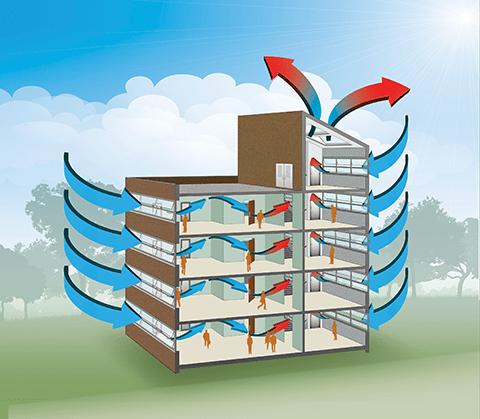
Buildings are great for enclosing an interior space. However, if there is no contact with the outside, then the air inside will become trapped and polluted. So how can we make sure that fresh air is continually supplied without overcooling the building? Well, we can use something known as ventilation, that allows some air to pass in and some to pass out, creating a continuous cycling of air. Ventilation is a fundamental part of the built environment and has become of the most important standards.