Tag: Green energy

Grid islanding

Grid islanding

Grid islanding

12/19/16

“What happens when a solar powered system experiences a blackout from the surrounding grid?”

Solar panels are truly an exquisite technology. Not only do they allow for energy independence from oil, but they also allow for energy independence from the surrounding grid! Because solar panels are self-sustaining, if you were to hook enough up to your residential area, you could provide enough electricity that you would not need to take from your local electric company, and even have enough to supply energy back! There is one large disadvantage to this, however. If a blackout were to happen, the electric grid would go down except for self-generating units such as solar panels, which would be islanded. This technology would continue to funnel electricity to the grid, an action that would open the potential for injury to repair workers. As such, most modern day solar panels come equipped with anti-islanding technology to prevent such a case from happening.  

Offshore windpower

Offshore windpower

Offshore windpower

11/30/16

“How can we use coastal winds to enhance wind power?”

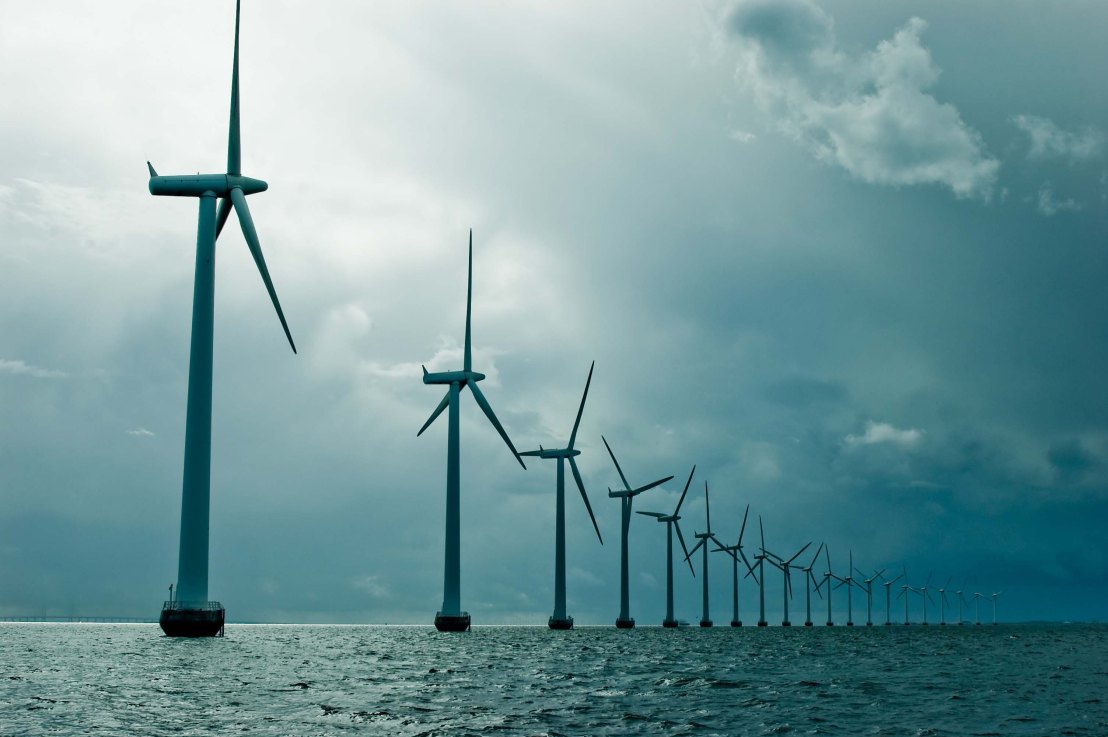
One of the primary criticisms launched against sustainable energy advocates is the systems for extrapolating such energy forms are too limited in geography, time of day, and energy density. However, thanks to the strong willpower of renewable energy engineers, we could have a new technology that could fundamentally upset this paradigm. In the past, wind turbines were only built on solid terrain. Even though this was the simpler way of doing things, it had a major drawback due to the fact that wind is not omnipresent. However, thanks to the flat and low friction nature of water, winds currents are much stronger and consistent over the ocean. And since higher wind current means higher wind power, wouldn’t it be logical to have wind turbines placed in the ocean? This is the exact behind offshore wind power. Offshore wind turbines only have 2 percent of the energy payback time as regular onshore turbines, are less noticeable to the common public, and can be located near a high number of population centers. However, like with everything in engineering, there are always drawbacks with offshore windpower, such as the fact that it takes much more materials to construct such turbines, and the technology is only nascent, requiring further development. But even with this, the future of offshore windpower looks bright, and many countries have already begun investing in to it, such as the gargantuan 630MW London array in the United Kingdom, the 600 MW Viking wind farm in Scotland, and the 400 MW Anholt windfarm in Denmark.

Some of my thoughts on environmentalism

Some of my thoughts on environmentalism

Some of my thoughts on environmentalism

10/29/16

“Hey Isaac, what are your thoughts on environmentalism?”

Environmentalism is a word that gets tossed around a lot nowadays. This word probably has more diffuse meanings to different people than the wavelengths of light that we can see. However, I would like to offer my own views on the subject matter, as I think they would be at least somewhat pertinent to the global discussion about this world issue.

For me, environmentalism is not about saving trees, but rather it is about saving us. Fundamentally, human civilization is not a separate entity from the habitat that it inhabits. Therefore, all long term destruction to the surrounding world contributed by our action will in time cause large scale repercussions on us, a sort of natural karma. For example, by overextending the limits on it’s water supply, my beautiful home state of California is now experiencing a drought on a scale that has not been seen in a millennium. As a result, the lives of innumerable farmers have been shattered, wildfires are spreading like a virus,  and billions of dollars have been diverted from other sources, all amounting to a greater loss than was saved because choosing the more supposedly “practical” anti-environmental route.

And to make matters worse, humanity still has not taken heed. Currently, Human generated and consumed energy is on the order of 16 Terawatt-hours per hour and climbing!  And to make matters even worse, over 84 percent of this energy is generated by non-renewable sources. And one must keep in mind that most of this energy is used by the developed world, and with the developing world rising, this could imply that we could go way beyond what it currently is.

“So what must we do?”

Well, what we need to do is have a complete paradigm shift regarding not only the energy source of society but even the basic infrastructure, and at a very quick rate.Think of it in this way: When a child is young, their metabolism is very high, and they can consume as much unhealthy food as they desire without any repercussions. However,as they get older, that metabolism will give way, and they will begin to feel the consequences if they continue their grievous habits. In order to prevent such an occurrence, the child needs to develop proper eating habits as soon as possible. As I can conceptualize it, human civilization for the past few centuries has been a spoiled child devouring as much unhealthy resources as possible, and since we are just on the cusp of adulthood, we are thrusted into a situation (to quote a great mentor of mine) where we need not gradual emancipation but immediate emancipation from fossil fuels.

We need to invest much more time and energy in developing the skills of not only young scientists and engineers but also policy makers, urban planners, and even community members to take action and design such new systems. We need to shift our civilization’s infrastructure and technological paradigm away from relying upon outdated ways of thinking and doing into new ones equipped to handle the issues of the 21st century. But most importantly, we must help guide the developing world through their construction into making the fundamental operations of their society to to be sustainable, so they can have our quality of life without our level of destruction..

So in summation, the current degradation of the environment will cause our eventual destruction, and we need to completely shift our paradigm to prevent our civilization’s. As I like to say, humanity walks faster looking forwards.

Hydropower

Hydropower

Hydropower

08/26/16

“Can water be used to create useful energy?”

Water is one of the most omnipresent substances found on this planet.An entire three-quarters of the planet is covered by it. Water often moves not in small streams but with large flows, piling through it’s path with titanic levels of energy. So one might think, is it possible to capture some of this energy to transfer it into useful forms?

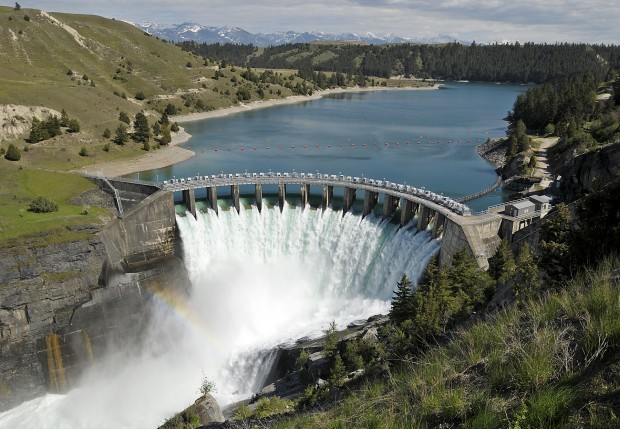
Well, let’s think about how we could do so. First of all, we know that turbines can extract energy from moving fluids to power a generator to create electricity. Second of all,  We know that water flow can be controlled through the uses of dams. So what if we placed a damn near a flowing path of water, and directed all of that energy so it would move a turbine that would power human infrastructure? Well, this is the operating principle behind hydropower.

Hydropower is the use of the kinetic energy of water to power electricity. The power generated by a hydropower plant can be calculated with the following equation P=Mu*rho*Q*g*h, with Mu being the efficiency of the turbines, rho being the density of the water passing through, (Kilograms per cubic meter), Q being the flow (Cubic meters per second), g being the acceleration by gravity, and h being the height difference between the inlet and outlet in meters. Hydropower is clean, renewable, and affordable form of energy. Hydropower produces almost one fifth of the world’s electricity, the primary contributors being China, Canada, Brazil, The United States, and Russia. Notable hydroelectric projects include the three gorges damn in China and the Grand Coulee Dam on the Columbia River in northern Washington in the U.S. However, one has to be cautious when developing such systems, and the infrastructure may disrupt local wildlife and natural resources.

In summation, hydropower is a fascinating subject, and engineers around the world are dedicating themselves to the study and application of this form of power.

Solar power

Solar power

Solar power          03/21/16

Let one consider this. The earth receives around 3.86*1026joules of energy hits the Earth every second. The Earth directly receives1.74*1017of those joules. This number is over 35,000 times the amount  of energy that all of human civilization consumes every second. If we are able to receive this much energy from the sun, wouldn’t it be logical to create a system to harness this energy? This is where Solar Power comes in. Solar power uses Solar panels which in take the energy of the sun and uses the photoelectric effect to transform this into usable energy. Most commercial solar panels have an efficiency rating of 15-20 percent, so research in to higher efficiency solar power is paramount.

Wind turbines

Wind turbines

Wind turbines         02/23/16


Wind turbines are one of my favorite parts of Engineering. Wind turbines work by transferring energy from the wind into a spinning shaft (mechanical energy) which rotates a generator which converts all of that into electrical energy. There are two types of wind turbines, vertical axis and horizontal axis. In the latter, the larger profile allows it to catch more wind but the tower is higher and it is more complicated to build, while the former is easier to build/design/maintain but catches less energy as an offset. The part of the turbine that catches wind with blades and converts it to mechanical energy is called the rotor. One possible design for a wind turbine is known as the drag design, which uses a turbine whose axis of rotation is perpendicular is to the movement of the wind to catch the drag force provided by the wind as energy. This design is slower moving but provides a heavier torque, making it useful for tasks such as lifting water or hay 9 your stereotypical dutch farm activities) A more modern design is the lift design, which uses a rotor facing the wind movement to use the lift force caused by an asymmetric blade profile. Lift based mechanisms have a much higher rotation speed than drag types and therefore make excellent candidates for electricity generation.


The number of blades on a wind turbine can have a multitude of effects on a wind generation system. Increasing the number of blades increases efficiency at a diminishing rate. Going from one to two blades gives us a 6% increase in efficiency while going from two to three blades gives us a 3 percent efficiency. typically, the less amount of blades, the lower material and torque needed. Rotor blades are always twisted to account for a changing angle of attack, explaining the curved structure. The theoretical power generated by a wind turbine is given by the equation Power = 1/2**A*v3, with being the wind density Abeing the area of the profile andvbeing the wind velocity. The Betz limit is the theoretical efficiency of a wind turbine, given at 59.3 percent. However, most commercial systems operate at around 10-30 percent.
Wind turbines have contain a generator which converts mechanical energy into electrical energy, and transmission which increases the rotation rate of a generator to accomplish an efficient electricity generation rate. The cut in speed is the speed in which a turbine will generate usable power, typically between 7 -15 mph. The Rated speed is the speed in which a wind turbine will generate it’s designated power, typically at around 25-25 mph. To account for dangerously high wind speeds at around 45-80 mph, most wind turbines have a cut out speed feature which shuts down the wind turbine using a versatile repertory of methods. Tower heights are usually two to three times the blade diameter to account for efficiency.