Tag: Favorites

Telescoping expansion joint

Telescoping expansion joint

Telescoping expansion joint

09/22/16


“How can we implement an expansion joint for tubular geometries?”

Expansion joints are very useful devices. However, how can we create affordable versions to implement on tubular geometries such as in pipes? First of all, let’s look at the problem at hand. Thermal expansion causes a material to change it’s size depending upon the surrounding temperature, and as such there needs to be “breath gaps” to ensure that a structure will not collapse. However, using something like a plaster or a soft filling will not be strong enough to sustain the expected pressures on a pipe, and having loose material might cause a leakage into the fluid flow. Therefore, we will have to think of an adjustable solid part. Well, how about we take some design inspiration from one of humanity’s greatest achievements, the telescope. Part of what makes telescopes the machines they are is the fact that they have a telescoping build, which means that solid parts are made so that they can slide past each other. Now, how about we take this mechanism and apply it to our thermal expansion joints?


Well, what we could do is have two concentric expansion tubes, one with a larger tube and the other with a smaller one. The smaller diameter tube will connect to the two joints of the mechanism, and will expand and contract upon need. The larger diameter tube will act as a fixed support in order to center the smaller diameter tube, and as such have a smaller diameter. You can analogize the larger diameter tubes as being like the “braces” of the smaller diameter tube. O-rings are often used to seal these parts to ensure that all operations are smooth. This layout is known as a telescoping expansion joint. Telescoping expansion joints are very useful due to their simple yet effective design, and the fact that they can be curated for tubular geometries.

Proxima B

Proxima B

Proxima B

09/10/16

“Is one of our nearest rocky planet habitable?”


A discovery has been made that is possibly so great that it can change the course of humanity forever. Or not. A new planet has been discovered in Proxima centauri (the nearest solar system to ours) only 4.2 light years away from us called Proxima B. We already know a few things about Proxima B, specifically has a mass that is just over a third greater than the Earth’s, it is only slightly more than seven million kilometers away from the star that it orbits, and is tidally locked (meaning one face of the planet will always be facing the star). But more importantly, this planet falls within the habitable zone of it’s star, which means that this planet has temperatures in the range  that is “just right” to host liquid water.

However, there are many factors of this planet that might just burst our bubble. First of all, we have no idea what the atmosphere of proxima B is composed of. In fact, for all we know, it could be completely toxic! Also, since the host star of Proxima B is a red dwarf, the habitable zone for the distance for the habitable zone of this planet is merely 5% of our own. This means that Proxima B is extremely close to it’s orbiting sun. So close in fact that the time for a single year to go by is merely 11 Earth days, and since red dwarfs can be very volatile, there is a strong possibility of unpredictable flairs from the planet.

Proxima B is a perfect example of why as a scientific thinker one must express excitement yet restraint when hearing possibly paradigm shifting news, since we must not bee to short-sighted to observe that such news could be false, yet not too cynical to take joy in the wonder and mystery of the universe.

Pulleys and mechanical advantage

Pulleys and mechanical advantage

Pulleys and mechanical advantage

09/06/16

“Is it possible to lift an object with a force that’s less than it’s weight?”


If you ever had to design a system focused on lifting objects, you probably bemoan the fact that if you want to lift a heavy object, you have to use a force that is greater or equal to it’s weight.

Or do you have to?

What if there was some way if we could manipulate the laws of physics, so we could lift an object with a force that is less than it’s weight? Well, let’s think about how we could do this using mechanical advantage.

Let us start with a very simple machine called a pulley. More specifically, we will be starting with a single, fixed pulley. A fixed pulley is a dimply a disk hinged onto an axis in which it is free to revolve around but may not move transitionally. If we were to take a rope and move throw it over the circumference of a pulley, it would reverse the direction of the rope, so we could lift an object while using a downward force instead of an upward force. We still have to use the same force as the weight, but it allows us to change directions.

Now let’s go a step further. What if we were to take that same rope, and make it go under a new pulley, this time a moveable pulley, attach the end of the rope to a ceiling like structure above the pulley, and attach the weight to the moveable pulley. Now the rope will be supporting the pulley on both sides of the object, it can effectively double it’s force value! This means we can now use a force value that is less than the weight of our object to lift it up! You can even create more complex pulley systems to create a greater mechanical advantage. However, there is one major downside to using this setup. Since energy must be conserved, and you are using a smaller force, you must increase the distance you pull your object proportionally to the strength of the force you are using. For example, if you have use a force that is half of the weight, then you will have to pull the rope twice as far, three times as far for a force a third of the weight, and so on. In addition, when we perform these calculations, we assume a massless pulley with no moment of inertia or friction, so there are bound to be some inefficiencies that will require us to use even greater distances

All in all, pulley systems are a testaments of human ingenuity, and are a classical representation of simple yet effective engineering.  

Significant figures

Significant figures

Significant figures

09/02/16

“How can we scientifically analyze a number for it’s accuracy?”


Believe it or not, scientific numbers are very different from mathematical numbers. This may sound absurd at first, but if you read on then it will start to make sense. In mathematics, there is no real difference between the number 1 and 1.0 and even 1.00000 for that matter. But when working in science, these numbers are anything but interchangeable! But why is that so?

Well, it’s all because scientists and engineers have to deal with something called accuracy. When working with empirically derived numbers such as the mass on a scale, it’s impossible to know the true value of a measurement. So each number one works with has a certain level of accuracy to  it. So to quantify this accuracy, we use a tool called significant figures, and they follow a certain set of rules.

Each number that we care about is termed a significant figure, or sig fig for short. All non zero numbers are significant (as they represent a quantity), all zeroes between two significant figures are significant (as the number will not be able to be simplified), and the numbers trailing after a sig fig and decimal point will be accurate (as they measure the level of accuracy of our measurements).

Let’s do a few examples. 400 has only 1 significant figure, (the four is a non zero integer, and none of the zeroes are “sandwiched” in between other significant figures and are before a decimal point).404 has 3 significant figures (The zero is sandwiched between two o non-zero numbers) 4 has only 1 significant figure (The only number is four, a non zero integer). 4.00 actually has 3 significant figures (Both of the zeroes are behind the decimal). .040 only has 2 significant figures (The first zero is  behind the zero but not behind any non-zero integers).

Hydropower

Hydropower

Hydropower

08/26/16

“Can water be used to create useful energy?”

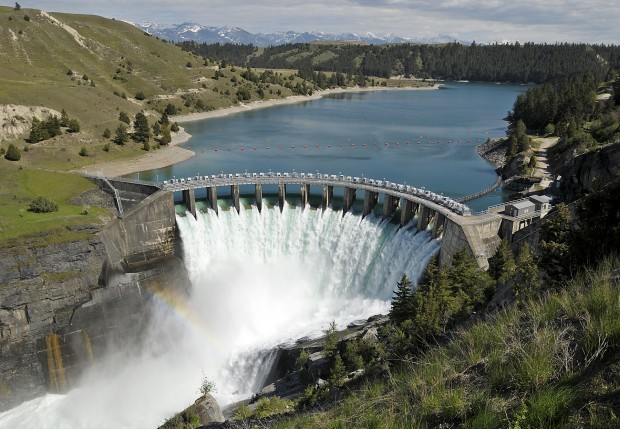
Water is one of the most omnipresent substances found on this planet.An entire three-quarters of the planet is covered by it. Water often moves not in small streams but with large flows, piling through it’s path with titanic levels of energy. So one might think, is it possible to capture some of this energy to transfer it into useful forms?

Well, let’s think about how we could do so. First of all, we know that turbines can extract energy from moving fluids to power a generator to create electricity. Second of all,  We know that water flow can be controlled through the uses of dams. So what if we placed a damn near a flowing path of water, and directed all of that energy so it would move a turbine that would power human infrastructure? Well, this is the operating principle behind hydropower.

Hydropower is the use of the kinetic energy of water to power electricity. The power generated by a hydropower plant can be calculated with the following equation P=Mu*rho*Q*g*h, with Mu being the efficiency of the turbines, rho being the density of the water passing through, (Kilograms per cubic meter), Q being the flow (Cubic meters per second), g being the acceleration by gravity, and h being the height difference between the inlet and outlet in meters. Hydropower is clean, renewable, and affordable form of energy. Hydropower produces almost one fifth of the world’s electricity, the primary contributors being China, Canada, Brazil, The United States, and Russia. Notable hydroelectric projects include the three gorges damn in China and the Grand Coulee Dam on the Columbia River in northern Washington in the U.S. However, one has to be cautious when developing such systems, and the infrastructure may disrupt local wildlife and natural resources.

In summation, hydropower is a fascinating subject, and engineers around the world are dedicating themselves to the study and application of this form of power.

CAD software

CAD software

CAD software 02/18/16


In my humble opinion, CAD software is one of the single greatest inventions created by the human species. CAD is short for Computer Aided Design, and this software allows for humans to accomplish one very important goal, the geometric design of Engineering systems. For all of human history, humans were limited to simple 2-dimensional sketches which required abstract visualization and therefore was more taxing on the brain. CAD software, however, allows a user to edit a 3-D model of an object with a repertory of different tools, Which consequently allows Engineers to be more free form and dynamic in image generation. One starts by making a 2-dimensional “sketch” and then protruding to create a 3-dimensional image.One can also sweep and revolve an sketch for other forms of 3-dimensional manipulation. CAD software really brings out the creative side of Engineering in designing parts and tools for use. CAD software also lets users simulate stresses to test ut different parts of an element.