Tag: Civil Engineering

Resilience Capacities

Resilience Capacities

Resilience Capacities

07/29/18

“How can we organize resiliency inputs?”


Resiliency Inputs are the foundation for creating long-lasting critical infrastructure systems. But without any form of organization, they’re quite useless. This is where Resilience Capacities come in. Resiliency Inputs to Resiliency Capacities is like bones to a skeleton. Examples of Resiliency Capacities include emergency response teams of repair workers to downed power lines after a natural disaster.

 

Resiliency Metrics

Resiliency Metrics

Resiliency Metrics

07/24/18

“How can we quantify a system’s  resilience ability?”


With the ascent of climate change, cities all over the world will have to change their infrastructure to be resilient against the winds of climate change. However, how can we quantify how resilient a given system is? Well, by breaking down an infrastructural system into multiple components (namely inputs, capacities, capabilities, performance, and outcomes), we can apply Resiliency Metrics to each to evaluate a system’s readiness. Resiliency metrics can be applied to any type of infrastructure, whether it be power systems, gas pipelines, or transportation networks.

Climate Change Resilience

Climate Change Resilience

Climate Change Resilience

07/23/18

“How can humanity adapt to climate change?”


Sustainability is the overarching goal of many people who work in energy, climate, and infrastructure. However, we must also take into account the concept of Climate Change Resilience. Simply put, Climate Change Resilience is the measure of a system’s capacity to withstand the increased external stresses of climate change. Take for example Puerto Rico during Hurricane Maria. When the extreme weather knocked down transmission lines and diesel plants, those who were dependent on them lost all power. However, people who had installed solar panels and microgrids were able to continue to use their electrical appliances despite the tumultuous events. Climate Change Resilience is used to quantify how much adaptation an area needs to do before becoming climate ready. By having infrastructure ready for the climate chaotic future, we can ensure human civilization a safe and resilient time on this planet.

Mechanical Ballasts

Mechanical Ballasts

Ship Ballasts

07/21/18

“How can we provide stability to a vessel?”


One of the most important things that a vessel must watch out for is its stability. If the weight is not distributed correctly, then the entire ship can capsize! So how can we use our engineering mindset to solve this problem? Well, what if we were to add some additional weight to another part of the ship to increase its inertia and resilience. This extra weight is called a Ship Ballast and is an essential part of modern Seafair.

Fusegates

Fusegates

Fusegates

07/19/18

“How can we have an extra secure flood control system?”


With the ever-increasing proliferation of climate-change-induced natural disasters, humanity needs to focus on making it’s built infrastructure more resilient. And since floods are becoming more powerful on average with each passing day, our floodgate designs must become stronger in proportion. Fusegates are an illustration of this commitment. Fusegates are formed by placing an inlet well behind ballast in an angled bucket on top of a concrete sill. When water floods into the well, the exceptionally strong stability of the system will be able to counteract the pressure. If an overflow occurs, then the inlet well will be able to stabilize the flow of water. If an exceptionally strong flood occurs, then some of the water will be able to be leaked into the basement and through the inlet for further control.

Drum Gates

Drum Gates

Drum Gates

07/16/18

“How can we control water in a reservoir using valves?”


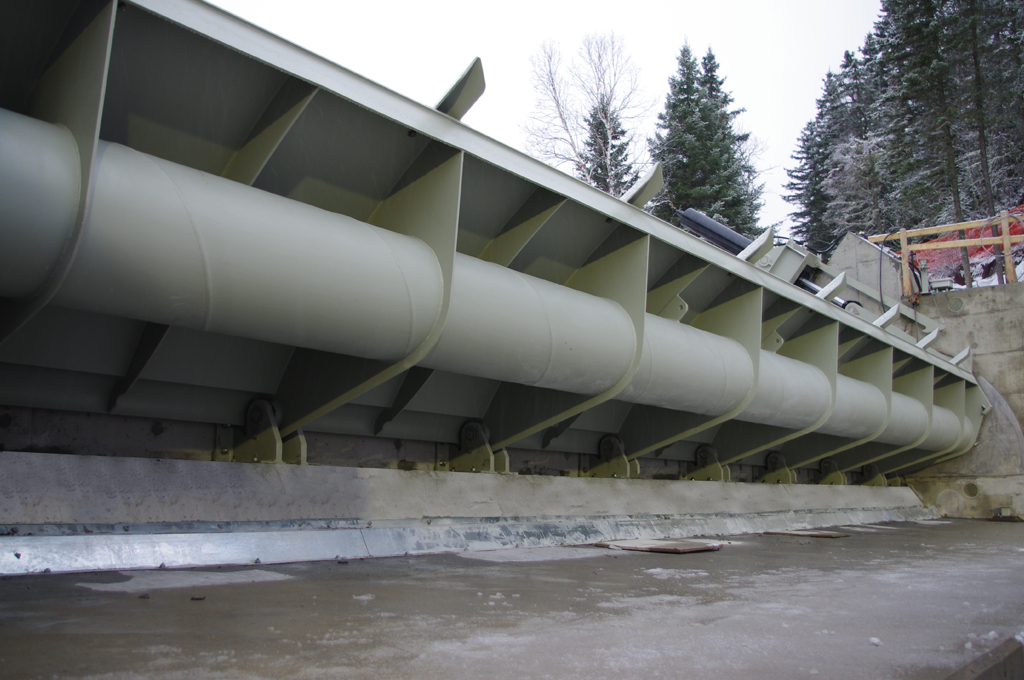
Water in reservoirs can be difficult to control. If there is too much rain, it can easily overflow. But how can we control this using our engineering mindsets? Well, what if we were to modify the height of the reservoir using a floating drum? And what if we were to place this floating drum in between two mounds, and use a valve to let water in to raise in and another one to lower it? This is the main idea behind Drum Gates and are applied to Floodgates all over the world.

Hinged Crest Gates

Hinged Crest Gates

Hinged Crest Gates

07/13/18

“How can we make a  floodgate that works by rotation?”


Floods happen in all types of environments with different conditions. Therefore, humanity will need to build different types of Floodgates that can adapt to these conditions. One of these types may need to work in colder, urban environments, where trash and ice may easily accumulate. By using a rotating gate, which can quickly dispose of any possible residue. These Hinged Crest Gates have been employed all over the world in frigid environments.