Category: Systems Science

Resilience Performance

Resilience Performance

Resilience Performance

07/31/18

“How can we quantify what is produced by critical infrastructure systems?”


Critical Infrastructure Systems are one the most important bedrocks of society. However, how can we apply a metric to quantify its outputs? Well, by applying something known as Resilience Performance, we can evaluate a system’s output. Examples of Resilience Performance include energy produced by solar panels or their fault tolerance. Resilience performance is commonly used to evaluate Resilience Capabilities.

Resilience Capabilities

Resilience Capabilities

Resilience Capabilities

07/30/18

“How can we measure how effective resilience capabilities are organized?”


Resilience Capacities are necessary to organize Resilience Inputs. But some have more flexibility than others. So how can we apply a metric to this? Well, by using Resilience Capabilities we can evaluate the effectiveness of how the resiliency response can be carried out, such as how the ability to repair damaged power lines.

Resilience Capacities

Resilience Capacities

Resilience Capacities

07/29/18

“How can we organize resiliency inputs?”


Resiliency Inputs are the foundation for creating long-lasting critical infrastructure systems. But without any form of organization, they’re quite useless. This is where Resilience Capacities come in. Resiliency Inputs to Resiliency Capacities is like bones to a skeleton. Examples of Resiliency Capacities include emergency response teams of repair workers to downed power lines after a natural disaster.


Resilience Inputs

Resilience Inputs

Resilience Inputs

07/28/18

“What are the building blocks of Resilience?”


With the ever-changing climate, critical infrastructure systems are going to have to become more resilient. To develop this, engineers and policymakers have developed a series of metrics to quantify the resilience of such systems. The most fundamental of which is the Resiliency Inputs to a system. Inputs are the like the bones of a skeleton. Although they compose the physical structure, on their own they are ineffective. Examples of Resilience Inputs in energy systems are budgets, equipment, spare parts, and personnel to support recovery operations.

Resiliency Metrics

Resiliency Metrics

Resiliency Metrics

07/24/18

“How can we quantify a system’s  resilience ability?”


With the ascent of climate change, cities all over the world will have to change their infrastructure to be resilient against the winds of climate change. However, how can we quantify how resilient a given system is? Well, by breaking down an infrastructural system into multiple components (namely inputs, capacities, capabilities, performance, and outcomes), we can apply Resiliency Metrics to each to evaluate a system’s readiness. Resiliency metrics can be applied to any type of infrastructure, whether it be power systems, gas pipelines, or transportation networks.

A visualization of reversible vs nonreversible processes

A visualization of reversible vs nonreversible processes

A visualization of reversible vs nonreversible processes

08/08/17

“What exactly is the difference between reversible and non-reversible systems?”


Reversible and non-reversible systems are two of the most fundamental and confusing concepts in thermodynamics. But this visualization should help clarify them. Let’s take a ping pong game. If we are playing without score, then after a round is over, everything goes back to normal with no change in the system, making it reversible. However, if we are keeping score, then after every round the number of points change forever, making this process non-reversible

Linear programming

Linear programming

Linear programming

08/06/17

“How can we maximize or minimize a set of linear equations?”


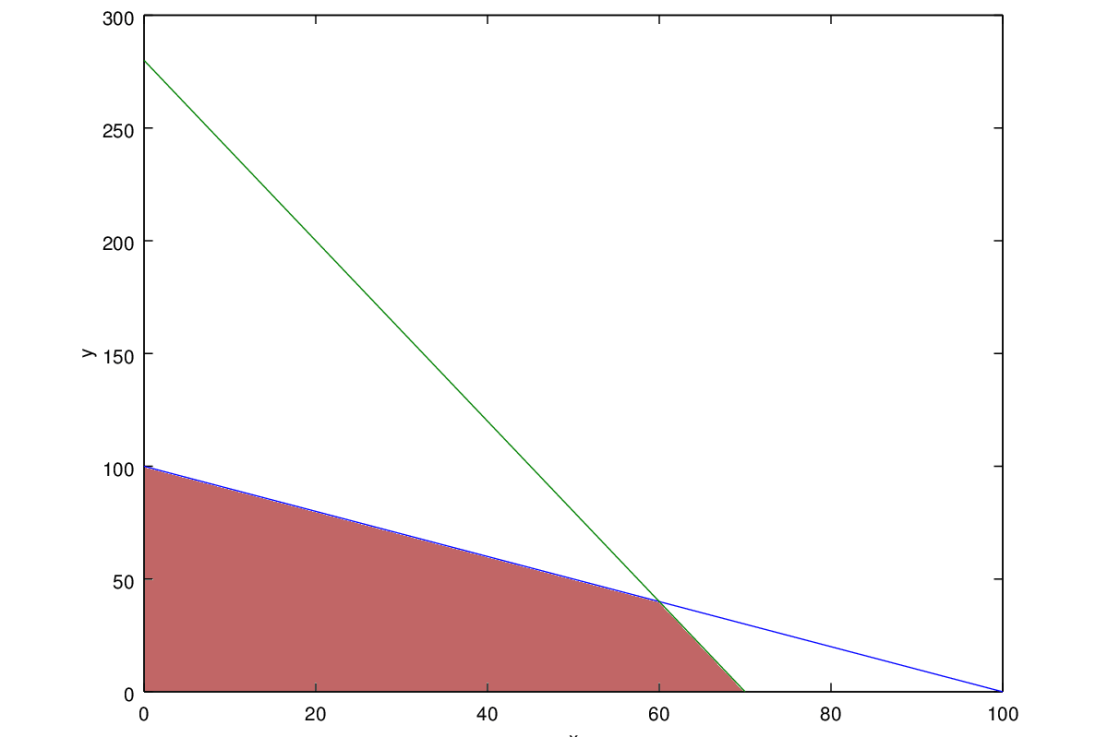
Often times, when working on problems, we have multiple variables related by multiple equations. For example, let’s start out with this situation. Let’s say we have two machine parts x and y that cost 2 dollars and 5 dollars to make respectively, symbolically p(x,y) = 2x + 5y. And let’s also say that we have to make a total of 100 machine parts respectively, or x + y = 100 (blue). And let’s also say that 202 times the number of part x and 5 times the number of part y must be equal to 1400, or 20x + 5y = 1400 (green). So how can we find the minimum price that meets all of our production needs? Well, let’s plot it on a graph (pictured), check all of the points of intersection (In this case (0,100), (60,40) and (100,0) ), and then see which of these points return the minimum desired quantity (In this case (0,100) –> $200). Linear programming can be applied to all forms of applications, ranging from engineering economic systems to control theory and even to general business!

Industrial ecology

Industrial ecology

Industrial ecology

08/01/17

“What is Industrial Ecology?”


Things are changing on  Earth. Climate levels are rising, the human population is expanding, and industrialization is increasing, while our natural resources are going down down down. So how can we create a framework that studies how all of these complex systems interact with one another? Well, after many years of research, an entirely new scientific field has formed, industrial ecology. Industrial ecology is the study of how energy and resources flow through our modern industrial system. Industrial ecology looks at this issue through a multitude of perspectives, such as engineering, economics, natural sciences, and sociology.

Homogeneous and heterogeneous systems

Homogeneous and heterogeneous systems

Homogeneous and heterogeneous systems

07/21/17

“How do we classify thermodynamic systems?”


Engineering thermodynamics looks at heat, energy, and matter from a macroscopic, or non-atomic perspective. Because of this, objects and materials such as air appear to be uniform in composition. As a result, systems such as these are classified as homogeneous systems. Homogeneous systems stand in direct contract with heterogeneous systems such as a human body (which is composed of many different macroscopic layers). When working out thermodynamics problems, it is extremely important to know if your system is homogeneous or heterogeneous.