Category: Engineering

Auxiliary view

Auxiliary view

Auxiliary view                          04/20/16


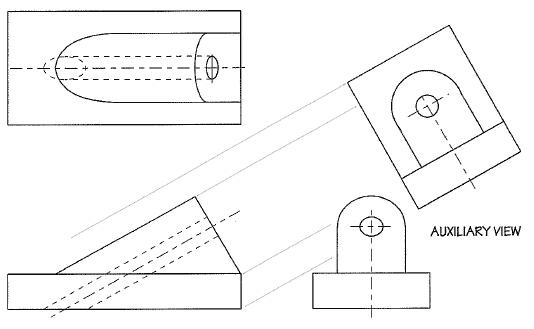
When doing Mechanical Engineering design, many parts often have slanted platforms. These platforms usually become distorted when created using the standard top-front-right views, so Auxillary views were created in response. Auxiliary views take a snapshot of the object from a viewpoint that is centered on the slanted object. This makes it so the object is much easier to visualize. Often, a partial auxillary view is often used so only the important details of the slant are seen (much of the non slanted slide of the part is often unnecessary and becomes distorted itself when viewed through the auxiliary view).

Chain drives vs belts

Chain drives vs belts

Chain drives vs belts           Isaac Gendler


One of the most heated decisions a Mechanical Engineer must make is to either utilize a chain drive or a belt for a rotary power transmission system. Chain drives lose much less energy to friction, making them more efficient. Chain drives are also usually stronger, and can slip around geared systems much more smoothly. Chain drives are also usually much narrower, making them easier to wrap around smaller objects. The drawbacks of chain drives is that they often have greater inertia, they can have a non-uniform velocity which can cause entanglement, and can be subject to vibrations.

Chain drive

Chain drive

Chain drive     04/17/16


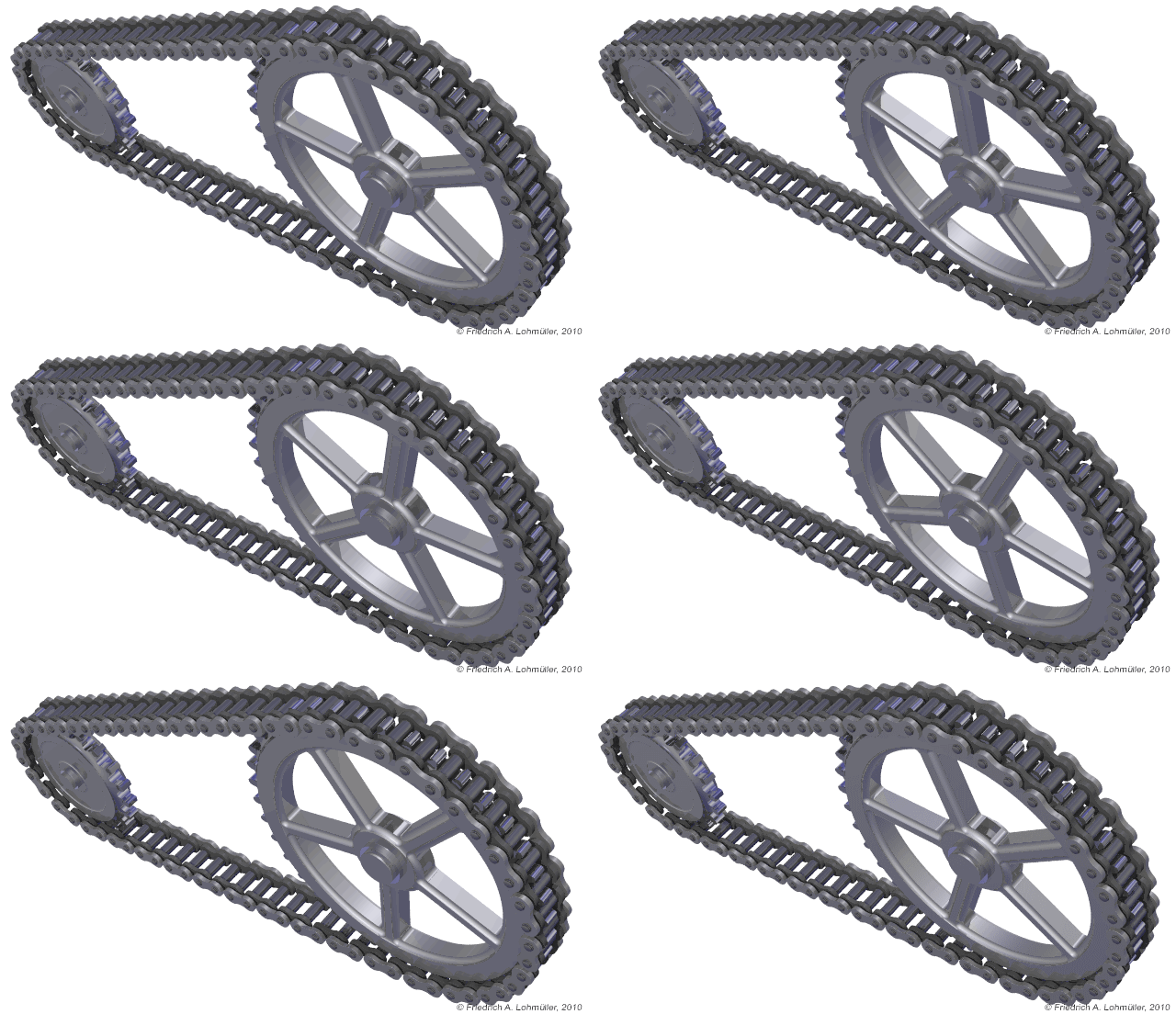
One ingenuitive way that humankind solved the issue of transferring power from one mechanical rounded object to another is through the use of a chain drive. A chain drive used a belt of chain to wrap around a gear  (each teeth is fitted into the holes) and then wrapped around another cylindrical object. Chain drives are often used in transportation applications such as bicycles and automobiles

Simple Machines

Simple Machines

Simple Machines      04/15/16


Simple machines are devices that change the direction or magnitude of force. In summation, they can be generalized as objects that utilize Mechanical advantage to modify the force values. The six machines identified as simple machines by renaissance scientists include the Lever (a beam fixed on a pendulum or fixed fulcrum), the Wheel and axle (A wheel attached to an axle and allowed to rotate which causes a force transmission), the Inclined plane (A flat planar surface tilted at an angle which is used to lift or lower loads), the wedge (A triangular shaped portable inclined plane), and the Screw (an object that translate rotational motion into linear motion)

Mechanical advantage

Mechanical advantage

Mechanical advantage 04/14/16


Mechanical advantage is the measurement of force amplification achieved by using a tool. In theory, power is conserved along along an object. In a linear object like a lever being spun around in a circle the velocity of a particle existing on a point along the lever increases with distance, which can be represented symbolically by equation  (1) v=*r. The equation of power is (2) P=F*v, and since power is conserved along the object, comparing a location  Ato a location Bcan be represented as Pa=Pb→ Fa*va= Fb*vbwhich can be stated as vavb=FbFa, and by inserting equation (1) we can finally arrive at ab=FbFa, thereby proving our force amplification effect.

Pulleys

Pulleys

  Pulleys          04/13/16


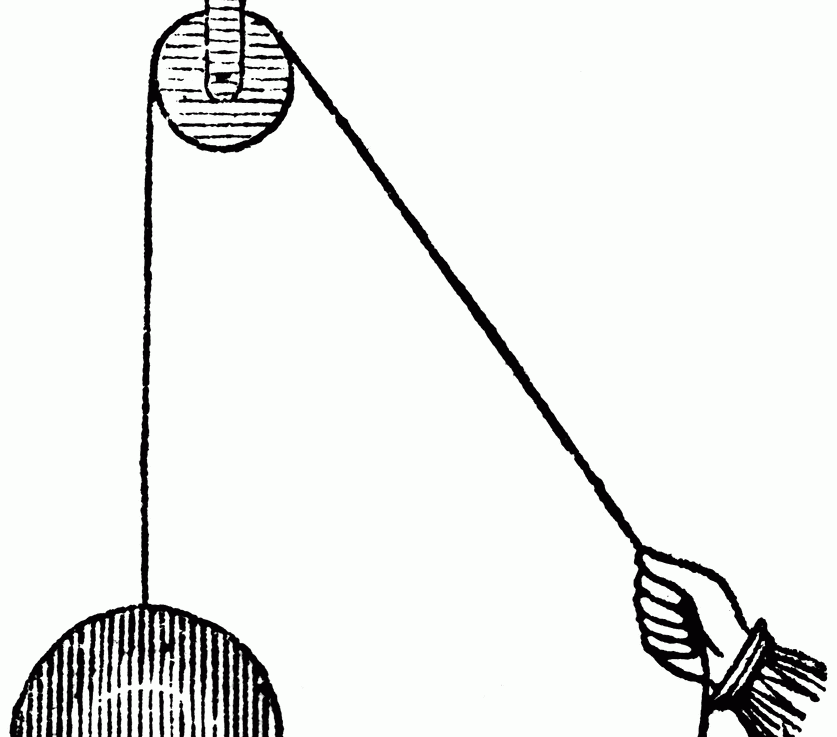
Pulleys are of the the machines that make up the six simple machines. On the surface, pulleys are wheels with a fixed axis that support a rope going around it. The movement of the pulley will move the rope in effect. There are three types of pulley systems: A Fixed Pulley system that involves an axle being mounted by bearings. A Movable pulley has an axle in a movable block and has a mechanical advantage of 2. A Compound Pulley is a pulley that is a combination of the two aforementioned systems. Belts and Pulleys ar eoften combined in to hybrid Belt Pulley systems

Conveyor systems

Conveyor systems

   Conveyor systems           04/12/16


Conveyer systems are systems that transports objects and materials from one endpoint to another in a consistent manner. Because Conveyer systems are often machine automated, they are quite applicable to transporting heavy materials from one endpoint to another. One of the most widely known parts of a conveyer system is the Conveyer belt. There are a myriad of diffuse number of conveyor systems. Pneumatic conveyer systems transport free-flowing materials such as dust or powders through tube vents by utilizing high velocity air. Vibrating conveyor systems use vibrations to move material through a U-shaped profile. Such machines are often used for industries such as agriculture where sanitation is paramount (The Vibrations shake off virulent materials). Flexible conveyor systems are conveyor systems that are able to twist in turn, making them useful for transporting merchandise. Vertical conveyor systems Use forks to transport heavy materials in the vertical direction. Heavy duty conveyors transport  materials that are in the excess of 225 Kilograms

Conveyor belts

Conveyor belts

 Conveyor belts           04/11/16


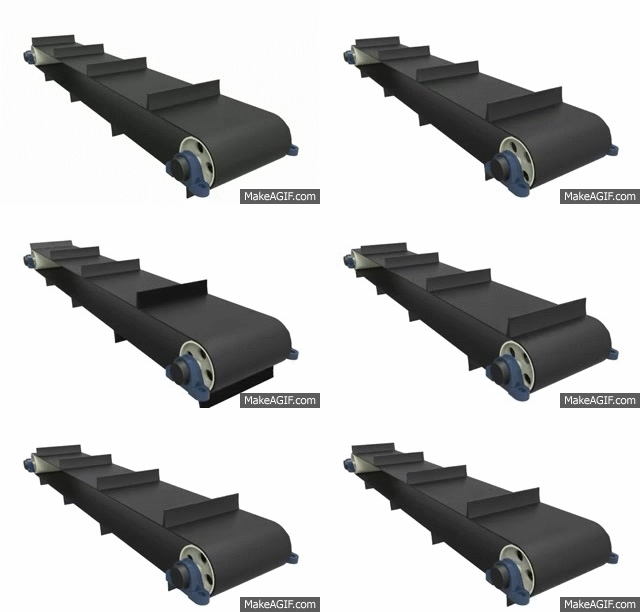
Conveyor belts are one of the most ubiquitous mechanical inventions known to humankind. The primary purpose of a conveyor belt is the smooth transportation of material (such as food or mineral ores) along a single axis. Conveyor belts are rather simple contraptions, requiring only a handful of parts. A Belt is wrapped around a series of parallel pulleys that rotate in the same direction. Conveyor belts are rather omnipresent in society, raging in locations from sushi restaurants to automobile factories.

Thermal runway

Thermal runway

Thermal runway 04/10/16


Have you ever wondered if an increase in temperature could cause a further increase in temperature? This simple idea is the basis of a phenomena known as a thermal runway. In Chemical Engineering, a thermal runaway can happen if a reaction rate increases due to an increase in temperature, which causes a further increase in temperature and spins out of control. In Electrical Engineering, joule heating may diminish resistive elements which further increases current which further increases heating.


If one thinks about it, couldn’t this phenomena simply be modeled with differential equations?