Category: Engineering

O-rings

O-rings

O-rings

09/20/16

“How can we apply our knowledge of gaskets to tubular geometries?”


Pipes and tubes are some of the most ubiquitous materials used to transfer fluids. And since they often do it at such high pressures, safety must be a central focus of their design. We already know that gaskets can be utilized to ensure the secure transfer of fluids, so how can we take our knowledge of these parts and apply it to tubular machines? Well, let’s use our engineering mindset to figure this out.


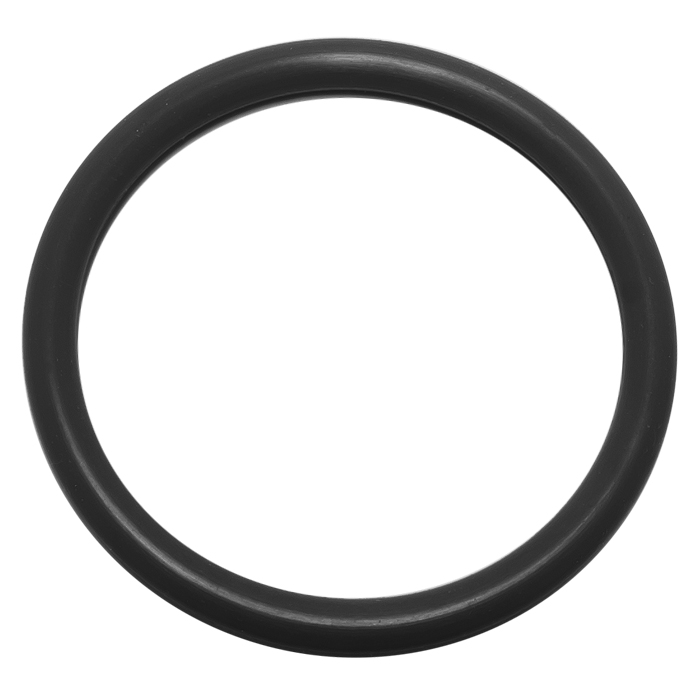
First of all, let us analyze the geometry that we are working with. This problem specifically has a uniform circular nature. So any fluid that might escape will do so in a direction perpendicular to the surface. So wouldn’t it be logical if we covered all critical points with a ring like material? Well, this is the operating principle behind an O-ring. O-rings can be found in all of sorts of applications, ranging from everyday uses such as car engines and even to extraordinary achievements of human through such as space shuttles! (in fact, the primary reason behind the infamous challenger failure was due to an O-ring failure)Since O-rings come in a diverse range of shapes and sizes for their diverse uses, these items are typically defined by the diameter of the inner circle and outer circle. All in all, O-rings are a salient example of how a simple part can have be utilized in far more complex ways.

Gasket

Gasket

Gasket

09/19/16

“What is a simple way to ensure that fluids can be transferred without leakage while under compression?”


In modern machinery, fluids are often transferred when under compression. However, this action often leads to fluid leakage, so how can we design an apparatus that allows us to safely transfer this fluid . Well, let’s think about at using our engineering mindset. Well, often times it is the compressed space surrounding the mechanical transferring parts that causes the leakage. So wouldn’t it be logical if we just added a new part in between this space to prevent any unwanted interference? Well, this is the operating principle behind a very fundamental piece of technology called a gasket. The design of gaskets are usually made out of soft materials such as asbestos, aluminum and copper. The design and material makeup of gaskets is contingent upon the substance needing to be sealed, the operating temperature, and the geometry of the conjoined parts. Gaskets are often prone to be worn out after continual use, and must be replaced. Gaskets have many ubiquitous applications, most notably in car engines. In some applications, gaskets are being phased out in favor of sealants. 

Clamps

Clamps

Clamps

09/15/16

“How can we use a simple tool to prevent two objects from separating?”


When doing engineering work, holding two discrete objects together might be a necessity. There are many ways to accomplish this, but how can one do it using a simple mechanical device? Well, luckily for us, engineers have already devised a tool known as a clamp. To make a clamp, simply create a solid “c” shape part, then drill a hole through the bottom curve, and then put an adjustable screw through the hole. If you put an object through the air gap of the “C” shape, and then adjust the screw to touch the object, you can apply enough pressure to entrap it in place.

Equivalent forces

Equivalent forces

Equivalent forces

09/13/16

“How can we simplify force diagrams?”


When working in physics or engineering, we all have to work with forces. Sometimes, we will have a multitude of forces, all going in different direction. However, how could we simplify all of these different elements of a problem to get the big picture and streamline our solution process? Well, let’s think about it. First we should think of our objective, and that is to see what happens when all of these forces are combined. So how about we take the components of each of the separate forces and moments, add them together, and find the equivalent force for all of these values? For example, let’s suppose that we had a bar of length 6 meters, with one force of 20 acting on the far left from the top and another one of 20 newtons acting at the far right coming in from the bottom. When we do all of the calculations, the equivalent force in the x direction will be 0 Newtons (Since none of the forces have an x component), The net force in the y direction will be 0 Newtons (since both forces are going in opposite directions, they will subtract each other) and the net moment will be 135 N-m (Since they are both in the same moment direction, 3m*20N+3m*25N=135N-m). With the use of equivalent forces, we can analyze an unlimited amount of problems, ranging from structural engineering to electrodynamics

Pulleys and mechanical advantage

Pulleys and mechanical advantage

Pulleys and mechanical advantage

09/06/16

“Is it possible to lift an object with a force that’s less than it’s weight?”


If you ever had to design a system focused on lifting objects, you probably bemoan the fact that if you want to lift a heavy object, you have to use a force that is greater or equal to it’s weight.

Or do you have to?

What if there was some way if we could manipulate the laws of physics, so we could lift an object with a force that is less than it’s weight? Well, let’s think about how we could do this using mechanical advantage.

Let us start with a very simple machine called a pulley. More specifically, we will be starting with a single, fixed pulley. A fixed pulley is a dimply a disk hinged onto an axis in which it is free to revolve around but may not move transitionally. If we were to take a rope and move throw it over the circumference of a pulley, it would reverse the direction of the rope, so we could lift an object while using a downward force instead of an upward force. We still have to use the same force as the weight, but it allows us to change directions.

Now let’s go a step further. What if we were to take that same rope, and make it go under a new pulley, this time a moveable pulley, attach the end of the rope to a ceiling like structure above the pulley, and attach the weight to the moveable pulley. Now the rope will be supporting the pulley on both sides of the object, it can effectively double it’s force value! This means we can now use a force value that is less than the weight of our object to lift it up! You can even create more complex pulley systems to create a greater mechanical advantage. However, there is one major downside to using this setup. Since energy must be conserved, and you are using a smaller force, you must increase the distance you pull your object proportionally to the strength of the force you are using. For example, if you have use a force that is half of the weight, then you will have to pull the rope twice as far, three times as far for a force a third of the weight, and so on. In addition, when we perform these calculations, we assume a massless pulley with no moment of inertia or friction, so there are bound to be some inefficiencies that will require us to use even greater distances

All in all, pulley systems are a testaments of human ingenuity, and are a classical representation of simple yet effective engineering.  

Reverse osmosis

Reverse osmosis

Reverse osmosis

09/04/16

“How can we use pressure to purify seawater?”

Already humanity is facing a major water problem. As the water reservoirs start to dry up, there will be entire areas with no hydration to speak of. So what is one way we could solve this? Well, how about we look to the most plentiful form of water, the ocean, to solve our problems. Ocean water is normally unusable for humanistic concerns due to it’s salty nature, but what if we were to desalinate it to make it usable?

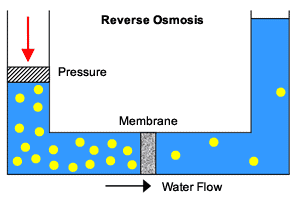
Now that we have the idea, let’s think about how we could make this a reality. Well, first of all, we should notice that salt water probably has other elements in it that are a result from exposure to the rest of the environment, such as seaweed and dead animals parts. These items are usually larger than the molecules of water and salt, so they can be filtered away easily through the use of a permeable layer. We can accomplish this by extracting sea water, and then using pressure to force it through a permeable layer. However, the leftover water will still have a high concentration of salt. But to our luck, it is still possible to separate the salt if we notice one factor, that both water and salt have different evaporation points, and more specifically, water has a lower point of evaporation. So what we can do with this leftover salt water is boil it until the point of evaporation for water, and then pass this steam off into another area, and then cool it until it solidifies again. After all of this, we will finally have ourselves some freshwater! This process is known as reverse osmosis, and plants are currently being used in arid regions such as California, Israel, and Saudi Arabia to create a usable water supply.

Polymers

Polymers

Polymers

08/31/16

“Are there chemical chains that can repeat themselves, and how do they relate to spider silk?”


We all know that different molecules can form bonds with one another. However, could we have a complex bonding structure that is made up of smaller, repeating, individual bits? This is the fundamental idea behind polymers. Polymers are large molecules made up of repeating units called monomers. The properties of polymers are contingent upon how their connecting-framework is built and the material that makes up the framework. For example, some polymers can be very sturdy, while others can be quite placid in nature.  Polymers can be made naturally or synthetically. For example plastics are a polymer-based material, while phenomena as fundamental as DNA is also a polymer, and even spider silk is a polymer! In fact, the polymer build of spider silk is so powerful that a single pencil-width strand of the material could stop an entire Boeing 747!

Shear strength

Shear strength

Shear strength

08/30/16

“How can we classify the ability of a material to resist forces that are parallel to the surface?”


Have you ever been mystified by how an object can be broken apart by taking two different sides and sliding one upwards and the other downwards? And have you ever thought about how we could quantify this phenomena? Well, believe it or not, this comes down to a very simple factor called shear strength. Shear strength is the maximum ability of an object to resist yielding against shear strains, or deformations in objects that are induced by internal sliding. Adhesives are often used to solidify the shear strength. The study of shear strength is critically important for structural engineering, as doing so could prevent catastrophic failures. For example, we  can apply the shear strength of materials to study how a boat being tethered to a dock could cause a rupture on the dock.

Yield

Yield

Yield

08/29/16

“How can we measure when a deformation will be permanent on a material?”


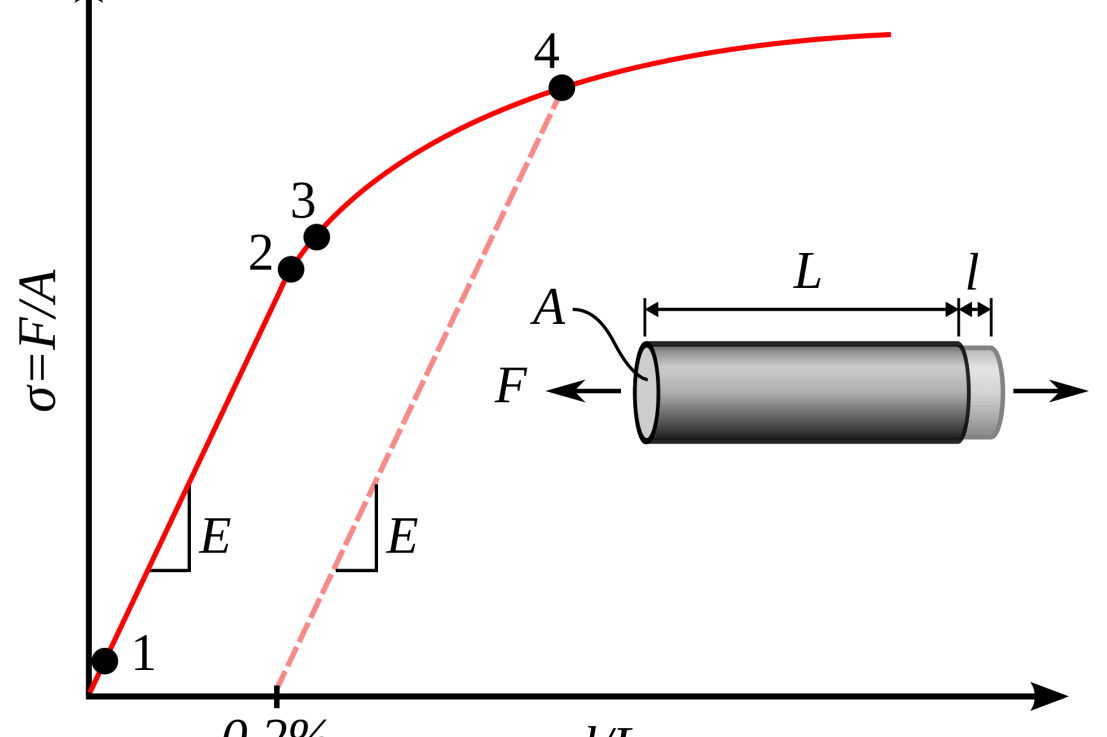
When you were young, you probably noticed that if you apply enough stress onto an object, there will be a point in which in the material will be permanently deformed. However, did you ever consider that we might be able to classify this point in some form? Well, after many years of research, structural engineers have termed this “point of no return” as the yield. In technical terms, the yield point or yield strength is a material property that measures the point at which the level of stress applied becomes so high that the material will no longer deform elastically (meaning returning to it’s original shape) and instead deform plastically (meaning that there is some permanent deformation). The yield strength of an object is very important for estimating the applied strength it can take, since it could be used for pre-emptive failure analysis.