Category: Earth/Climate science

Parallel Drainage Patterns

Parallel Drainage Patterns

Parallel Drainage Patterns

08/26/25

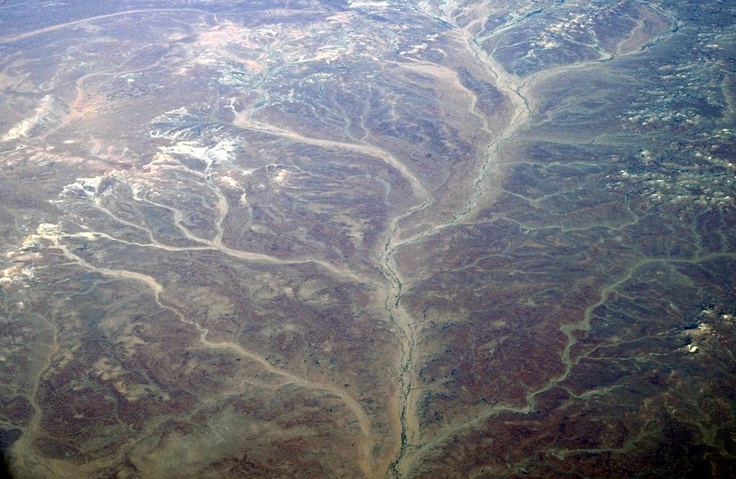
“Why do some rivers flow down in parallel lines?”

Dendritic drainage patterns form when there are no major geological challenges to river flow. Something interesting is that when the slopes are constantly steep (greater than 5 degrees), the forces of gravity will force the different “branches” to become parallel to each other. These Parallel Drainage Patterns move in a consistent direction with consistent spacing from one another. Some rivers in the Lesser Himalayas exhibit parallel drainage patterns.

Image credit: https://i0.wp.com/

Dendritic Drainage Patterns

Dendritic Drainage Patterns

Dendritic Drainage Patterns

08/25/25

“What is the most common type of drainage pattern?”

Close your eyes and visualize a drainage pattern. You’ll probably think of a river with a power center, with smaller branches periodically coming out, and even smaller branches coming out of those, analogous to a tree trunk with branches and leaves on those branches. Have you ever wondered what exactly makes it this way? Well, this happens because as water flows downhill due to gravity, it will seek the lowest path downward. If the geology is fairly uniform and there are no major faults, the main flow direction will form the main river branch, while other headwaters will naturally flow into it. This will form the Dendritic Drainage Patterns that we all know. Dendritic drainage patterns are the most common form of drainage patterns in the world.

Image credit: https://i.pinimg.com/

Cloudburst Hubs

Cloudburst Hubs

Cloudburst Hubs

08/24/25

“How is New York City using modern planning and engineering techniques to adapt to cloudburst flooding events?”

Cloudbursts release a voluminous amount of rain in a short amount of time, which can cause widespread damage to people and infrastructure. New York City is taking an innovative approach to protecting against these events through its Cloudburst Hubs. Cloudburst hubs are hydraulically connected areas in NYC that are vulnerable to deep flooding and can also include infiltration, storage, and conveyance to reduce the flood depths of hotspots, connect onsite with right-of-way strategies, including diverting street runoff, and use a combination of green-grey strategies to mitigate against floods. These cloudburst hubs can help city residents adapt to the new climate paradigm. 

Image credit: https://www.nyc.gov/

Cloudbursts

Cloudbursts

Cloudbursts

08/23/25

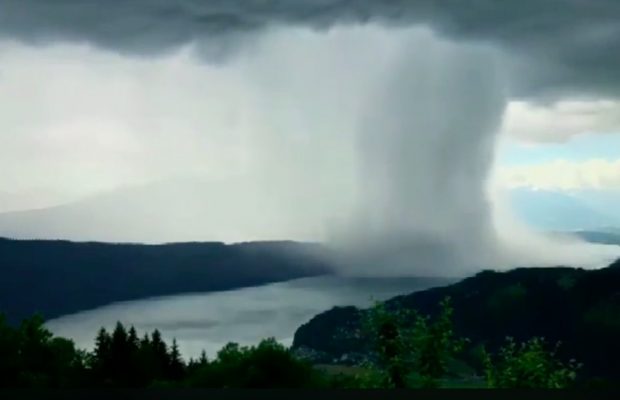
“How can we get storm events that dump a year’s worth of rain?”

Clouds carry water moisture. This moisture is released as rain when enough water molecules condense and become too heavy to stay afloat. When clouds are pushed up in mountainous regions, the quick elevation can force drastic condensation that leads to cloud collapse. These Cloudbursts result in heavy localized downpours that can dump even a year’s worth of water in the span of a few hours. Community managers need to take proactive action to ensure their residents are safe from cloudburst floods.

Image credit: https://www.goodthingsguy.com/

Drainage Patterns

Drainage Patterns

Drainage Patterns

08/22/25

“What makes different river drainage topologies unique?”

Each drainage basin is unique. Whether it be the ways the rivers flow or the flora and fauna, there’s something different for each one. When it comes to riverine layout, there are a set number of typologies that form from certain topographic, rock type, and land gradient combinations. These Drainage Patterns have large effects on how water moves through the drainage basin.

Plant Wilting Point

Plant Wilting Point

Plant Wilting Point

08/21/25

“What’s the minimum amount of water in soil needed to keep plants alive?”

Plants require a specific amount of water in their root zone to survive. Otherwise, they’ll wither up and die. This quantity, defined by the Plant Withering Point, is affected by the soil type, plant species, and characteristics of the roots.

How to Calculate Power for Hydraulic Pumps

How to Calculate Power for Hydraulic Pumps

How to Calculate Power for Hydraulic Pumps

08/20/25

“How do we calculate power for hydraulic pumps?”

Hydraulic pumps are a pillar of modern water infrastructure. Through their mechanisms, they can create a pressure differential to match the needs of people. But pumps need power to operate, and we may need to calculate the power to accomplish what our goals. To do this, we can go to the simple physics equation (1) work = force * distance (W = F * h). Going further, we may notice that if we’re lifting a fluid, the force will be equal to (2) the fluid’s mass * gravity (m_fluid * g), and (3) mass of fluid = density of fluid * volume of fluid (m_fluid = rho_fluid * V_fluid).  This is related to power through the equation (4) P = dW/dt, where Power is P. We can plug in equation (1) to (4) to make (5) P = d(F * h)/dt. → dF/dt*ht. If we substitute in equation (3), we get (6)  P =  (d(rho_fluid * V_fluid*g)/dt*h), and by (7) fluid flow = change in fluid over time (Q = dV_fluid/dt), we can substitute for (8) P = rho_fluid * g * h * dV_fluid/dt → P = rho_fluid * g * h * Q. And by remembering that (9) specific weight = density of fluid * gravity (Gamma_fluid = rho_fluid * g), we can finalize with (10) P = Gamma_fluid * Q * h. This is How to Calculate Power for Hydraulic Pumps. The pump’s efficiency will also affect this value.

Manning’s Roughness Coefficient

Manning’s Roughness Coefficient

Manning’s Roughness Coefficient

08/19/25

“How can we measure the resistance to fluid flow in channels and floodplains?”

Fluids flow through open channels in conduits and floodplains. The structures supporting fluid flow provide resistance to movement. The structure’s base surface roughness, stage and discharge, obstructions, geometric irregularities and alignment, vegetation, and debris contribute to fluid resistance. These are quantitatively summarized by Manning’s Roughness Coefficient, a variable vital for channel flow calculations. Manning’s roughness coefficients for various materials are found in engineering reference manuals.

Water Treatment Residuals

Water Treatment Residuals

Water Treatment Residuals

08/18/25

“What are the residuals left behind by drinking water treatment?”

Treating water for toxins is a vital part of modern infrastructure. However, these processes will leave behind Water Treatment Residuals such as coagulants or sediments. Water infrastructure engineers must handle these residuals to create a healthy, sustainable system.