Category: Chemistry

Why does soda fizz?

Why does soda fizz?

Why does soda fizz?

08/24/16

“Why does soda fizz?”


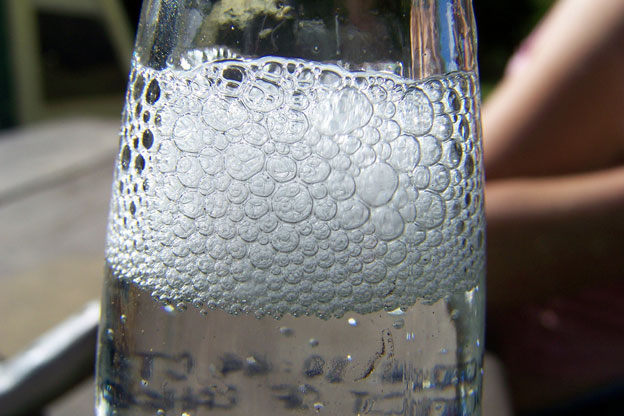
Have you ever opened a can of soda and just wondered why it seemed to fizz? Well, believe it or not, it all comes down to one very simple scientific principle, pressure. When soft-drink manufacturers construct soda, they force Carbon dioxide [CO2] into water [H2O] at over 8.274 kilopascals. This pressure will be sustained inside an insulating material such as a soda can, and by result the carbon dioxide will stay dissolved in the water. However, if one were to open this can, then all of the carbon dioxide will be liberated from the soda can because of the pressure difference, causing fizz to form!

Smart rubber

Smart rubber

Smart rubber

08/23/16

“Are there materials that can “heal” themselves when torn?”


Have you ever had the misfortune of having a rubber material rendered useless just because you’ve torn it? Wouldn’t it be nice to have some form of rubber in which the object can heal itself once it becomes damaged?

Well, how about instead of being in dismay over such an issue, we take action and use our technical mind to solve the problems! First of all, let’s think of the root cause. Rubber materials obtain their strength from the fact that they are composed of multiple polymer molecules being crosslinked through three different ways: Covalent, ionic, and hydrogen bonding. However, only hydrogen bonding can revert to it’s original structure after being deformed. So wouldn’t it be logical that if we only had the rubber composed of hydrogen bonds, then it would be completely mendable?

Well, this is exactly the working principle behind smart rubber. Smart rubber is rubber composed entirely of hydrogen bonds, so that it “heal” itself when necessary (at near room temperature). Smart rubber can be used to create items such as shoes and tires that can repair themselves after intense use. Smart rubber is better for the environment since it encourages less waste. The one downside of Smart rubber is that it is weaker than normal rubber by nature, as the material lacks the extra structure of the covalent and ionic bonds.

Hydrogen bonding

Hydrogen bonding

Hydrogen bonding

08/22/16

“Why is water such a special element?”


Water is a very special element. This single molecule allows for the scientific miracle of life to occur, whether it be the smallest of fungi to the largest of whales. Water allows for humans to hydrate themselves, and to create agriculture.

But why is it so special? Well, believe it or not, it all comes down to one basic property of water, the special way that it bonds. Water is made up of one oxygen atom and two hydrogen atoms (hence the name H2O). Both of these atoms have shared electrons. However, due to the electronegativity of the oxygen atom, the electrons will be closer to the oxygen than the hydrogen atom. This means that the water molecule will become polarized, resulting in a dipole. This type of charge is so special that scientists and engineers have termed this type of bond a hydrogen bond.

Because of this asymmetry of charge, water can dissolve electrolytes such as sodium chloride [NaCl] easily. This hydrogen bond also allows water to hold together DNA, proteins, and other macromolecules. The polar quality of hydrogen molecules also allows for other water molecules to attract one another very easily, with the oxygens reaching out to the hydrogens. This form of bonding gives water some of it’s special properties, such as a high boiling point (100 degrees C) and surface tension.

Lithium

Lithium

Lithium

Isaac Gendler

08/17/16

“What are some special properties of Lithium?”


When taking a chemistry class, one will learn about an element known as lithium. Lithium has an atomic number of three, so it contains around three neutrons and is an alkaline metal as a result. The atomic weight of lithium is 6.941, and has a density of 0.534 grams per cubic centimeter. Since Lithium has a melting point of 180.5 degrees Celsius,  and a boiling point of 1342 degrees Celsius, this element is a solid at room temperature. Lithium is light and soft, so soft in fact that it could be cut with a knife. For Astrophysicists, Lithium poses a problem, since the amount of Lithium that has been predicted to have been produced during the big bang is actually three times as high then what is empirically observed in stars!

Oxidation-reduction reactions

Oxidation-reduction reactions

Oxidation-reduction reactions

08/15/16

“What happens when two elements of different oxidation numbers magnitudes come into contact with one another?”

Let’s think about something. Different elements tend to have different electronegativity. This different electronegativity gives different elements a tendency to obtain different ionic charges when near other atoms. So with this information, what can we construct when such an event occurs?

Well, let’s organize some information. Let’s classify these different ionic tendencies as oxidation numbers, or the number of charge that an element has when it reacts with another one. And let’s classify the current ionic charge that an element is in as an oxidation state. So when an element is by itself, it has an oxidation number of zero, but when it reacts with an element it will have it’s oxidation number. The elements that become positive are called oxidized ions and the elements that become negative are called reduced ions. These types of reactions are called oxidation-reduction reactions

Now let’s put this framework into reality. Let’s take two elements, lithium [li], with an oxidation number of +1, and fluoride [f], with an oxidation number of -1. Before these two elements combine, they will have an oxidation state of zero, but when they react with one another, they will obtain their oxidation states of +1 and -1. We can represent this symbolically with Li + F → LiF, with LiF being called lithium fluoride.

To go further, let’s try a second example. First, let’s take two chemicals that we all know, hydrogen and oxygen. Hydrogen has an oxidation number of +1, and oxygen has an oxidation number of -2. So when the chemicals react, not only will the elements become ionized, but there must be two hydrogen atoms to balance out the negative charge of the oxygen atom. We can represent this symbolically as 2H+O→ H_2O [water]

What went wrong with Fukushima?

What went wrong with Fukushima?

What went wrong with Fukushima?

08/04/16

“What exactly took place with the fukushima reactor?”


Many people still remember the events of March 11th, 2011. On that day, an earthquake and a tsunami both with an insurmountable amount of force hit Japan, causing truly catastrophic damage. What was particularly hit were the Nuclear reactors in Fukushima, causing a great dispersal of radiation into the surrounding region

Let’s start with the basics. The reactors in Fukushima use both plutonium and uranium as fuel. These atoms are so large that they can easily become unstable. If a neutron hits them then they are likely to collapse. When fission occurs, these atoms release at least two neutrons, which  cause a butterfly effect know as a chain reaction if those neutrons hit more atoms, causing much energy to be created which ends up as heat. Fukushima use water as a coolant to form steam, which passes through a moisture separator to power a large turbine to create electrical energy.

Usually, reactors have a shutdown safety feature, in which a control rod slams into the fission reactor, stopping the fission process. However, since the isotopes are still in the process of decaying, so the “decay heat” needs to be removed so a meltdown does not ensue. Usually, this is accomplished by a cooling pump. However, this cooling pump often requires energy, so it usually takes it from the grid or two backup diesel generators.

Since radiation is still being generated, a three-layer security system is often put into place. This protection system includes fuel cadding (which uses a thin layer of a zirconium alloy to surround the fuel rod), the reactor vessel (a thick steel vessel that contains the fuel rods and a high-pressure coolant) and the containment structure (a thick shell of reinforced concrete). And since pressure from the water reactor often rises with the water temperature level, the vessel has safety valves that are designed to vent pressure (usually in the form of steam or radioactive water).

What happened in Fukushima went as follows; The earthquake caused massive tremors, which caused the fail-safety features to activate. However, the connection to the grid was knocked out by the earthquakes, and the tidal waves destroyed the diesel engines. This in turn caused a heat buildup, which in turn lead to a complete meltdown for three of the reactors.

Whatever has happened, the people lost in Fukushima will always be in our hearts, and we must strive constantly to make sure that such a calamity does not happen again. After reading, this, try to find a way to help the victims of Fukushima
Actinides

Actinides

Actinides

07/31/16

“What are the actinide elements?”

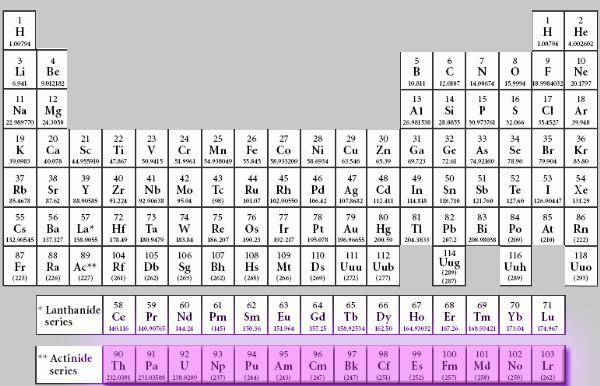
As we continue throughout our tour of the periodic table, we approach a most virulent group of chemicals known as the actinides. All of the actinides have relatively high density, plasticity, and level of radioactivity. The elements that make up the actinide metals include actinium [Ac], thorium [Th], protactinium [Pr], uranium [U], neptunium [Np], plutonium [Pu], americium [Am], curium [Cu], berkelium [Bk], einsteinium [Es], Fermium [Fm], Mendelevium [Md], nobelium [No], and lawrencium [Lr]

Lanthanides

Lanthanides

Lanthanides

07/30/16

“What are the lanthanide metals?”

Continuing on with our tour of the periodic table, we have come across a series of metals with atomic numbers 58 through 71 called the lanthanides. The lanthanides are bright, silvery, and are so soft that they could be cut with a knife. Lanthanides react with hot water to produce hydrogen gas. Lanthanides used to be called the rare metals, not because they were rare, but because it is very difficult to find the in their pure form. The elements that make up the Lanthanides include lanthanum (La), cerium (Ce), praseodymium (Pr), neodymium (Nd), promethium (Pm), samarium (Sm), europium (Eu), gadolinium (Gd), terbium (Tb), dysprosium (Dy), holmium (Ho), erbium (Er), thulium (Tm), ytterbium (Yb), and lutetium (Lu).

Reversable reactions

Reversable reactions

Reversible reactions

07/24/16

“Is it possible for atoms to revert to their original state after a chemical reaction?”


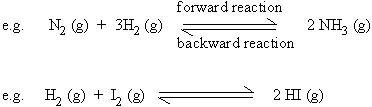
As we all know, when a series of elements undergo a chemical reaction, the elements and their composition will change as a result. However, is it possible for the products to reverse this change and revert to their original forms? Believe it or not, this is a common process. Products of a reaction can re-react and reform into the reactants! This phenomena is known as a reversible reaction, and the symbol for this process is shown in the picture.